Services Invoice Template: Examples for Hourly and Project Work
Six worked services invoices with real numbers, 30 copy-paste line-item descriptions, hourly rounding rules and service tax rules for six countries.
- Written by
- Monjur Hossain
- Published
- Last updated
- Reading time
- 18 min read

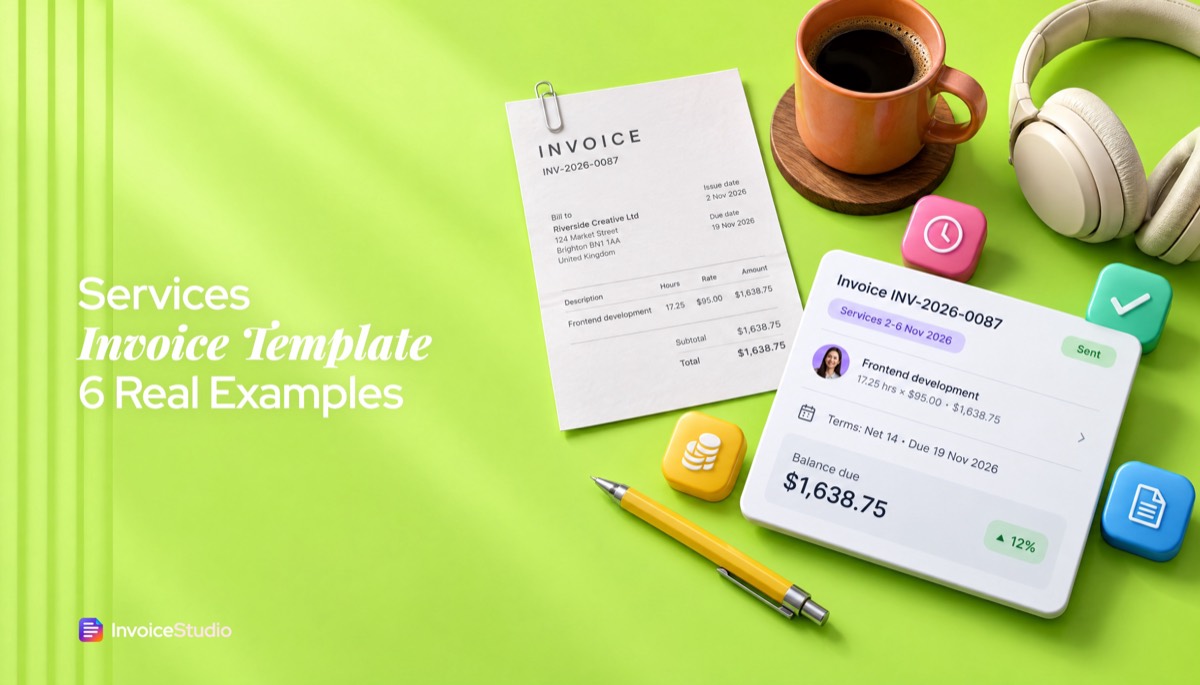
A services invoice template bills work rather than goods. It shows your details, the client's details, a unique invoice number, the invoice date and service period, one line per service with hours, days or a fixed fee and its rate, any tax and deposit, the balance due, a due date and how to pay.
On this page 11 sections
- What is a services invoice template?
- How to write an invoice for services (step by step)
- How to describe services on an invoice (wording examples)
- Hourly invoice template: how to bill time correctly
- Day rate, retainer and milestone invoice examples
- How to stop scope creep on a services invoice
- Photography invoice template: deposit, usage licence and prints
- Graphic design invoice template and web design examples
- Do you charge tax on services? (US, UK, EU, Canada, Australia, India)
- Self-employed invoice template: what sole traders must show
- FAQs
A services invoice template is a ready-made layout for billing work rather than products: your details, the client's details, an invoice number and dates, a line for each service with hours or a fixed fee, taxes, the total and how to pay. That part is easy. The part that decides whether you get paid in five days or fifty is the wording on those service lines, because the person approving your invoice usually wasn't in the room when you did the work.
I've freelanced for long enough to have sent hundreds of invoices for consulting days, hourly dev work, monthly retainers, photo shoots and logo projects. These days I build them in an invoice generator for freelancers, but the lessons came from the early ones. Most of my payment delays came from a vague line like "Design work - $2,000", maths the client couldn't check, or a wrong tax line. You'll get six worked invoice examples for services with real numbers, a bank of 30 line-item descriptions you can copy, hourly rounding rules, and the service tax rules for the US, UK, EU, Canada, Australia and India.
What is a services invoice template?
A services invoice is a bill for work you performed, such as time, expertise or a finished deliverable, rather than physical goods. It asks the client to pay a stated amount by a stated date, and it becomes the record you and they both keep for tax.
A product invoice says "40 x Blue mugs at $6". An invoice for services describes something the client can't hold, like "Homepage redesign, milestone 2 of 3". Because the work is invisible, the description, the time period and the link to an agreed quote or purchase order do all the heavy lifting. If you want the wider background, our guide on what an invoice is covers invoice vs receipt vs bill.
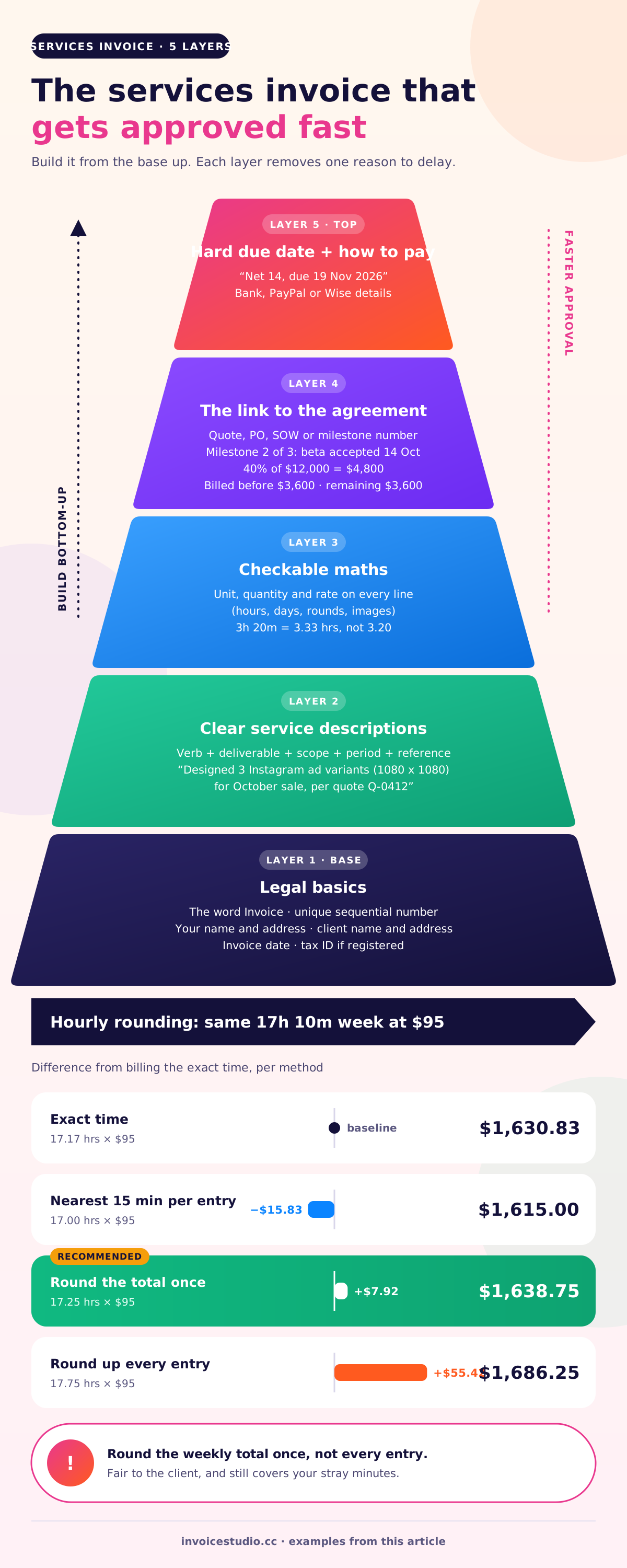
Every service invoice template, whatever the trade, carries the same core fields: the word "Invoice" and a unique sequential number (see our invoice number format guide), your details and any tax ID, the client's details and PO number, the invoice date and service period, the service lines, the totals after tax and deposits, and the payment terms with a due date.
How to write an invoice for services (step by step)
To write an invoice for services, list what you did in the client's language, show how each amount was calculated, apply the right tax, and print a clear due date with payment details. The ten steps below are the order I fill mine in.
- Pull up the quote, contract or PO. Your invoice should mirror its wording and numbers. If the quote said "Phase 1: Discovery, $1,800", the invoice line should too.
- Give it the next invoice number. Sequential, no gaps, no reuse. INV-2026-0087 follows INV-2026-0086.
- Add the invoice date and the service period. "Services 1 to 31 October 2026" stops the "which month is this for?" email.
- Put the client's details in exactly as they want them. Large companies often need a specific legal entity name and an accounts payable email. Ask once, save it.
- Write one line per deliverable or block of time. Don't bundle three months of work into one line.
- Show the unit. Hours, days, rounds, images, pages. "8 hours x $95" can be checked; "$760" can't.
- Subtract what's been paid. Deposits and earlier milestones go in as a separate "less deposit paid" line.
- Apply tax correctly for your registration and the client's location (the country rules are further down).
- Set terms and a real due date. "Net 14, due 19 November 2026". Our net 30 guide explains how to count the days.
- Add how to pay and a one-line thank-you note. Bank details, PayPal, Wise or whatever you accept, printed on the invoice, not buried in an email.
For the generic walkthrough, read how to make an invoice.
How to describe services on an invoice (wording examples)
Describe each service with a verb, the deliverable, and the date or period, in words the client's finance team will recognise. A good description answers "what did we get, and when?" in under 15 words.
Most people write either one word ("Consulting") or a diary entry. The finance person matching your invoice to a budget code needs something in between. I use this pattern:
[Verb] + [deliverable] + [scope or quantity] + [date or period] + [reference]
So "Design work" becomes "Designed 3 Instagram ad variants (1080 x 1080) for October sale, per quote Q-0412". Ten more seconds of typing saves a week of emails.
A wording bank of 30 line-item descriptions
Copy these, change the numbers, and you'll have a description for almost any service invoice.
Consulting and advisory
- Strategy workshop with leadership team, 1 full day on site, 14 Oct 2026
- Market entry assessment for UK launch, written report (22 pages) and 60-min debrief
- Advisory retainer, October 2026, up to 10 hours included
- Additional advisory hours beyond retainer, 3.5 hrs at agreed overage rate
- Pricing review of 4 subscription tiers, recommendations deck delivered 20 Oct
- Weekly operations call (4 x 60 min), October 2026
Hourly and technical work
- Frontend development, checkout page, per attached timesheet (2 to 6 Nov)
- Bug fixes on contact form and mobile menu, tickets #214 and #219
- Database migration to new host, including 2 hrs post-launch monitoring
- Bookkeeping, October transactions reconciled (148 items)
- Virtual assistant support, inbox and calendar management, 12.5 hrs
- Copywriting, 4 blog articles (1,200 words each) with 1 revision round
Project and milestone billing
- Milestone 1 of 3: discovery and sitemap approved, 30% of fixed fee
- Milestone 2 of 3: beta delivered and accepted 14 Oct, 40% of fixed fee
- Final milestone: launch and handover, 30% of fixed fee
- Deposit to reserve project start date of 2 Nov 2026 (50%)
- Change request CR-03: add booking form to services page
- Project management and client calls, flat fee per agreement
Photography and video
- Product photography, half day (4 hrs) studio session, 9 Oct 2026
- Retouching and colour grading, 40 final images at per-image rate
- Usage licence: website and organic social, UK, 24 months from payment
- Travel to location, 84 miles return at agreed mileage rate
- Prints: 10 x A4 archival prints on matte paper
- Second shooter, 6 hours, wedding of A. Khan and R. Patel, 3 Oct
Design and web
- Logo design, 3 initial concepts and 2 revision rounds (as quoted)
- Additional revision round 3, requested 12 Oct, 2 hrs
- Brand guidelines PDF, 12 pages, colour, type and logo usage
- Website design, 5 pages (Home, About, Services, Blog, Contact), responsive
- Monthly website care plan, November 2026: updates, backups, uptime checks
- Stock image licences passed through at cost, 6 images (receipts attached)
Use the client's own words. If their PO says "Q4 Brand Refresh", put "Q4 Brand Refresh" on your invoice, even if you call it "the logo job". Accounts payable matches strings, not intentions.
Hourly invoice template: how to bill time correctly
An hourly invoice multiplies the hours you worked by your hourly rate, with the time shown in decimal hours and a timesheet attached or summarised. The two places hourly invoices go wrong are converting minutes to decimals and rounding.
First, the conversion. Divide minutes by 60. Fifteen minutes is 0.25 hours, 20 minutes is 0.33, 40 minutes is 0.67 and 50 minutes is 0.83. Writing "3.20 hours" when you mean 3 hours 20 minutes undercharges you by 8 minutes every time, and people do it for years without noticing.
Example 1: hourly invoice template with a timesheet
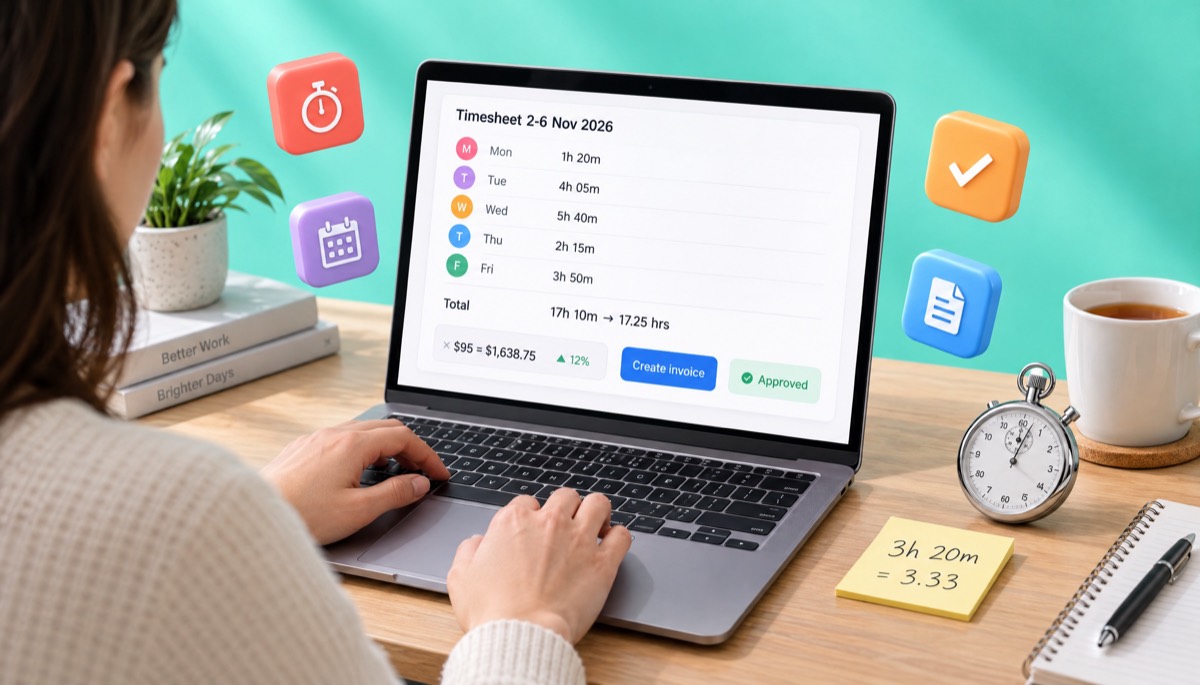
Here's a typical week for a freelance developer billing $95 an hour to a US client. Your contract should say how you round. Here are three common methods side by side:
| Date and task | Actual time | Exact decimal | Nearest 15 min | Round up to 15 min |
|---|---|---|---|---|
| Mon 2 Nov: discovery call and requirements notes | 1h 20m | 1.33 | 1.25 | 1.50 |
| Tue 3 Nov: wireframes, homepage and pricing page | 4h 05m | 4.08 | 4.00 | 4.25 |
| Wed 4 Nov: build pricing page components | 5h 40m | 5.67 | 5.75 | 5.75 |
| Thu 5 Nov: client review call and revisions | 2h 15m | 2.25 | 2.25 | 2.25 |
| Fri 6 Nov: QA fixes and deploy to staging | 3h 50m | 3.83 | 3.75 | 4.00 |
| Total hours | 17h 10m | 17.17 | 17.00 | 17.75 |
| At $95/hr | $1,630.83 | $1,615.00 | $1,686.25 |
There's a fourth method: add up the exact minutes first (17h 10m) and round the total once to the nearest quarter hour, giving 17.25 hours, or $1,638.75. That's what I use and what I'd recommend. Rounding up every entry looks small per line, but here it adds $55.42 to a single week, and a client who adds up your timesheet will spot it. Rounding the total once is fair to both sides and easy to explain.
The invoice itself then needs just one line, with the timesheet attached as a second page or PDF:
Frontend development, pricing and checkout pages, 2 to 6 Nov 2026 (timesheet attached) | 17.25 hrs | $95.00 | $1,638.75
Most US states don't charge sales tax on custom development or consulting, so the total due is $1,638.75. Lawyers and accountants often bill in 6-minute units (0.1 hour) instead of 15. Either works; just put the unit in your contract and stay consistent.
Day rate, retainer and milestone invoice examples
Advisory and project work is billed either by the day, by a fixed monthly retainer, or by milestones on a fixed-fee project, and each needs slightly different lines. Here are three examples with the numbers worked through. If consulting is your main trade, our consulting invoice template has all three layouts ready to fill in.
Example 2: consulting day rate (UK, VAT registered)
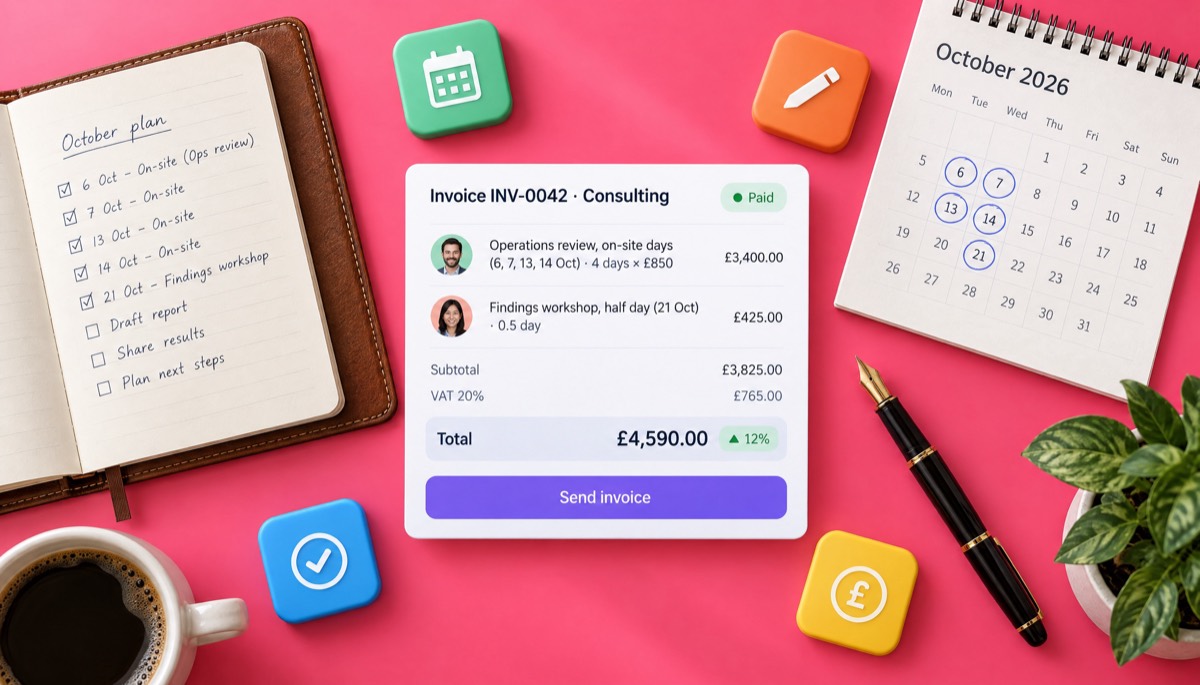
A UK consultant charging £850 a day to a London client, VAT registered at the standard 20% rate. They worked four full days and one half day in October.
| Description | Qty | Rate | Amount |
|---|---|---|---|
| Operations review, on-site days (6, 7, 13, 14 Oct 2026) | 4 days | £850.00 | £3,400.00 |
| Findings workshop, half day (21 Oct 2026) | 0.5 day | £850.00 | £425.00 |
| Subtotal | £3,825.00 | ||
| VAT at 20% | £765.00 | ||
| Total due by 20 Nov 2026 (net 30) | £4,590.00 | ||
Define a "day" in your contract. Mine is 7.5 hours; anything over 9 hours on one day is billed as 1.25 days. Without it, a day can quietly stretch to 12 hours. Because this is a UK VAT invoice, it also needs your VAT number and the tax point, which our VAT invoice requirements guide lists in full.
Example 3: monthly retainer with overage (EU cross-border)
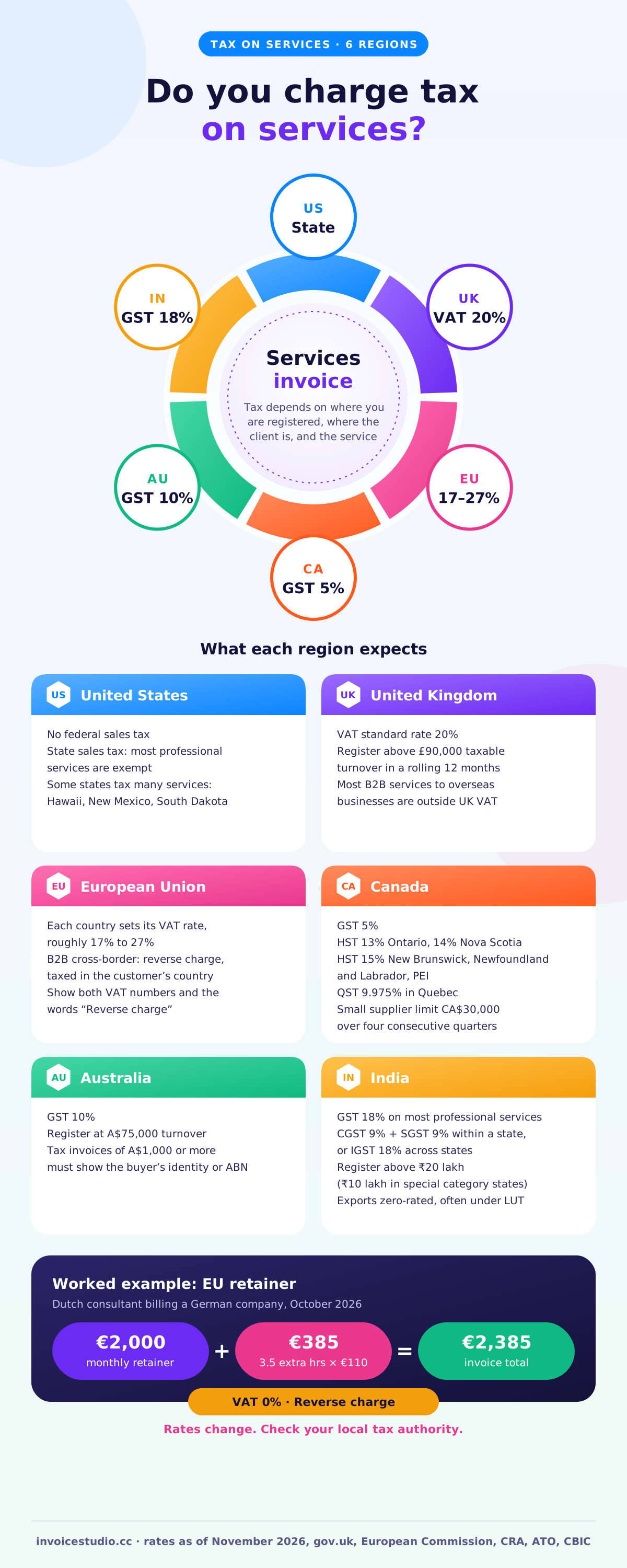
A Dutch marketing consultant on a €2,000 monthly retainer for a German company, covering up to 20 hours. Agencies use the same structure for a marketing retainer invoice. Extra hours are €110 each. In October they used 23.5 hours.
| Description | Qty | Rate | Amount |
|---|---|---|---|
| Marketing advisory retainer, October 2026 (includes 20 hrs) | 1 | €2,000.00 | €2,000.00 |
| Additional hours beyond retainer, October 2026 | 3.5 hrs | €110.00 | €385.00 |
| VAT 0%, reverse charge | €0.00 | ||
| Total due | €2,385.00 | ||
Because this is a business-to-business service across an EU border, the general rule is that VAT is due where the customer is established, so the German client accounts for it under the reverse charge. The invoice must show both VAT numbers and the words "Reverse charge". The European Commission's place-of-taxation page sets out the B2B rule and its exceptions.
Put the rollover rule on every retainer invoice: "Unused hours do not roll over" or "Up to 5 unused hours roll into the following month." Bill the base fee at the start of the month and the overage at the end.
Example 4: milestone project (US fixed fee)
A consultant agrees a $12,000 fixed fee to set up a client's CRM, paid 30% on signing, 40% when the beta is accepted and 30% at launch. Here's the second invoice:
| Description | Amount |
|---|---|
| CRM implementation, fixed fee per SOW-2026-09 | $12,000.00 |
| Milestone 1 of 3, invoiced INV-0091 (paid 2 Sep) | $3,600.00 |
| Milestone 2 of 3: beta delivered and accepted 14 Oct 2026 (40%) | $4,800.00 |
| Remaining after this invoice (milestone 3, at launch) | $3,600.00 |
| Amount due on this invoice | $4,800.00 |
Showing the whole contract value, what's been billed, and what's left is what makes milestone invoices easy to approve. The finance team can tick it off against the statement of work in one glance. Tie each milestone to something the client signs off ("accepted", "approved"), not to a date, or you'll end up invoicing for work they say isn't finished.
How to stop scope creep on a services invoice
To stop scope creep, put the scope and its limits in the quote, reference that scope on every invoice, and bill anything outside it as a named change request at an agreed rate. The invoice is where scope creep either gets paid for or gets written off.
Scope creep rarely arrives as one big ask. It's "can you just look at this deck too?" five times a month. What works for me:
- Name the limits in the quote. "Includes 2 workshops and 1 written report. Further sessions billed at £850 per day."
- Log small extras as you go. A 20-minute review is 0.33 hours. Write it down the same day, or you'll forget it by invoice time.
- Bill extras as their own lines. "Out of scope: review of investor deck v3, 1.5 hrs." Clients accept a visible extra far more readily than a total that's mysteriously higher.
- Use change requests for anything bigger than a few hours. Quote it, get a yes in writing, number it (CR-01, CR-02), and put that number on the invoice.
If a client works with purchase orders, scope creep has a hard stop: their system won't pay more than the PO value. Ask for a PO amendment before you do extra work, not after. Our guide to purchase orders explains how POs and invoices match.
Photography invoice template: deposit, usage licence and prints
A photography invoice should split the fee into the shoot, the editing, the usage licence and any prints or extras, then subtract the booking deposit. Separating the licence is the bit most photographers skip, and it's the bit that protects your income later.
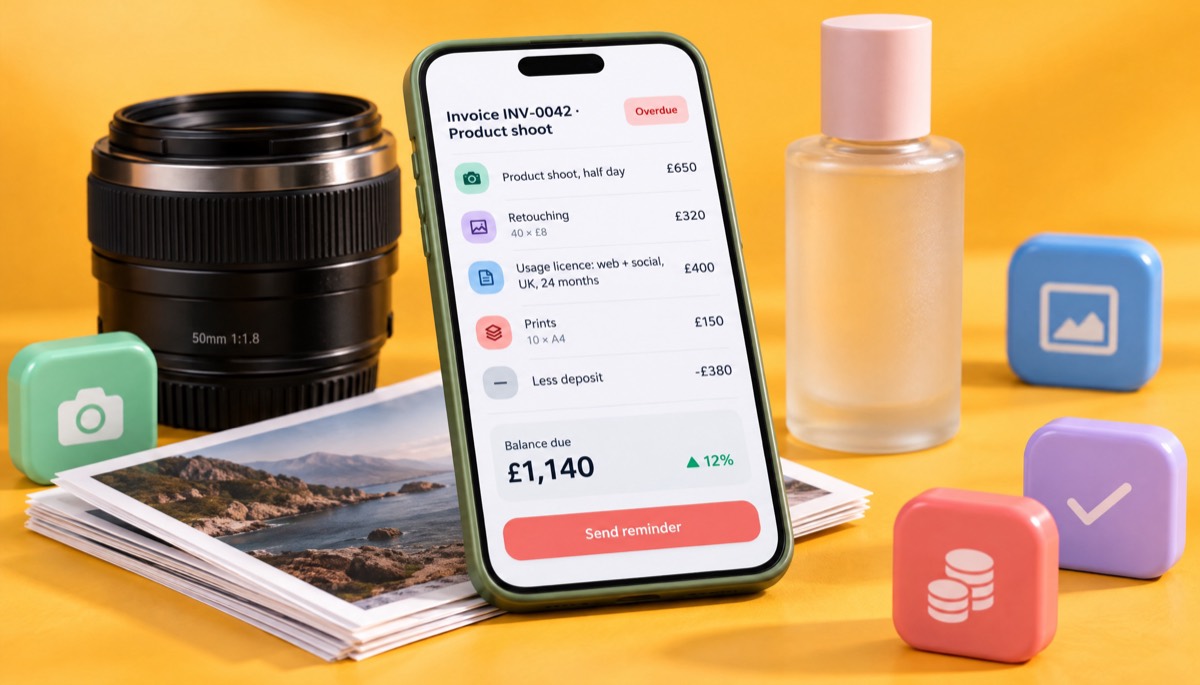
Example 5: commercial product shoot (UK, not VAT registered)
A UK photographer shooting products for a small skincare brand. They took a 25% deposit on booking and are below the £90,000 VAT registration threshold, so no VAT is charged. (You must register once your taxable turnover passes that figure in a rolling 12 months; check the current threshold on gov.uk's VAT registration page.)
| Description | Qty | Rate | Amount |
|---|---|---|---|
| Product photography, half day (4 hrs) studio session, 9 Oct 2026 | 1 | £650.00 | £650.00 |
| Retouching and colour correction, final images | 40 | £8.00 | £320.00 |
| Usage licence: website and organic social, UK, 24 months from payment | 1 | £400.00 | £400.00 |
| Prints: A4 archival matte | 10 | £15.00 | £150.00 |
| Subtotal | £1,520.00 | ||
| Less deposit paid 18 Sep 2026 (25%) | -£380.00 | ||
| Balance due by 30 Oct 2026 | £1,140.00 | ||
Add this note under the totals, and adjust it to your licence terms:
The usage licence starts on payment in full. It covers the client's website and organic social media in the UK for 24 months. Paid advertising, print advertising and packaging need a separate licence. Copyright remains with the photographer.
When the brand wants the hero shot on a billboard next year, you have a written record that it wasn't included, and a price to quote. Wedding and portrait photographers work differently: they usually invoice a non-refundable booking fee, then the balance 14 to 30 days before the event, with prints and albums as add-ons.
Graphic design invoice template and web design examples
A graphic design or web design invoice should show the fixed fee with the number of revision rounds it includes, bill any extra rounds separately, and subtract the deposit. Revision limits written on the invoice are the cheapest scope protection a designer has.
Example 6: logo and brand identity with revision rounds (US)
A designer quoted $2,800 for a logo with three concepts and two revision rounds, plus $600 for brand guidelines, with 50% of the logo fee as a deposit. The client asked for a third round of changes, billed at $120 an hour.
| Description | Qty | Rate | Amount |
|---|---|---|---|
| Logo design: 3 initial concepts and 2 revision rounds (as quoted Q-0412) | 1 | $2,800.00 | $2,800.00 |
| Additional revision round 3, requested 12 Oct 2026 | 2 hrs | $120.00 | $240.00 |
| Brand guidelines PDF, 12 pages: colour, type, logo usage | 1 | $600.00 | $600.00 |
| Subtotal | $3,640.00 | ||
| Less deposit paid 15 Sep 2026 (50% of logo fee) | -$1,400.00 | ||
| Balance due on receipt of final files | $2,240.00 | ||
Add a short ownership line: "Full rights to the final logo transfer to the client on payment in full. Unused concepts remain the property of the designer." It reassures the client and gives you a reason to hold final source files until the invoice clears.
Web design: the 50/50 split and the care plan
A web design invoice template usually comes in two or three parts. A $2,400 website project with 50% upfront means a $1,200 deposit invoice before you start ("Deposit to reserve project start date of 2 Nov 2026") and a $1,200 final invoice at launch. For anything above about $5,000 I'd move to three milestones, like Example 4, so you're never carrying more than a third of the fee as risk.
After launch, a monthly care plan is a recurring service line: "Website care plan, November 2026: plugin updates, daily backups, uptime monitoring, 1 hr content edits, $150." Domain and hosting renewals you pay on the client's behalf should go on as separate pass-through lines at cost, with the receipt attached, so nobody thinks you're marking them up. For more trade-specific layouts, see our freelance invoice template and contractor invoice template guides.
Here's how the six examples compare, so you can pick the billing model that fits your next job:
| Billing model | Best for | What the invoice must show | Common mistake |
|---|---|---|---|
| Day rate | Consultants, trainers, on-site work | Dates of each day, definition of a day | No cap on hours per day |
| Hourly with timesheet | Developers, VAs, bookkeepers | Decimal hours, rate, timesheet | 3h 20m written as 3.20 |
| Time and materials | Repairs, IT support, open-ended builds | Hours at your rate plus parts or expenses at cost | Materials billed with no receipts |
| Monthly retainer | Advisors, marketers, care plans | Month covered, hours included, overage rate | No rollover rule |
| Milestones | Fixed-fee projects over $5,000 | Contract value, billed to date, remaining | Milestones tied to dates, not sign-off |
| Deposit plus balance | Photographers, event services | Deposit paid, licence terms, balance | Licence not written down |
| Fixed fee plus revisions | Designers, copywriters | Rounds included, extra rounds billed | Unlimited revisions by default |
Do you charge tax on services? (US, UK, EU, Canada, Australia, India)
Whether you charge tax on services depends on where you're registered, where the client is, and what the service is. In the US most services aren't subject to sales tax; in the UK, EU, Canada, Australia and India they usually are once you pass a registration threshold.
| Country | Tax on services | When you must register | Cross-border clients |
|---|---|---|---|
| US | State sales tax; most professional services exempt, but rules vary by state | Depends on each state's nexus rules | No federal sales tax; foreign clients normally not taxed |
| UK | VAT, standard rate 20% | Taxable turnover over £90,000 in a rolling 12 months | Most B2B services to overseas businesses are outside UK VAT |
| EU | VAT, rates set by each country (roughly 17% to 27%) | National thresholds; many countries have small business schemes | B2B: reverse charge, customer's country |
| Canada | GST 5%, or HST 13% to 15% in participating provinces; QST in Quebec | Over CA$30,000 in four consecutive calendar quarters | Many services to non-residents are zero-rated |
| Australia | GST 10% | Turnover of A$75,000 or more | Many services to overseas clients are GST-free |
| India | GST, 18% on most professional services | Turnover over ₹20 lakh (₹10 lakh in special category states) | Export of services zero-rated, often under a LUT |
United States. Sales tax is a state matter, and most states tax goods rather than services. A handful, including Hawaii, New Mexico and South Dakota, tax a broad range of services, and others tax specific ones such as data processing or certain repairs. The IRS doesn't prescribe an invoice format at all; it just expects you to keep invoices as records that support your income, as its record-keeping guidance explains.
United Kingdom. If you're VAT registered, add 20% to most services and issue a proper VAT invoice. If you're not registered, don't show VAT at all. Writing "VAT 0%" when you aren't registered just confuses clients. For services to a business outside the UK, the place of supply is usually the customer's country, so you'd normally not charge UK VAT. Note the reason on the invoice.
European Union. Within one country, charge that country's VAT. Across borders between two businesses, the customer usually accounts for VAT under the reverse charge, as in Example 3. Selling to private consumers in another EU country is more complicated and often means registering for the One Stop Shop. The European Commission's VAT invoicing rules list what an EU invoice must contain.
Canada. Once you're past the small supplier limit, charge GST at 5%, or HST if the service is supplied in a participating province: 13% in Ontario, 14% in Nova Scotia, and 15% in New Brunswick, Newfoundland and Labrador, and Prince Edward Island. Quebec adds QST at 9.975% on top of GST. Show your GST/HST number on the invoice. Confirm current rates with the CRA.
Australia. Registered businesses add 10% GST and issue a tax invoice. A tax invoice for a sale of A$1,000 or more must also show the buyer's identity or ABN. Below A$75,000 turnover, registration is optional. Check the ATO's current guidance before you quote.
India. Most professional services carry 18% GST: CGST 9% plus SGST 9% within a state, or IGST 18% across states. You'll need a SAC code for each service line. Exports of services are zero-rated if the conditions are met. Our GST invoice format guide walks through every field.
Freelancers in Bangladesh billing foreign clients usually invoice in USD with no local VAT on the invoice, but rules depend on your registration and how the money is received. Check with the NBR or an accountant before you assume.
Self-employed invoice template: what sole traders must show
A self-employed invoice template has to show your own name (or your name and trading name), an address, a unique invoice number, the date, the client's details, a description of the services, the amount and the total. Sole traders don't need a company number, but they do need to be identifiable as the person behind the business.
In the UK, gov.uk's invoice rules say a sole trader must include their name and any business name they use, plus an address where legal documents can be served. If you trade as "Northlight Studio", the invoice should still say "Sam Ortiz trading as Northlight Studio". Limited companies have stricter rules: full registered name and, if any director is named, every director's name.
Beyond the legal minimum, here's what I'd put on every self-employed invoice:
- Your tax ID if you have one, such as a VAT, GST or ABN number. US freelancers don't need an SSN or EIN on the invoice; clients get it from your W-9.
- Payment terms you can enforce. In the UK you can charge statutory interest of 8% plus the Bank of England base rate on late business payments, as set out on gov.uk's late payment page. Mention it on the invoice and you'll rarely have to use it.
- Every way you accept payment. Bank details, PayPal, Wise, Payoneer, or bKash and Nagad for Bangladeshi clients. One fewer step for the client means a faster payment.
- A PDF copy you keep for the IRS, HMRC or your local tax office.
Self-employed invoice examples: virtual assistant and real estate agent
A virtual assistant billing a UK coach might send: "Virtual assistant support, October 2026: inbox, calendar and travel booking, 12.5 hrs at £28 = £350." One line, the month, the hours and the rate. A self-employed real estate agent in the US invoices the brokerage, not the buyer: "Commission, 14 Elm Street sale closed 3 Oct 2026, 2.5% of $410,000 = $10,250, less $400 desk fee, balance $9,850." Quote the closing date and the split agreed with your broker so their accounts team can check it against the settlement statement.
Here's a closing note you can paste onto any services invoice:
Thank you for your business. Payment is due by 19 November 2026 by bank transfer or PayPal (details below). Please quote INV-2026-0087 as the reference. Late payments may incur statutory interest. Questions about this invoice? Reply to this email and I'll answer the same day.
Once the invoice is ready, how you send it matters too: PDF attached, invoice number in the subject line, and a short email. Our guide on how to send an invoice has templates, and if a client goes quiet, use these polite payment reminder emails.
You can build every example here with the free invoice generator: line items with qty, unit and price, tax rows for VAT or GST, and a PDF to download or email. Browse the invoice templates for a layout that fits your trade. For retainers and care plans, set up a recurring invoice once and let it go out each month.
The template is the easy part. What gets you paid quickly is a description the client recognises, maths they can check in their head, and a due date nobody can misread. Get those three right on your next services invoice and you'll spend a lot less time chasing.
Frequently asked questions
How do I write a description of services on an invoice?
How do I invoice for hourly work?
Do I charge sales tax on services?
What should a self-employed invoice include?
How do I invoice for milestone payments?
How do I set up recurring invoices for a retainer?
Monjur builds Invoice Studio and incorporated MotionTrust Digital in September 2022, where he leads Amazon strategy across the client base. Eight years in e-commerce and marketplace marketing taught him how much time invoices and late payments eat, so every guide here is tested against the real product and current tax rules before it goes live.
More guides by Monjur