Net 30 Payment Terms Explained: Meaning, Examples and Dates
Net 30 means payment is due 30 calendar days after the invoice date. Here's the date maths, the discount maths and the UK, EU and US rules behind it.
- Written by
- Monjur Hossain
- Published
- Last updated
- Reading time
- 21 min read

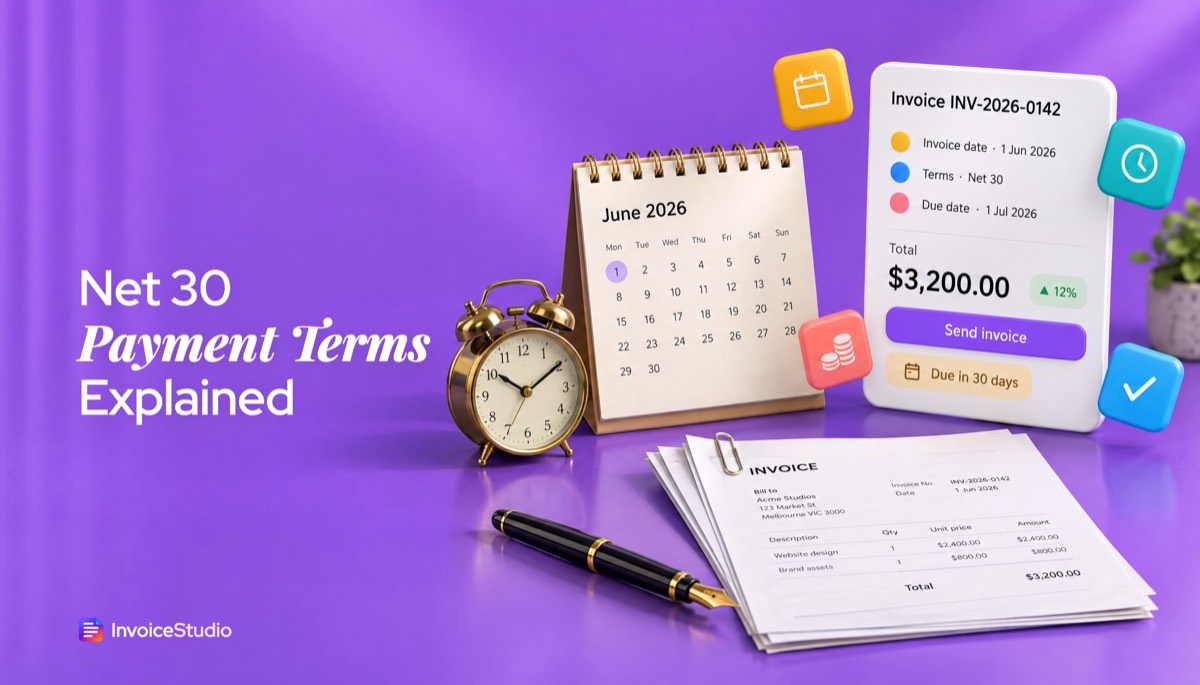
Net 30 means the full invoice amount is due 30 calendar days after the invoice date, unless the contract sets a different start such as delivery or receipt. Weekends and holidays count. So an invoice dated 1 June 2026 on net 30 is due 1 July 2026, and payment is late from 2 July.
On this page 14 sections
- Net 30 meaning: what does net 30 mean on an invoice?
- Net 30 calendar days vs business days: which counts?
- Net 30 start date: invoice date, receipt or delivery?
- Net 15 vs net 30 vs net 60: which payment terms should you use?
- What does 2/10 net 30 mean? (worked discount maths)
- What does due upon receipt mean?
- What do EOM, CIA and CWO mean on an invoice?
- How to calculate an invoice due date for net 30
- What payment terms apply by law in the UK, EU and US?
- How to write payment terms on an invoice (copy-paste wording)
- What happens when a net 30 invoice goes overdue?
- How do payment terms affect cash flow and accounts receivable?
- Common net 30 mistakes (and how to avoid them)
- FAQs
Net 30 means the full amount on an invoice is due 30 calendar days after the invoice date. So an invoice dated 1 June on net 30 is due on 1 July. That's the short answer, and it's the one most glossary pages stop at. Where they go quiet is where the actual disputes start: does the clock run from the invoice date or from delivery? Do weekends count? What do you do when day 30 lands on a Sunday? And is 2/10 net 30 a good deal for anyone?
I've sent several hundred invoices on every kind of payment terms, from "due on receipt" for a $300 logo tweak to net 60 for a corporate client whose accounts payable team ran payments on the second Thursday of each month. This guide is what I wish someone had given me before my first big client. You'll get the meaning of each term, a date table for seven common terms, the discount maths on a real $5,000 invoice, the legal defaults in the UK, EU and US (useful when invoicing clients abroad), and wording you can paste straight onto your next invoice.
Net 30 meaning: what does net 30 mean on an invoice?
Net 30 is a payment term that gives your client 30 days to pay the full invoice total, counted from the invoice date unless your contract says something else. "Net" refers to the net amount, which is the total after any agreed discounts or credits, and "30" is the number of days.
The name comes from trade credit, where wholesalers let buyers take goods now and pay later. Putting net 30 on an invoice does the same thing: you give your client a 30-day, interest-free loan. Remember that when you decide which clients deserve it. Net 30 is one of a family of credit terms, alongside net 15, net 60 and EOM, that all answer the same question: how long can the buyer hold your money?
Here's what net 30 looks like in practice:
- Invoice date: 1 June 2026
- Payment terms: Net 30
- Due date: 1 July 2026
- Late from: 2 July 2026
A payment that arrives on 1 July is on time; one that arrives on 2 July is late. I've had clients argue they could start the transfer on day 30 and let it clear on day 33, so if that matters, write "payment must be received by". Net 30 is also written "n/30" or "30 days net". (The "net 30 accounts" you see online are supplier credit lines for building business credit, a different topic.)
Always print the actual due date next to the term. "Net 30" makes the client do maths. "Net 30 (due 1 July 2026)" doesn't, and it removes any argument about when the clock started.
Net 30 calendar days vs business days: which counts?
Net 30 means 30 calendar days by default, so weekends and public holidays count. If you want business days, you have to write "30 business days", and that's a much longer deadline than most people expect.
The difference is bigger than it looks. Thirty business days from 1 June 2026 isn't early July; it's mid July. Without any holidays, 30 business days lands on 13 July 2026. In the US, where Juneteenth (19 June) and the observed Independence Day holiday (Friday 3 July) fall in that window, it stretches to 15 July. That's two weeks longer than calendar-day net 30.
| Invoice dated 1 June 2026 | Due date | Days you wait |
|---|---|---|
| Net 30 (calendar days) | Wednesday 1 July 2026 | 30 |
| 30 business days (no holidays) | Monday 13 July 2026 | 42 |
| 30 business days (US federal holidays) | Wednesday 15 July 2026 | 44 |
My advice: never offer business-day terms. Every country has different holidays, and they hand the client an extra fortnight for free. If a client insists, put the calculated date on the invoice.
What if net 30 falls on a weekend or holiday?
When the due date falls on a weekend or bank holiday, most businesses treat the next working day as the practical deadline, because banks don't process transfers on those days. Legally, though, the date on the invoice is the date. If you want to be generous, say so on the invoice; if you don't, pick a due date that lands on a weekday.
Take an invoice dated Thursday 5 November 2026. Net 30 lands on Saturday 5 December, and you'll probably see the money on Monday 7 December. I avoid the ambiguity by writing the Monday date as the due date.
Net 30 start date: invoice date, receipt or delivery?
Net 30 normally starts on the invoice date, which is the date printed on the invoice. But a contract or purchase order can change the trigger to the date the client receives the invoice, the date goods are delivered, or the date work is accepted, and the contract always wins.
This is the question that causes the most real arguments, so let's go through the four common triggers:
- Invoice date. The default. Day 1 is the day after the date printed on the invoice.
- Receipt of invoice. Common in corporate procurement. Email the PDF the same day and there's no difference; post it and you can lose a week.
- Delivery. If you bill on 1 June but deliver on 10 June, the client may argue net 30 runs to 10 July.
- Acceptance or approval. The slowest. Approval can take weeks, and nobody tells you when it happens.
The UK law follows this logic too. According to gov.uk's guidance on late commercial payments, if no payment date is agreed, payment is late 30 days after the customer receives the invoice or after delivery of the goods or service, whichever is later. So even the statutory default isn't strictly tied to the invoice date.
Two habits protect you. Email the invoice the day you date it, so invoice date and receipt date match. And if the purchase order says "net 30 from receipt of a valid invoice", make sure yours is valid: PO number, right legal entity, right billing address. A missing PO number is the most common way I've seen net 30 turn into net 50. My guide on what a purchase order is and how it ties to your invoice covers that in detail.
Net 15 vs net 30 vs net 60: which payment terms should you use?
For most freelancers and small businesses, net 15 or net 14 is the best default, net 30 is fine for established business clients, and net 60 should be a negotiated exception for large companies. Shorter terms get you paid sooner, but longer terms are sometimes the price of working with big buyers.
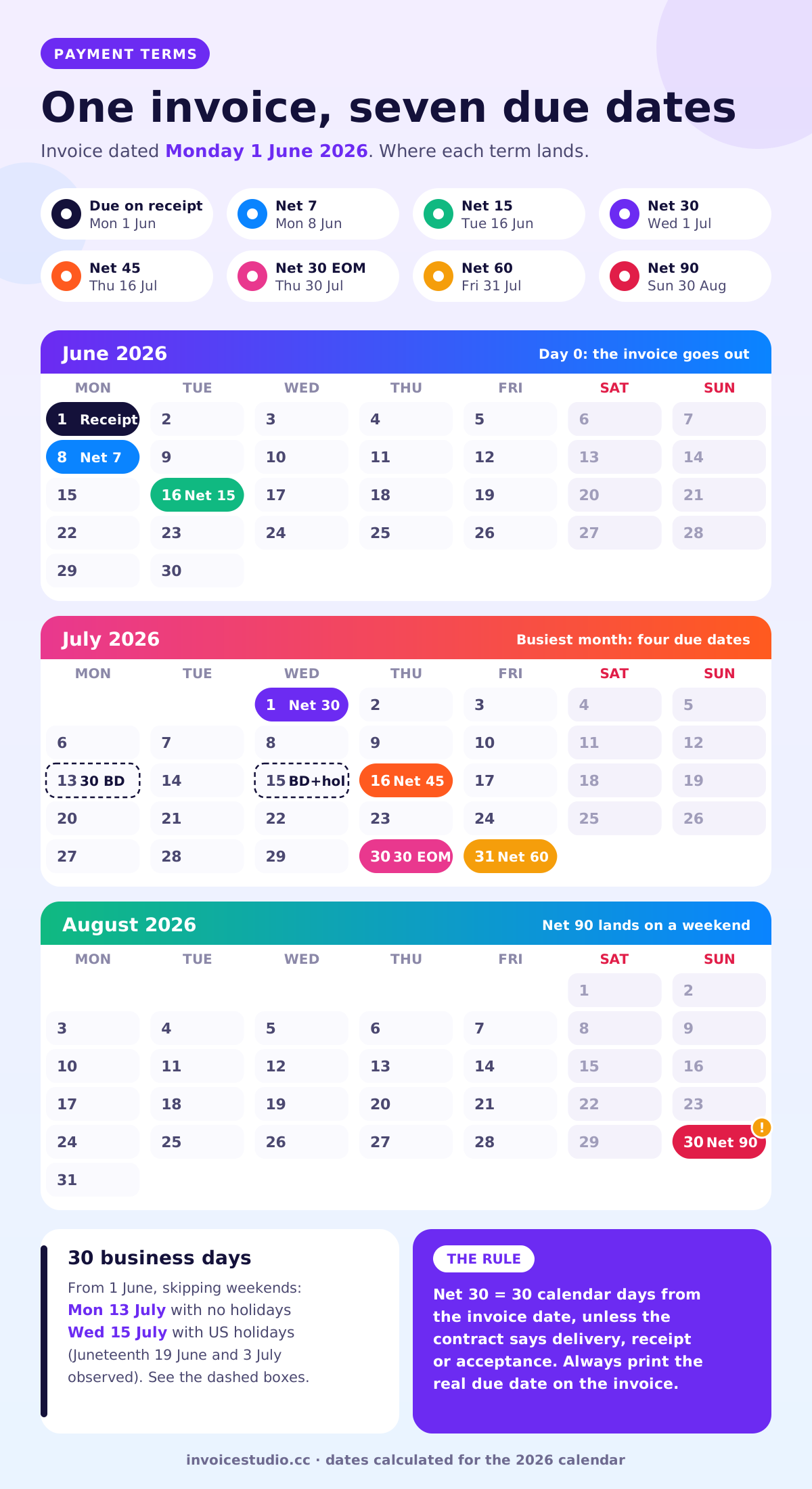
Here's how the common terms compare for the same invoice, dated Monday 1 June 2026:
| Term | What it means | Due date (invoice dated 1 June 2026) | Typical use |
|---|---|---|---|
| Due on receipt | Pay immediately | Monday 1 June 2026 | Small one-off jobs, new clients, consumers |
| Net 7 | Pay within 7 days | Monday 8 June 2026 | Short gigs, trades, weekly billing |
| Net 15 | Pay within 15 days | Tuesday 16 June 2026 | Freelancers, agencies, small business clients |
| Net 30 | Pay within 30 days | Wednesday 1 July 2026 | The B2B standard |
| Net 30 EOM | 30 days after the end of the invoice month | Thursday 30 July 2026 | Clients who run monthly payment batches |
| Net 45 | Pay within 45 days | Thursday 16 July 2026 | Mid-size companies, distributors |
| Net 60 | Pay within 60 days | Friday 31 July 2026 | Large corporations, retailers |
| Net 90 | Pay within 90 days | Sunday 30 August 2026 | Enterprise and some government buyers |
Notice the net 90 row: day 90 falls on a Sunday. That's exactly why I keep saying you should write the real date on the invoice.
Net 15 payment terms
Net 15 payment terms give the client 15 calendar days to pay. It's my default for freelance work: most small clients can pay within two weeks, and it halves the time your money sits with them. Bill $4,000 a month, and moving everyone from net 30 to net 15 means roughly $2,000 less owed to you at any point. UK and European freelancers often use net 14, so the due date falls on the same weekday as the invoice date.
Net 60 payment terms
Net 60 payment terms give the client 60 days, which is two full months of you funding their business. Large companies ask for net 60, and sometimes net 90, because it helps their own cash flow. Is net 60 or net 90 normal? For big retailers, manufacturers and some enterprise software buyers, yes, it's common. For a freelancer, it's normal only if you've agreed to it and priced it in.
If a client insists on net 60, here's what I do:
- Ask for a 25% to 50% deposit, due on receipt.
- Add a 2% to 3% uplift to the price.
- Split the project into milestones.
- Get their payment run dates and time invoices to hit the right batch.
In the UK and EU, B2B terms over 60 days are only allowed in limited cases (see the legal section below).
Best payment terms for freelancers
Use net 14 or net 15 as your default, ask for a 50% deposit on any new client or any project over about $1,500, and keep net 30 for established clients who've paid reliably. If you work for consumers rather than businesses, use due on receipt or a deposit-plus-balance structure, because individuals rarely run on net terms at all.
A worked example: you quote a $2,400 website project. You invoice $1,200 (50%) due on receipt before you start, then $1,200 on net 15 when you hand over the site. If the client goes silent at the end, you're out half the money, not all of it, and you still hold the files. You can see how to set this up on the invoice itself in my freelance invoice template guide.
What does 2/10 net 30 mean? (worked discount maths)
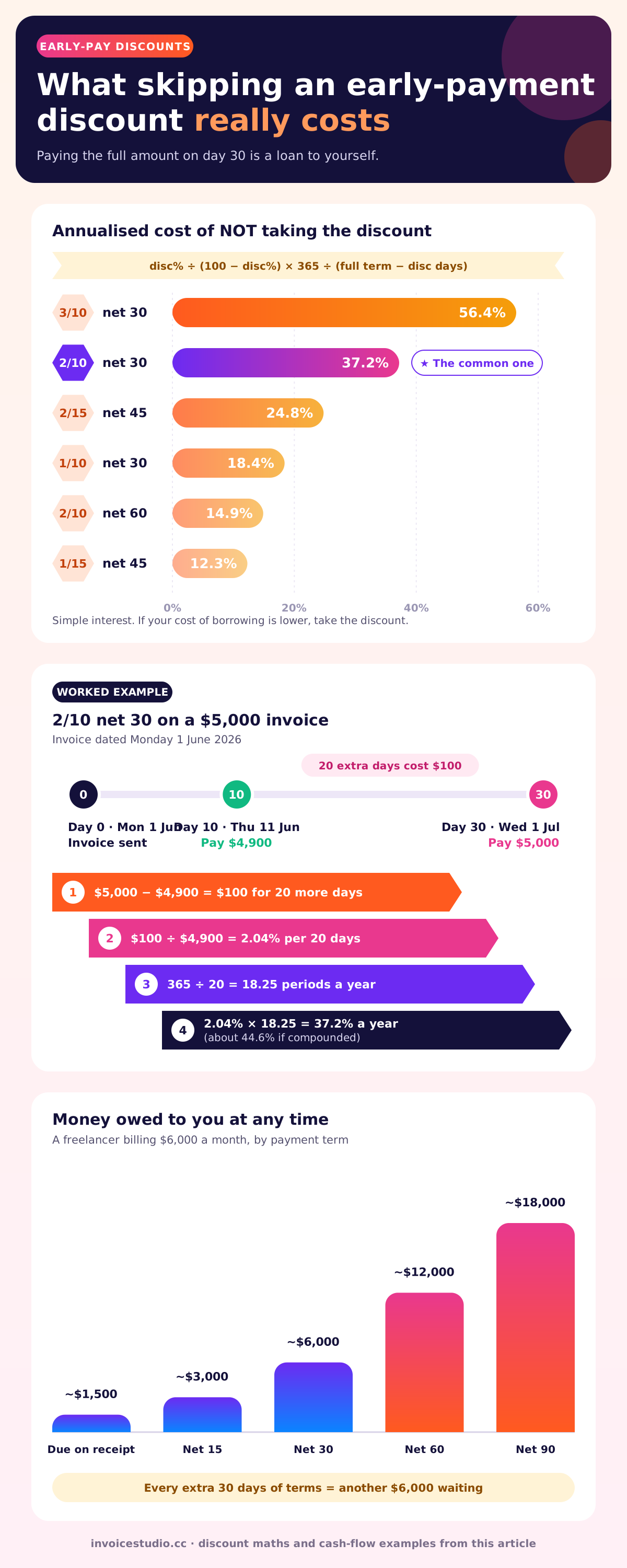
2/10 net 30 means the client can take a 2% discount if they pay within 10 days, otherwise the full amount is due within 30 days. It's an early-payment discount, and the maths behind it is much more expensive than most people realise: skipping the discount costs the buyer roughly 37% a year.
Let's work it on a $5,000 invoice dated 1 June 2026:
| Option | Pay by | Amount |
|---|---|---|
| Take the 2% discount | Thursday 11 June 2026 (day 10) | $4,900 |
| Pay the full amount | Wednesday 1 July 2026 (day 30) | $5,000 |
| Difference | 20 extra days | $100 |
So the client is effectively paying you $100 for the right to hold $4,900 for 20 more days. Turn that into an annual rate:
- Cost per period: $100 ÷ $4,900 = 2.04%
- Number of 20-day periods in a year: 365 ÷ 20 = 18.25
- Annualised cost: 2.04% × 18.25 = 37.2%
The standard formula is: discount % ÷ (100 − discount %) × 365 ÷ (full term − discount period). If you compound it instead of using simple interest, the figure is even higher, around 44.6%. Either way, any buyer with access to a business credit line at 10% to 15% should always take the discount.
Here's what other common discount terms cost when the buyer skips them:
| Term | Meaning | Annualised cost of skipping the discount |
|---|---|---|
| 1/10 net 30 | 1% off if paid in 10 days, else full in 30 | 18.4% |
| 2/10 net 30 | 2% off if paid in 10 days, else full in 30 | 37.2% |
| 3/10 net 30 | 3% off if paid in 10 days, else full in 30 | 56.4% |
| 2/15 net 45 | 2% off if paid in 15 days, else full in 45 | 24.8% |
| 2/10 net 60 | 2% off if paid in 10 days, else full in 60 | 14.9% |
| 1/15 net 45 | 1% off if paid in 15 days, else full in 45 | 12.3% |
Should you offer 2/10 net 30 as a freelancer?
Rarely. The 37% is a cost you pay. Giving up $100 to get paid three weeks sooner can make sense if cash flow is tight, but in my experience the clients who take early discounts were going to pay on time anyway. Some also take the 2% and pay on day 25, so decide in advance whether you'll chase it. UK VAT-registered sellers should also check HMRC's rules on prompt payment discounts. I'd use a shorter term and a clear late fee first; that costs you nothing unless the client pays late.
What does due upon receipt mean?
Due upon receipt means the client should pay as soon as they receive the invoice, with no credit period at all. In practice, most businesses read "due on receipt" as "pay within a few days", so if you mean immediately, add a hard date.
"Due on receipt", "payable on receipt" and "payment is due upon receipt" are the same term. It suits small jobs, deposits, one-off clients and consumers. It works badly with large companies, whose accounts payable teams just add it to the next weekly or monthly batch, and because it has no exact date, it's hard to say when it became overdue. If you're in the UK and the contract has no agreed date, the statutory 30-day default may be what applies. My fix is simple: write "Due on receipt (by 8 June 2026)". That gives the client a week and gives you a clear point to send a reminder.
What do EOM, CIA and CWO mean on an invoice?
EOM means "end of month", and it moves the start of the payment clock to the last day of the month the invoice is dated. CIA means "cash in advance" and CWO means "cash with order", which both mean the client pays before you deliver anything.
Here are the less common terms you'll run into, with what they mean in plain English:
| Term | Stands for | What it means | Example (invoice dated 12 March 2026) |
|---|---|---|---|
| EOM | End of month | Due at the end of the invoice month | Due 31 March 2026 |
| Net 30 EOM | Net 30, end of month | Due 30 days after the end of the invoice month | Due 30 April 2026 |
| 15 MFI | 15th of month following invoice | Due on the 15th of the next month | Due 15 April 2026 |
| CIA | Cash in advance | Pay before work starts | Paid before delivery |
| CWO | Cash with order | Pay when the order is placed | Paid with the order |
| COD | Cash on delivery | Pay when goods arrive | Paid on the delivery date |
| Stage payments | Milestones | Fixed amounts at agreed points | 30% / 40% / 30% |
EOM payment terms are worth understanding because they can quietly add weeks. An invoice dated 1 March on net 30 EOM isn't due until 30 April, which is 60 days. An invoice dated 31 March on the same term is due 30 April as well, just 30 days. If a client asks for EOM terms, invoice as early in the month as you can, or ask them to switch to straight net 30.
You'll sometimes see "prox" on older invoices, as in "10th prox". That means the 10th of the month after the invoice month. It's the same idea as MFI.
How to calculate an invoice due date for net 30
To calculate an invoice due date, take the invoice date and add the number of days in the payment term, counting every calendar day. An invoice dated 15 December 2026 on net 30 is due 14 January 2027, because December has 31 days.
"Net 30 means the same date next month" is only true for 30-day months. The steps I use:
- Find the start date. Normally the invoice date. Check the contract or PO in case it says delivery, receipt or acceptance.
- Count forward the number of days. Day 1 is the day after the start date. For net 30, count 30 days.
- Adjust for EOM if needed. For net 30 EOM, jump to the last day of the invoice month first, then count 30 days.
- Check the weekday. If it lands on a Saturday, Sunday or bank holiday, decide whether you'll accept the next working day.
- Print the date on the invoice. Next to the term, in the same font size as the total.
Some examples from this year, all on net 30:
| Invoice date | Net 30 due date | Why it's tricky |
|---|---|---|
| Saturday 31 January 2026 | Monday 2 March 2026 | February has 28 days, so it's not "end of February" |
| Sunday 15 February 2026 | Tuesday 17 March 2026 | Short month pushes it past the 15th |
| Monday 1 June 2026 | Wednesday 1 July 2026 | June has 30 days, so it matches the same date |
| Thursday 5 November 2026 | Saturday 5 December 2026 | Lands on a weekend |
| Tuesday 1 December 2026 | Thursday 31 December 2026 | December has 31 days |
| Tuesday 15 December 2026 | Thursday 14 January 2027 | Crosses the year and a holiday period |
Calculate invoice due date in Excel or Google Sheets
In Excel or Google Sheets, put the invoice date in A2 and use =A2+30 for net 30. For net 30 EOM, use =EOMONTH(A2,0)+30. For business days, use =WORKDAY(A2,30), adding a range of holiday dates as a third argument if you need one. If you use a free invoice generator such as Invoice Studio, you pick the invoice date and the due date on the invoice itself, so the date the client sees is the one you chose rather than one they work out.
One note on the invoice date itself: it's the date the invoice is issued, not necessarily the date you did the work. In the UK, a VAT invoice also shows the time of supply if it differs. Never backdate an invoice to make net 30 look further along.

What payment terms apply by law in the UK, EU and US?
In the UK, a business invoice with no agreed payment date is late 30 days after the client receives it or the work is delivered, whichever is later. In the EU, business-to-business terms are capped at 60 days unless expressly agreed and not grossly unfair, and public authorities must pay within 30 days. The US has no general federal default for private businesses, but federal agencies must pay on time under the Prompt Payment Act and some cities and states protect freelancers.
Your contract normally sets the terms. These laws matter when the contract is silent, when a client tries to impose very long terms, or when you want to charge interest on a late invoice. This isn't legal advice, and rules change, so check the official page for your country before you rely on any of it.
United Kingdom
Under the Late Payment of Commercial Debts (Interest) Act 1998 and later regulations, these defaults apply to business-to-business transactions:
- No agreed date: payment is late 30 days after the customer receives the invoice or after delivery, whichever is later.
- Agreed dates: per gov.uk, these must usually be within 30 days for public authorities or 60 days for business transactions. You can agree longer than 60 days between businesses, but it must be fair to both.
- Statutory interest: 8% plus the Bank of England base rate, as set out on gov.uk's page on charging interest on commercial debt.
- Fixed compensation: £40 for debts under £1,000, £70 for £1,000 to £9,999.99, and £100 for £10,000 or more, on top of interest.
A worked example: a client owes you £1,200 on an invoice that's 50 days late. Suppose the base rate were 4%. Your statutory rate would be 12%, so the yearly interest is £144, which is about 39p a day, or around £19.73 for 50 days. Add the £70 fixed sum and you can claim roughly £89.73 on top of the £1,200. Use the real base rate for your period when you do this for real, and send a new invoice for the interest and compensation.
European Union
The EU Late Payment Directive (2011/7/EU) sets minimum rules that each member state has written into its own law. According to the European Commission's Late Payment Directive page:
- Public authorities must pay within 30 days, or 60 days in very exceptional circumstances.
- Businesses must pay their invoices within 60 days, unless they expressly agree otherwise and it isn't grossly unfair.
- Creditors are automatically entitled to statutory interest of at least 8% above the European Central Bank's reference rate.
- Creditors are entitled to a minimum of €40 as compensation for recovery costs.
Several countries go further than the directive. France, for example, caps most B2B terms at 60 days from the invoice date, or 45 days end of month, and requires late-payment wording on invoices. The Commission is also working on a revision of the directive, so check your country's current rules.
United States
There's no single federal rule that sets payment terms between private businesses. Your contract governs, and state law handles disputes, interest limits and collection. Three rules are worth knowing:
- Prompt Payment Act. Federal agencies that receive a proper invoice must pay on time, generally within 30 days unless the contract says otherwise, and must pay interest if they're late. The Treasury's Prompt Payment page publishes the interest rate, which is 4.75% for 1 July to 31 December 2026.
- NYC Freelance Isn't Free Act. In New York City, contracts worth $800 or more (including work adding up to $800 over 120 days) must be in writing and must state the payment date. If there's no date, the hiring party must pay within 30 days after you complete the work. Freelancers can recover double damages for unpaid amounts. See the NYC Department of Consumer and Worker Protection's freelancer page.
- New York State. A statewide Freelance Isn't Free Act took effect on 28 August 2024, extending similar written-contract protections across the state. Other places, including Illinois and Los Angeles, have passed their own versions.
Canada, Australia, India and Bangladesh
- Canada and Australia: no general statutory default for private B2B invoices, so your contract decides. Construction is the exception, with prompt payment (Canada) and security of payment (Australia) laws.
- India: under the MSMED Act 2006, a buyer must pay a registered micro or small enterprise within the agreed period, which can't exceed 45 days, or within 15 days if nothing was agreed. From the 2023-24 tax year, section 43B(h) of the Income Tax Act also limits the buyer's tax deduction for late payments to such suppliers, which has made many Indian clients far more careful about net 45.
- Bangladesh: there's no general statutory payment period for commercial invoices, so write the terms into your quote and invoice. Local clients often pay by bKash or Nagad, and printing those details on the invoice removes a common excuse for delay.
How to write payment terms on an invoice (copy-paste wording)
Write your payment terms in one plain sentence near the total, include the exact due date, and say how to pay. Good invoice payment terms answer three questions: how much, by when, and by what method. If you search for "payment terms net 30" wording, the first example below is the one most clients expect.
Here's wording for eight common terms. Replace the dates and details with your own.
1. Net 30
Payment terms: Net 30. Payment of $3,200.00 is due by 1 July 2026 (30 days from the invoice date). Please include invoice number INV-2026-0142 as the payment reference.
2. Net 15
Payment terms: Net 15. The total of $1,850.00 is due within 15 days of the invoice date, by 16 June 2026.
3. Net 60
Payment terms: Net 60, as agreed in purchase order PO-88412. Payment is due by 31 July 2026. Invoices unpaid after this date are subject to late payment interest.
4. Due on receipt
Payment is due on receipt of this invoice, and no later than 8 June 2026.
5. 2/10 net 30
Terms: 2/10 net 30. Take a 2% discount ($100.00) if paid in full by 11 June 2026, for a total of $4,900.00. Otherwise the full $5,000.00 is due by 1 July 2026. The discount applies only to payments received by the discount date.
6. Net 30 EOM
Payment terms: Net 30 EOM. Payment is due 30 days after the end of the invoice month, on 30 April 2026.
7. Deposit and balance
A 50% deposit of $1,200.00 is due on receipt before work begins. The remaining $1,200.00 is due within 15 days of project delivery.
8. Milestone (stage) payments
This project is billed in three stages: 30% on signing, 40% on approval of the first draft, and 30% on final delivery. Each stage invoice is due within 14 days of its invoice date.
Add a late-fee line below whichever term you use, for example: "Overdue balances are charged interest at 1.5% per month, or the maximum rate allowed by law, whichever is lower." In the UK you can write: "We reserve the right to claim interest and compensation under the Late Payment of Commercial Debts (Interest) Act 1998." If you're setting up your first invoice from scratch, my step-by-step guide to making an invoice shows where each of these lines goes on the page. PayPal's guide to invoice payment terms has a few more sample phrasings if you want options.
Whichever of the 28 Invoice Studio invoice templates you pick, place this wording just below the total, where clients look first.
Put the payment terms in three places: the quote or contract, the invoice itself, and the email you send it with. Clients rarely read the contract again. They do read the email.
What happens when a net 30 invoice goes overdue?
Once day 30 passes, the invoice is overdue and you can start chasing. A late fee only sticks if it was agreed in advance in your contract or terms, except where the law gives you statutory interest, as in the UK and EU. Honestly, I rarely collect late fees; their value is that they make the invoice look serious. The fee options, the legal limits and the reminder emails themselves are in my guide on how to ask for payment politely and charge a late fee.
A simple chasing timeline for a net 30 invoice dated 1 June 2026:
- 25 June: friendly reminder that payment is due on 1 July.
- 2 July: "This is now overdue" email with the invoice attached again.
- 9 July: second reminder that mentions the late fee or statutory interest.
- 16 July: phone call, or an email to the accounts payable contact as well as your usual contact.
- 31 July: final notice with a clear date before you pause work or start a formal claim.
How do payment terms affect cash flow and accounts receivable?
Longer payment terms mean more of your earned money sits in accounts receivable instead of your bank account. Every invoice you've sent but haven't been paid for is accounts receivable, and the longer your terms, the bigger that number gets for the same amount of work.
Here's what that looks like for a freelancer billing $6,000 a month, spread evenly, assuming every client pays exactly on the due date:
| Terms | Money typically owed to you at any time | Wait before first payment |
|---|---|---|
| Due on receipt (paid in about a week) | About $1,500 | About 1 week |
| Net 15 | About $3,000 | 15 days |
| Net 30 | About $6,000 | 30 days |
| Net 60 | About $12,000 | 60 days |
| Net 90 | About $18,000 | 90 days |
Moving from net 15 to net 60 doesn't mean waiting longer once. It means permanently carrying about $9,000 more of your own money in your clients' accounts. With my first net 60 client, I covered two months of rent before I saw a cent.
Can you get paid before net 30 is up? (invoice factoring)
Yes, at a price. With invoice factoring, a finance company buys your unpaid net 30 or net 60 invoices and pays you most of the value, often 80% to 90%, within a day or two, then collects from your client and pays you the rest minus a fee of a few percent. It can rescue cash flow with one slow corporate client, but on a $5,000 invoice a 3% fee is $150, so compare that with simply asking for a deposit or shorter terms first.
What is DSO and how do you work it out?
Days sales outstanding (DSO) measures how many days, on average, it takes you to get paid. The formula is: accounts receivable ÷ total credit sales for the period × number of days in the period.
Say you have $18,000 in unpaid invoices today and you invoiced $36,000 over the last 90 days. Your DSO is $18,000 ÷ $36,000 × 90 = 45 days. If your standard terms are net 30, a DSO of 45 tells you clients are paying about two weeks late on average. That's your sign to tighten up reminders, ask for deposits, or shorten terms for the slowest clients.
Things that bring DSO down, roughly in the order I'd try them:
- Invoice the day the work is done, with the due date and PO number on it.
- Print every way to pay under "How to pay": bank, PayPal, Wise, Stripe, Payoneer, or bKash and Nagad.
- Send a reminder a few days before the due date.
- Bill retainers in advance with recurring invoices.
And mark each invoice paid, partly paid or overdue the day money arrives, so your accounts receivable figure stays honest. When you email an invoice, put the due date in the email body as well as the PDF; my guide on how to send an invoice covers the email itself.
Common net 30 mistakes (and how to avoid them)
Most payment term problems come from a handful of avoidable mistakes. These are the ones I've made myself, or watched clients make, more than once.
- Writing "net 30" without a date. The client will calculate it in their favour.
- Dating the invoice and sending it a week later. On "from receipt" terms, you've just lost a week.
- Different terms on the contract and the invoice. Expect to wait for the longer one.
- Missing the PO number. The clock doesn't start until they have a valid invoice.
- Accepting net 60 without changing the price. Price it in or ask for a deposit.
- Not following up on day 31. Most late invoices are forgotten, not refused.
If you bill the same clients every month, recurring invoices with the terms already filled in remove most of the work.
One last thing: payment terms are a negotiation. If a client asks for net 60, you can say yes, no, or "net 60 with a 30% deposit". Pick terms that let you pay your own bills, put them in writing before you start, and print the exact due date on every invoice.
Frequently asked questions
What does net 30 mean?
Does net 30 mean calendar days or business days?
When does net 30 start, invoice date or delivery?
What does 2/10 net 30 mean?
What does "due on receipt" mean?
What payment terms should a freelancer use?
Is net 60 or net 90 normal?
Monjur builds Invoice Studio and incorporated MotionTrust Digital in September 2022, where he leads Amazon strategy across the client base. Eight years in e-commerce and marketplace marketing taught him how much time invoices and late payments eat, so every guide here is tested against the real product and current tax rules before it goes live.
More guides by Monjur