What Is an Invoice? Meaning, Types and Invoice vs Receipt
A one-line invoice definition, a labelled sample with real numbers, the six documents people mix up, and 11 invoice types with when to use each.
- Written by
- Monjur Hossain
- Published
- Last updated
- Reading time
- 20 min read

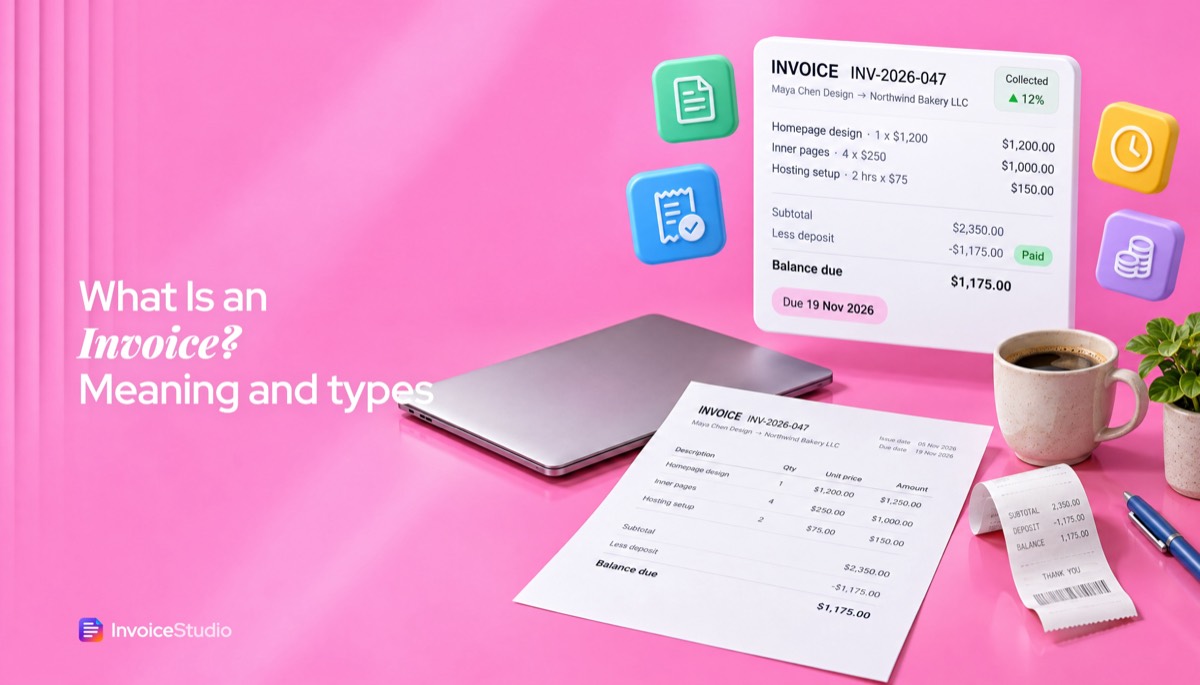
An invoice is a dated, numbered document a seller sends a buyer to request payment for goods or services. It lists what was supplied, the price of each item, any tax, the total due, the due date and how to pay. It also serves as the seller's sales record and the buyer's proof of a cost.
On this page 13 sections
- What is an invoice? (simple definition)
- What is the purpose of an invoice?
- Is an invoice a contract or a legal document?
- Invoice vs receipt: what's the difference?
- Invoice vs bill: are they the same thing?
- What is a sales invoice vs a purchase invoice?
- Types of invoices: the 11 kinds you will actually use
- What information is on an invoice?
- How do invoices fit into accounts receivable?
- Who issues an invoice and when?
- Invoice, receipt and the rest: how the documents connect
- What is an invoice? The short version
- FAQs
An invoice is a dated, numbered document a seller sends a buyer to ask for payment for goods or services, listing what was supplied, how much is owed, and when and how to pay. That is the whole definition in one line. What is an invoice in practice? It is also your record of the sale, the buyer's proof of a cost, and the paper trail a tax office looks at when it checks your books.
I have sent a few hundred invoices as a freelancer, these days mostly from a freelancer invoice generator, from a first one typed in Word with the wrong year on it to monthly retainers that go out on their own. Most of the confusion I see from people starting out is not about how to make an invoice. It is about the words around it: is a bill the same thing, when does a receipt come in, what is a proforma, and does an invoice actually bind anybody to pay? This page answers all of that in one place.
You will get a plain invoice meaning, a labelled sample with real numbers, a table that compares six documents people mix up (invoice, receipt, bill, quote, proforma and credit note), 11 types of invoices with when to use each, and short legal notes for the US, UK, EU, Canada, Australia, India and Bangladesh.
What is an invoice? (simple definition)
An invoice is a request for payment that a business issues after, or sometimes before, it delivers goods or services. It names the seller and buyer, gives a unique invoice number and date, lists each item with a price, adds any tax, and states the total due and the payment terms.
The dictionary definition of invoice is shorter: an itemised list of goods shipped or services rendered, with a statement of the sum due. That works, but it leaves out the two things that make an invoice useful in real life. First, it is numbered, so you and your client can refer to it without confusion. Second, it carries terms, such as "due in 14 days" or net 30, which turn a list of prices into a deadline.
A labelled mini sample invoice
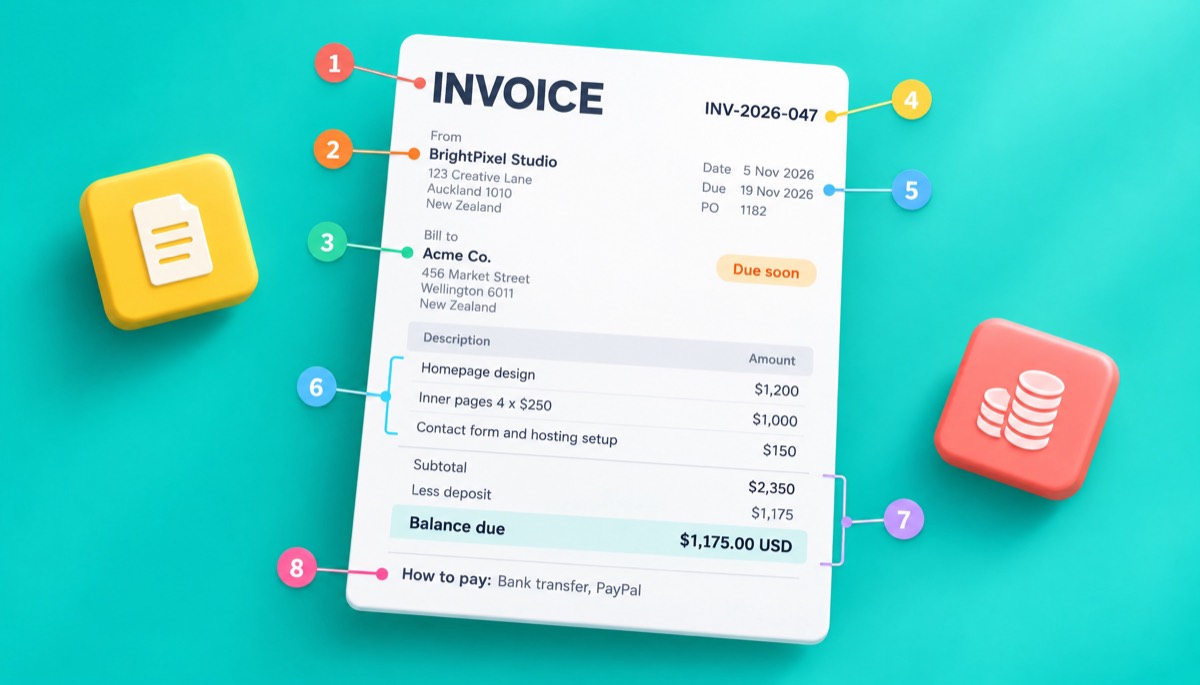
Here is a real-shaped example. Say you are a web designer called Maya Chen. You built a five-page website for a bakery, took a 50% deposit at the start, and now you invoice the balance.
| Part of the invoice | What it says on the sample | Why it is there |
|---|---|---|
| 1. Title | INVOICE | Tells the reader this is a demand for payment, not a quote or a receipt |
| 2. Seller | Maya Chen Design, 14 Elm Street, Portland OR, maya@example.com | Who is owed the money |
| 3. Buyer | Northwind Bakery LLC, attn. Sam Ortiz, 220 Pine Ave, Portland OR | Who owes the money |
| 4. Invoice number | INV-2026-047 | Unique reference for both sides and the tax office |
| 5. Invoice date | 5 November 2026 | Starts the payment clock |
| 6. Due date and terms | Due 19 November 2026 (14 days) | The deadline |
| 7. PO or reference | PO 1182 | Matches the client's own paperwork |
| 8. Line items | Homepage design, 1 x $1,200 = $1,200 Inner pages, 4 x $250 = $1,000 Contact form and hosting setup, 2 hrs x $75 = $150 | What was supplied, how many, at what price |
| 9. Subtotal | $2,350.00 | Total before tax and deductions |
| 10. Tax | $0.00 (design services not taxed here) | Sales tax, VAT or GST if it applies |
| 11. Less deposit received | -$1,175.00 (paid 1 October, INV-2026-039) | Shows money already paid |
| 12. Balance due | $1,175.00 USD | The one number the client must act on |
| 13. How to pay | Bank transfer or PayPal, details below | Removes any excuse to delay |
Each part answers a question the client's accounts person would otherwise email you about. For more layouts, the invoice format and samples guide has versions for products, hourly work and international clients.
What is the purpose of an invoice?
The purpose of an invoice is to get you paid and to create a record of the sale. It tells the buyer exactly what to pay, by when and how, and it gives both businesses a document to put in their books and tax returns.
In my experience an invoice does five separate jobs, and it helps to know them because each one changes what you put on it:
- Payment request. The obvious one. A clear total, a due date and payment details.
- Sales record. Your invoices, numbered in order, are the backbone of your income figure. The IRS lists invoices among the supporting documents for gross receipts.
- Tax document. In VAT and GST countries, a valid tax invoice is what lets your business customer reclaim the tax they paid you. Get the fields wrong and they cannot claim it, which means they will ask you to reissue.
- Evidence. If a client disputes what was agreed or simply does not pay, your invoice, together with the quote or contract and emails, is the core of your case.
- Cash-flow tool. Every unpaid invoice is money you are owed. Add them up and you have your accounts receivable, which tells you whether you can pay rent next month.
Is an invoice a contract or a legal document?
An invoice is a legal document in the sense that it is a formal business and tax record, but on its own it is usually not a contract. The contract is the agreement you made before the work: a signed proposal, a purchase order, a written contract or even a clear email exchange. The invoice is evidence of that deal and a demand under it.
This matters in two common situations.
Surprise terms. Say you agree a $3,000 project by email with no mention of late fees, then print "2% per month on overdue balances" on the invoice. Can you enforce it? In most places, not reliably, because the client never agreed to it. Terms belong in the agreement first and on the invoice second. In the US, deals for goods between merchants fall under Article 2 of the Uniform Commercial Code, and under its "battle of the forms" rule extra terms on paperwork can sometimes become part of the deal, but not if they materially change it. A new interest charge usually counts as a material change. Do not rely on it.
No written contract at all. Plenty of small jobs run on a phone call and a handshake. Here the invoice becomes much more important as evidence. If the client paid three earlier invoices for the same kind of work at the same rate without complaint, a court or small-claims judge will usually see that pattern as proof of the terms.
Legal status by country
Rules on what makes an invoice valid vary a lot. These are the short versions, correct as of November 2026. Always check with your local tax authority or an accountant for your exact case.
- United States. There is no federal invoice format. The IRS wants records that support your income and expenses, and states set sales tax rules, including what a resale or exempt sale invoice must show. Keep invoices for at least as long as the IRS can audit the return, generally three years and longer in some cases.
- United Kingdom. Gov.uk lists what every invoice must include: a unique number, your name and address, the customer's name and address, a description, the supply date, the invoice date, the amounts and the total. If you are VAT-registered, HMRC Notice 700/21 adds VAT fields, says you normally issue a VAT invoice within 30 days of the supply, and allows a simplified invoice for sales of £250 or less including VAT.
- European Union. The VAT Directive (2006/112/EC, Article 226) sets the full invoice content for VAT-registered businesses, including a sequential number, both parties' details, VAT ID numbers, the VAT rate and the VAT amount. The European Commission summary also covers simplified invoices, "reverse charge" wording and self-billing. Several member states are moving to mandatory structured e-invoices for business sales, so check your country's dates.
- Canada. GST/HST registrants need specific information on invoices so buyers can claim input tax credits. The Input Tax Credit Information Regulations use three tiers: under $100, $100 to under $500, and $500 or more, with the buyer's name required at the top tier.
- Australia. A GST-registered seller must give a tax invoice when a business customer asks for one on a taxable sale over $82.50 including GST. Sales of $1,000 or more also need the buyer's identity or ABN. The ATO website has the full list.
- India. GST tax invoices follow the CGST Act and Rule 46, with GSTIN, HSN or SAC codes and place of supply. Businesses above the e-invoicing turnover threshold (currently ₹5 crore) must report B2B invoices through the government's invoice registration portal. See the GST invoice format guide.
- Bangladesh. VAT-registered sellers issue the Mushak 6.3 tax invoice under the VAT and Supplementary Duty Act 2012. The National Board of Revenue sets the format.
In VAT and GST countries a missing field can stop your customer reclaiming tax, so they will hold payment until you fix it.
Invoice vs receipt: what's the difference?
An invoice asks for payment and a receipt confirms payment. You send the invoice before the money arrives, and you send the receipt after it lands. Same sale, two documents, opposite moments.
A quick worked example. On 5 November you invoice Northwind Bakery $1,175 (INV-2026-047). On 17 November they pay by bank transfer. You then issue a receipt, or mark the invoice paid and send a copy stamped "Paid 17 Nov 2026", showing the amount, the date, the method and the invoice it settles.
What is a receipt in plain terms? A receipt is proof that money changed hands. Shops print one at the till because payment and delivery happen at the same moment, so no invoice is needed. In freelance and B2B work the gap between delivery and payment is days or weeks, which is why the invoice comes first.
Copy-paste receipt wording that has never caused me a query:
Received with thanks: $1,175.00 from Northwind Bakery LLC on 17 November 2026 by bank transfer, in full settlement of invoice INV-2026-047. Balance outstanding: $0.00.
Is an invoice the same as a receipt? No, and mixing them up causes real trouble. If you send a document headed "Receipt" before you are paid, the client's accounts team may file it as settled and never pay.
Invoice vs bill: are they the same thing?
An invoice and a bill are usually the same document seen from two sides. The seller calls it an invoice because it is money coming in. The buyer calls it a bill because it is money going out. Accounting software such as QuickBooks follows this split: invoices sit under sales and bills sit under expenses.
There are two small differences. "Bill" is the usual word for consumer charges, like a phone or restaurant bill. And in some tax systems "bill" has a special meaning. In India, for example, a "bill of supply" is issued instead of a tax invoice when no GST is charged, such as by composition dealers or for exempt goods.
So if a client says "send me your bill", send an invoice. It is what their finance team needs anyway.
Invoice vs receipt vs bill vs quote vs proforma vs credit note
These six documents get mixed up more than any others. The table below sets them side by side.
| Document | Who sends it | When | Main purpose | Asks for payment? | Hits the books? |
|---|---|---|---|---|---|
| Invoice | Seller to buyer | After or at delivery, or per milestone | Request payment and record the sale | Yes | Yes: sales and accounts receivable |
| Receipt | Seller to buyer | After payment | Prove payment was received | No | Records cash received |
| Bill | Same as invoice, named from the buyer's side | When the buyer receives it | Record a cost to pay | Yes | Yes: expenses and accounts payable |
| Quote or estimate | Seller to prospect | Before the work is agreed | Offer a price | No | No |
| Proforma invoice | Seller to buyer | Before delivery, often before shipping or a deposit | Preview the final invoice; used for customs, deposits or buyer approval | Sometimes, for advance payment | No, not as a sale |
| Credit note | Seller to buyer | After an invoice, when it needs reducing | Cancel or reduce an invoice (refund, return, error) | No, it reduces what is owed | Yes: reverses part or all of a sale |
The proforma line trips people up most. A proforma looks like an invoice but is not a tax invoice and should not be booked as a sale. When the goods ship or the work is done, you issue the real invoice. The proforma vs commercial invoice guide covers it in depth, and credit memo vs credit note covers the reversal side.
Invoice vs statement
A statement is a summary of several invoices and payments over a period, usually a month. It shows the opening balance, each invoice issued, each payment received and the closing balance. It is not a new demand for payment. It is a reminder of the running total.
Example: a café you supply weekly gets four invoices in October for $420, $380, $455 and $410, total $1,665. They paid the first two ($800). Your October statement shows $1,665 invoiced, $800 received and $865 outstanding. Useful for regular customers. Not a replacement for individual invoices, which are still the tax documents.
What is a sales invoice vs a purchase invoice?
A sales invoice and a purchase invoice are the same piece of paper. It is a sales invoice in the seller's books and a purchase invoice in the buyer's books. The labels only tell you which side of the deal you are looking from.
When Maya sends INV-2026-047 to Northwind Bakery:
- In Maya's books it is a sales invoice. It increases her sales and her accounts receivable by $1,175.
- In Northwind's books it is a purchase invoice (or supplier invoice, or bill). It increases their expenses and their accounts payable by $1,175.
Why care? In VAT and GST countries your sales invoices produce output tax (tax you charged) and your purchase invoices support input tax (tax you can reclaim). Keep them apart, or your VAT return will not reconcile.
A purchase invoice is also different from a purchase order. The PO comes from the buyer before the work and says "we will buy this at this price". The invoice comes from the seller after delivery and says "here is what you owe". Many larger companies run a three-way match: PO, delivery note and invoice must agree before anyone pays. If your client issued a PO, put its number on your invoice. It is the single fastest way to avoid a rejection.
Types of invoices: the 11 kinds you will actually use
The main types of invoices are standard, proforma, interim, final, recurring, timesheet, commercial, credit note, debit note, past-due and self-billing invoices. They share the same core fields. What changes is the timing, who issues them and what extra details they carry.
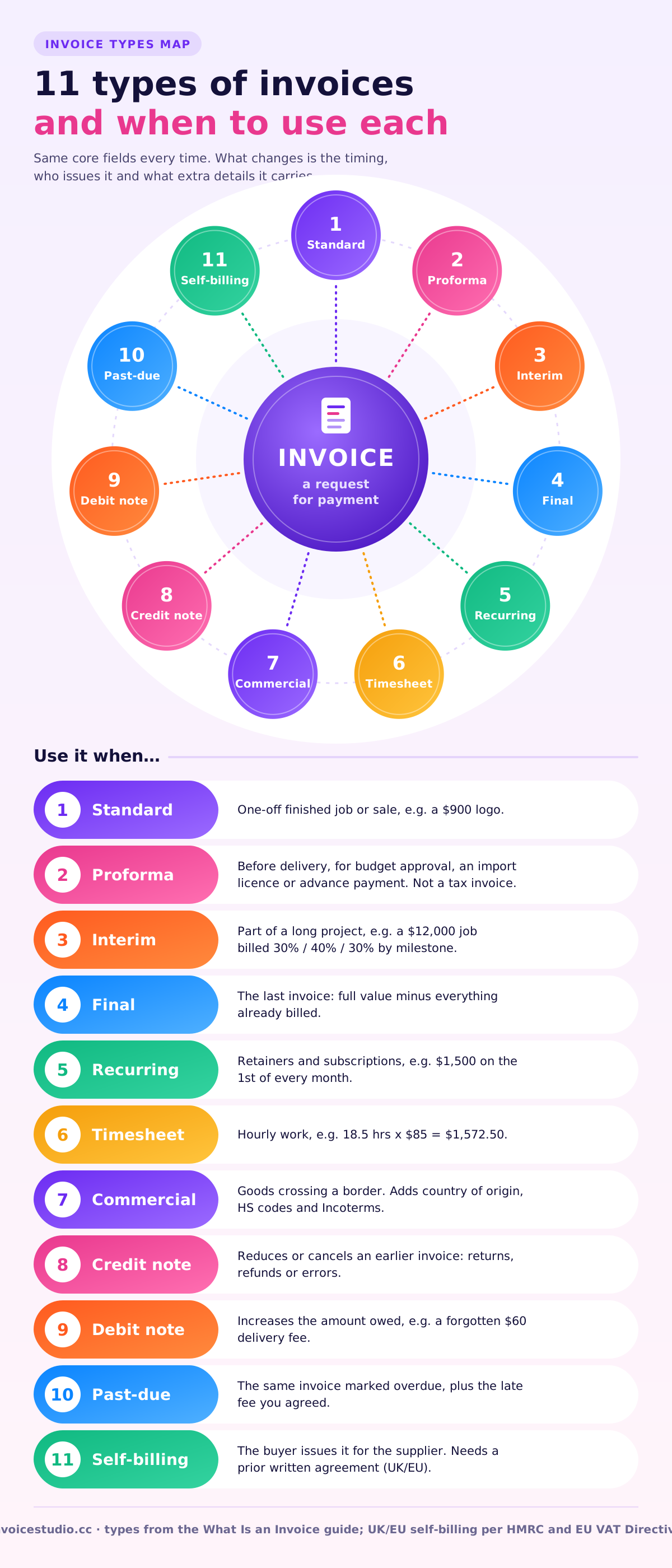
Here is each one, with when I would use it.
1. Standard invoice
The everyday invoice for a finished sale or job. Use it for one-off work: a $900 logo, a pallet of stock, a day's consulting. If you are only going to learn one, this is it. In VAT countries the standard invoice issued by a registered business is the "VAT invoice" or "tax invoice".
2. Proforma invoice
A preliminary invoice sent before delivery. Use it when a buyer needs a firm document to approve a budget, arrange an import licence or pay in advance. It is not a tax invoice. Replace it with a standard or commercial invoice once you supply.
3. Interim invoice
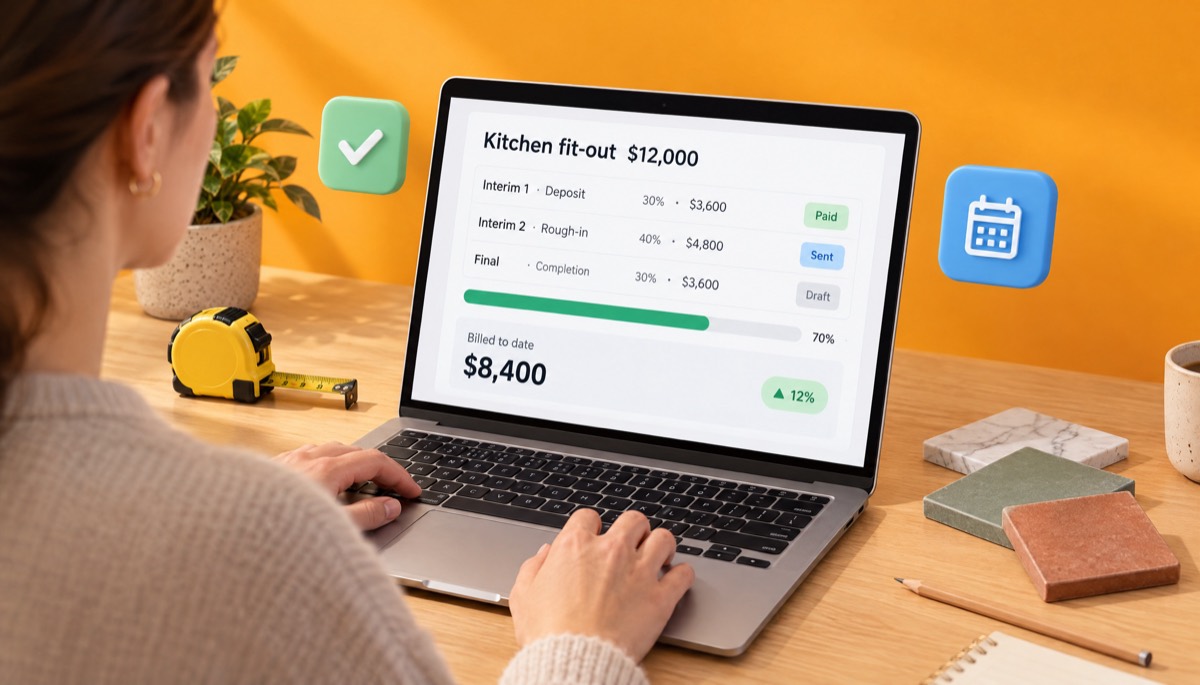
An interim invoice bills part of a larger job before it is finished. It is also called a progress invoice or milestone invoice. Use it on long projects so you are not funding the work yourself for months. Example: a $12,000 kitchen fit-out billed as 30% deposit ($3,600), 40% at rough-in ($4,800) and 30% on completion ($3,600). Each interim invoice should say which stage it covers and what has been billed so far.
4. Final invoice
The last invoice on a project that had interim invoices or a deposit. It shows the full contract value, subtracts everything already billed or paid, and asks for the balance. Maya's sample above is a final invoice. Spell out the earlier invoice numbers so the client's accounts team can tick them off.
5. Recurring invoice
The same charge billed on a schedule. Use it for retainers, subscriptions, rent, maintenance plans and monthly bookkeeping. Example: a $1,500 monthly content retainer invoiced on the 1st of each month, net 7. Recurring invoices are where software pays for itself, because forgetting to send one is the same as working for free that month.
6. Timesheet invoice
An invoice built from hours. Use it for hourly freelance, legal, consulting or agency work. List dates, tasks and hours, for example 18.5 hours x $85 = $1,572.50. Clients trust hourly bills more when they can see the breakdown, and they argue less. For filled-in hourly, retainer and milestone layouts, see these services invoice examples.
7. Commercial invoice
A customs document for exporting goods. Use it whenever physical goods cross a border. It adds the country of origin, HS tariff codes, Incoterms, weights and the reason for export. The US International Trade Administration explains what customs expects. A missing commercial invoice is one of the classic reasons a parcel gets held.
8. Credit note (credit memo)
A negative invoice that reduces or cancels an earlier one. Use it for returns, refunds, overcharges or a discount agreed after the fact. Never edit or delete a sent invoice. Issue a credit note that references it, for example "Credit note CN-2026-004 against INV-2026-031, $150.00, two items returned".
9. Debit note
A document that increases the amount owed on an earlier invoice, or that a buyer sends to a seller to request a credit. Use it when you undercharged, for example you forgot a $60 delivery fee, or when goods came back and the buyer wants to formalise the claim.
10. Past-due invoice
A reissued invoice marked overdue, often with any agreed late fee added. Use it after the due date passes. It is still the same invoice number, just with "Overdue" status, the days late and the new total if your contract allows interest. In the UK, businesses can claim statutory interest and fixed recovery costs on late business payments.
11. Self-billing invoice
A self-billing invoice is an invoice the buyer prepares on the seller's behalf. Use it when the customer knows the amounts better than the supplier does, as with a publisher paying royalties, a supermarket buying from farmers or a platform paying drivers. In the EU it needs a prior agreement between the two parties (in the UK that agreement must be in writing), and the invoice must say "self-billing". Simple wording for the agreement:
We agree that [Buyer Ltd] will issue self-billed invoices for all supplies made by [Supplier] from 1 January 2027 to 31 December 2027. [Supplier] will not issue its own invoices for these supplies and will tell [Buyer Ltd] at once if its VAT registration changes.
Two more labels you will see that are formats rather than types. An e-invoice is a structured data file (such as Peppol in Europe or India's GST e-invoice schema) that software can read, not just a PDF. A mixed invoice combines goods and services, or taxed and untaxed lines, on one document.
What information is on an invoice?
A complete invoice includes the word "Invoice", a unique number, the issue date, the seller's and buyer's details, a description of each item with quantity and price, any tax, the total due, the due date and how to pay. Tax-registered businesses also add their tax ID and the tax breakdown.
Here is the checklist I run before I hit send. The first ten are close to universal. The rest depend on your country and your client.
- The word "Invoice" (or "Tax invoice" or "VAT invoice" where required)
- Unique, sequential invoice number. See the invoice number guide for formats
- Invoice date
- Your business name, address and contact email
- Client's legal name and address, plus a contact name
- Description of each good or service
- Quantity, unit and unit price per line
- Subtotal, discounts, tax and total
- Due date or payment terms
- Payment methods and details
- Your tax number: VAT, GST, GSTIN, ABN or BIN as relevant
- Date of supply, if different from the invoice date
- Client PO number or project reference
- Currency code, for example USD, GBP or EUR, especially on international invoices
- Late payment terms, only if already agreed
- Notes, such as a thank-you, a deposit reference or "Reverse charge: customer to account for VAT" for EU B2B services
Copy-paste payment terms line:
Payment is due within 14 days of the invoice date (by 19 November 2026). Please quote INV-2026-047 as the payment reference. Bank and PayPal details are below.
The most common mistakes I see on invoices from new freelancers, in the order I see them: no due date, no invoice number, the client's trading name instead of their legal name, a vague description like "work done", and payment details buried in the email instead of on the invoice. Any one of these can add a week to payment. For the full walkthrough, read how to make an invoice.
How do invoices fit into accounts receivable?
Accounts receivable is the money customers owe you for goods or services you have already delivered. Every sales invoice you send and have not been paid for is part of it. When you send an invoice, accounts receivable goes up. When the client pays, it goes down and your cash goes up by the same amount.
A worked example with three clients over October:
| Date | Event | Accounts receivable | Cash received |
|---|---|---|---|
| 1 Oct | Invoice Client A $3,000, net 30 | $3,000 | $0 |
| 8 Oct | Invoice Client B $1,200, net 14 | $4,200 | $0 |
| 15 Oct | Invoice Client C $800, due on receipt | $5,000 | $0 |
| 20 Oct | Client B pays $1,200 | $3,800 | $1,200 |
| 28 Oct | Client A pays $3,000 | $800 | $4,200 |
| 31 Oct | Client C still unpaid (16 days) | $800 | $4,200 |
You "earned" $5,000 in October, but only $4,200 hit your account. That gap is why invoices matter for cash flow, not just bookkeeping. A busy month on paper can still be a tight month in the bank.
Accountants track receivables with an ageing report, which sorts unpaid invoices into buckets: current (not yet due), 1 to 30 days overdue, 31 to 60, 61 to 90, and over 90. The older the bucket, the less likely you are to collect. My rule is simple: anything in the 1 to 30 bucket gets a polite reminder, and anything past 30 gets a phone call.
If you invoice on the cash basis for tax, as many US sole proprietors do, you report income when you are paid, not when you invoice. On the accrual basis you report it when you invoice. Your invoice dates and payment dates feed both methods, so record both.
Invoice Studio tracks partial and full payments, flags overdue invoices and shows money received on a dashboard. It is not an accounting ledger, so if you need a full balance sheet, export the CSV to your bookkeeping software.
Who issues an invoice and when?
The seller issues the invoice, normally as soon as the goods are delivered or the work is done, or at the milestones agreed in the contract. The only exception is self-billing, where the buyer issues it under a written agreement.
When exactly to send it depends on the deal:
- One-off job: the day you deliver. Every day you wait is a day added to payment. I invoice within an hour of sending final files.
- Project with a deposit: a deposit invoice at signing, interim invoices at each milestone, and a final invoice at handover.
- Retainer or subscription: a recurring invoice on a fixed date, often the 1st of the month, in advance.
- Hourly work: weekly or monthly from your timesheet. Weekly works better for new clients because it keeps the exposure small.
- Goods sold on credit: with the delivery or right after it. Many B2B buyers will not pay a supplier until the invoice and delivery note match.
- Tax deadlines: UK VAT-registered businesses normally have 30 days from the supply. EU rules usually allow until the 15th of the month after the supply for cross-border B2B. Do not sit on invoices to manage your VAT. Tax offices look for that.
Who can issue an invoice? Anyone selling goods or services. You do not need a company, an EIN or a VAT number. A freelancer can invoice under their own name; registering for tax only adds your tax number and the tax lines.
How to send an invoice
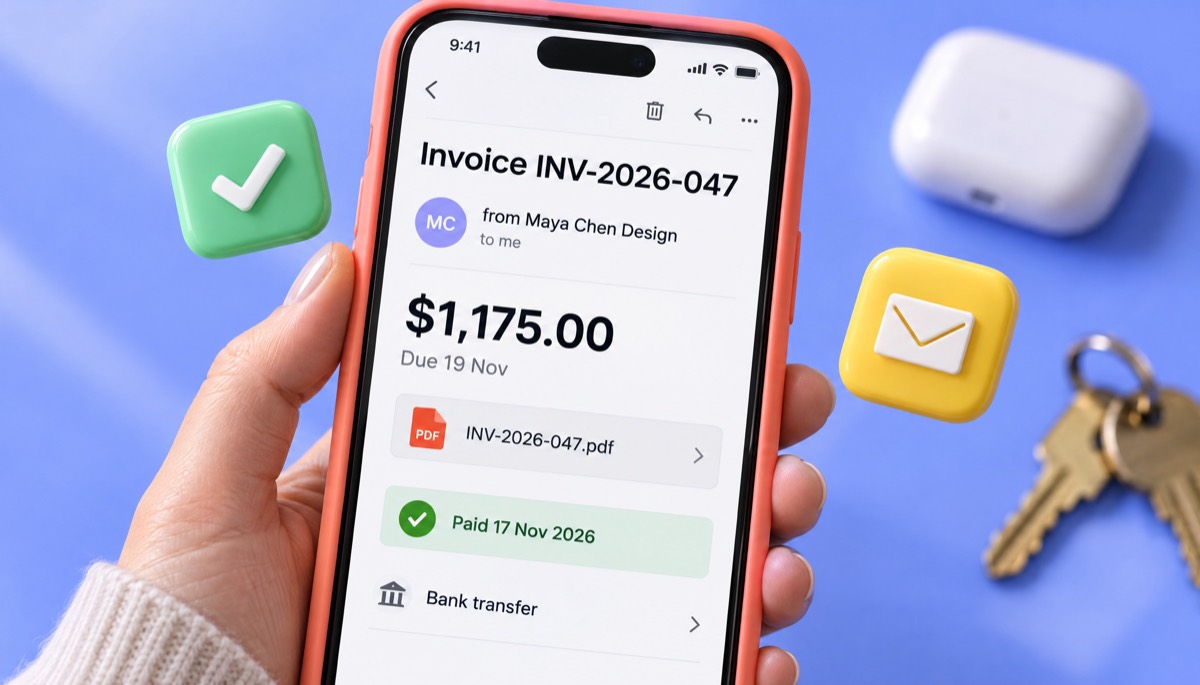
Most invoices today go as a PDF attached to an email, because a PDF cannot be edited by accident and looks the same on every device. Put the invoice number and amount in the subject line, for example "Invoice INV-2026-047 from Maya Chen Design: $1,175 due 19 Nov". The how to send an invoice guide covers email wording, PayPal and follow-ups.
A short email that gets paid:
Hi Sam, please find attached invoice INV-2026-047 for $1,175.00, the balance for the Northwind website. It is due by 19 November. Bank and PayPal details are on the invoice. Thanks again, it was a pleasure building this with you. Maya
Invoice, receipt and the rest: how the documents connect
An invoice is one step in a short chain of documents that runs from first price to final payment. Seeing the whole chain makes each document's job obvious.
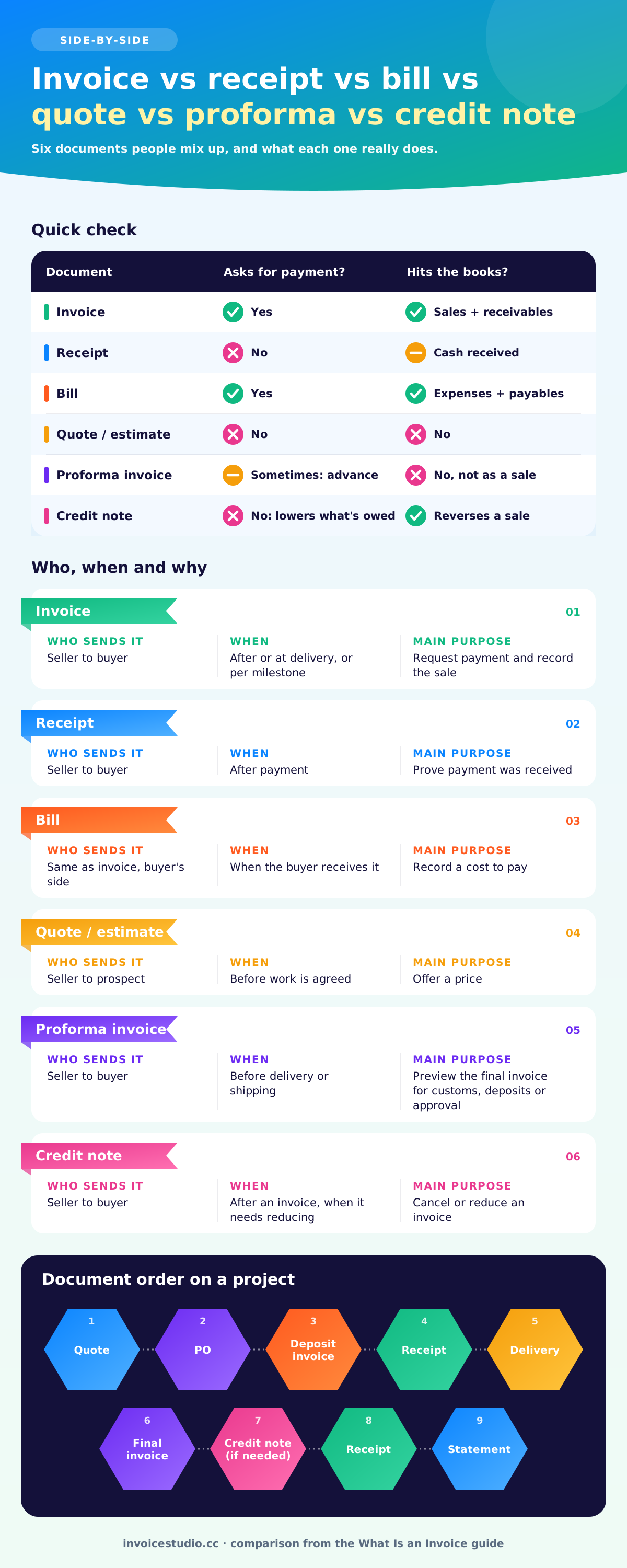
For a typical project the order is:
- Quote or estimate: you offer a price ($2,350 for the website).
- Purchase order or signed proposal: the client accepts (PO 1182).
- Proforma or deposit invoice (optional): you ask for money up front ($1,175).
- Receipt for the deposit.
- Delivery note (goods) or handover email (services).
- Final invoice: the balance ($1,175).
- Credit note (only if something is returned or overcharged).
- Receipt for the final payment.
- Statement (regular clients): a monthly summary of all of the above.
Paper vs PDF vs e-invoice
A paper invoice and a PDF invoice are legally the same in most countries, provided the content is complete and the buyer accepts electronic invoices. In the EU, electronic and paper invoices are treated equally, but you need the customer's agreement to send electronic ones unless your country makes them mandatory.
If you want to see what a finished invoice looks like before you build your own, the invoice templates are a good place to start. Pick one, add your logo and brand colour, and you have a standard you can reuse for every client.
What is an invoice? The short version
An invoice is a numbered, dated request for payment that also serves as your record of the sale. A receipt proves payment. A bill is the same invoice seen by the buyer. A quote offers a price, a proforma previews the invoice, and a credit note reverses one. Pick the right type for the job: standard for one-offs, interim and final for projects, recurring for retainers and self-billing only with a written agreement. Then fill in the fields your country requires.
Get those basics right and most payment delays disappear before they start. When you are ready to make one, the free invoice generator lets you add line items, tax, discounts and your payment methods, then download a PDF or email it straight to your client. You can browse all 28 designs in the free invoice template gallery.
Frequently asked questions
What is an invoice?
Is an invoice the same as a receipt?
What is the difference between an invoice and a bill?
Is an invoice legally binding?
What are the different types of invoices?
What is an interim invoice?
What is a self-billing invoice?
Monjur builds Invoice Studio and incorporated MotionTrust Digital in September 2022, where he leads Amazon strategy across the client base. Eight years in e-commerce and marketplace marketing taught him how much time invoices and late payments eat, so every guide here is tested against the real product and current tax rules before it goes live.
More guides by Monjur