How to Ask for Payment Politely: Emails for Overdue Invoices
Five copy-paste payment reminder emails, a final notice letter and the real late fee and interest rules, worked on a £1,200 overdue invoice.
- Written by
- Monjur Hossain
- Published
- Last updated
- Reading time
- 17 min read

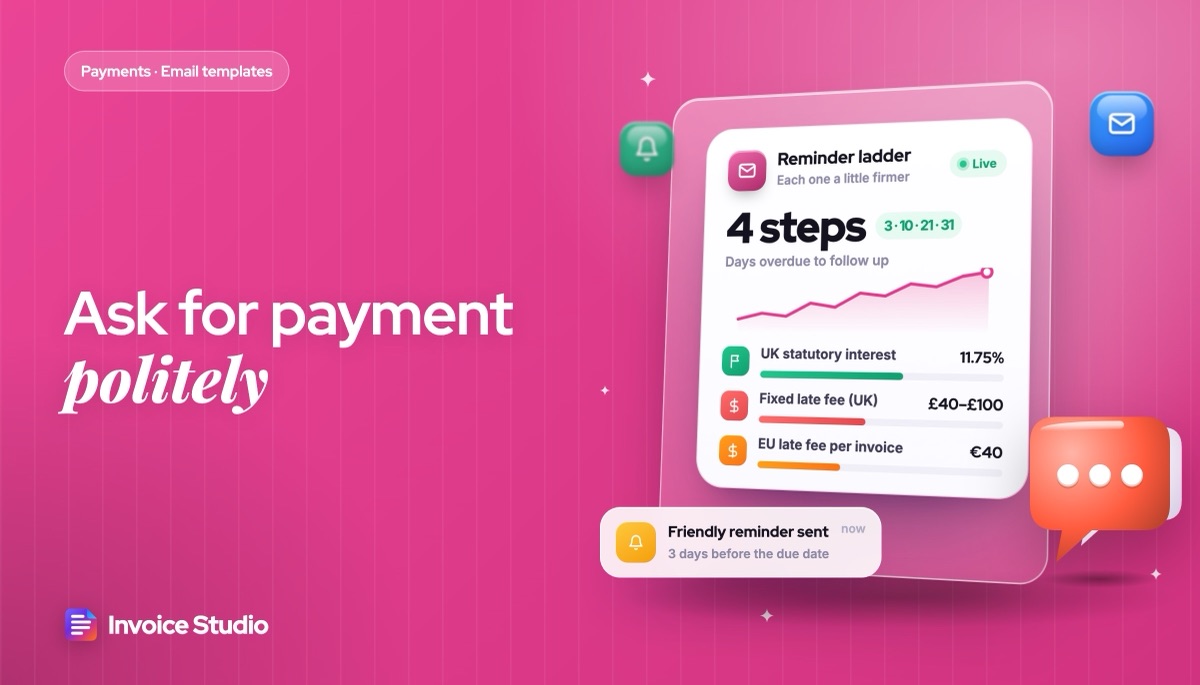
To ask for payment politely, send a short email that names the invoice number, amount and due date, reattaches the invoice and gives one way to pay, then asks when payment is scheduled. Follow up on a fixed schedule: 3 days before the due date, then 3, 10, 21 and 31 days overdue, ending with a final notice.
On this page 12 sections
- How to ask for payment politely (the short version)
- When should you send a payment reminder?
- Payment reminder email templates you can copy
- How to word a past due invoice notice
- How to write a final notice letter before collections
- Can you charge a late payment fee on an overdue invoice?
- How much late payment interest can you charge in the UK, EU and US?
- What should you do when a client ghosts after delivery?
- Should you stop work until an unpaid invoice is paid?
- How to take an unpaid invoice to small claims court
- How to prevent overdue invoices next time
- FAQs
Knowing how to ask for payment politely comes down to being specific, early and calm: name the invoice number, the amount and the due date, assume the delay is an honest mistake, and make paying take one click. Then follow up on a fixed schedule, getting a little firmer each time, until the money arrives or you send a final notice.
I've chased more unpaid invoices than I'd like to admit. Most were paid after one friendly email. A handful needed four. Two went to a court claim, and both clients paid within a week of getting the papers. Politeness and firmness aren't opposites: polite emails work because they're clear.
This guide gives you the plan: a dated 5-email reminder ladder you can copy, a past due invoice notice, a final notice letter, the real late payment fee and interest rules for the UK, EU and US (with a worked calculation on a £1,200 debt), a ghosting playbook and how to collect unpaid invoices through small claims court.
How to ask for payment politely (the short version)
To ask for payment politely, send a short email that states the invoice number, amount and due date, attaches the invoice again, and gives one simple way to pay. Keep the tone neutral, skip the apologies and the guilt, and end with a clear next step such as "Could you let me know when this is scheduled?"
Here's the whole method in seven points:
- Lead with the facts. "Invoice INV-0187 for £1,200, due 16 October." Facts aren't rude.
- Assume good faith in the first two emails. Most late payments are admin, not malice.
- Reattach the invoice every time.
- Give one payment route. A bank transfer reference or a PayPal link in the email.
- Ask a question they can answer. "When is this scheduled for payment?" gets replies.
- Follow a fixed schedule. Decide the dates in advance.
- Escalate in steps, not jumps. Each email a little firmer than the last.
Words I'd cut from every payment reminder email: "sorry to bother you", "just a gentle reminder" and "whenever you get a chance". They tell the client the deadline is optional.
Copy-paste opener that is polite without grovelling: "Hi Sam, a quick note that invoice INV-0187 for £1,200 was due on Friday 16 October. I've attached it again here. Could you let me know when it's scheduled for payment?"
When should you send a payment reminder?
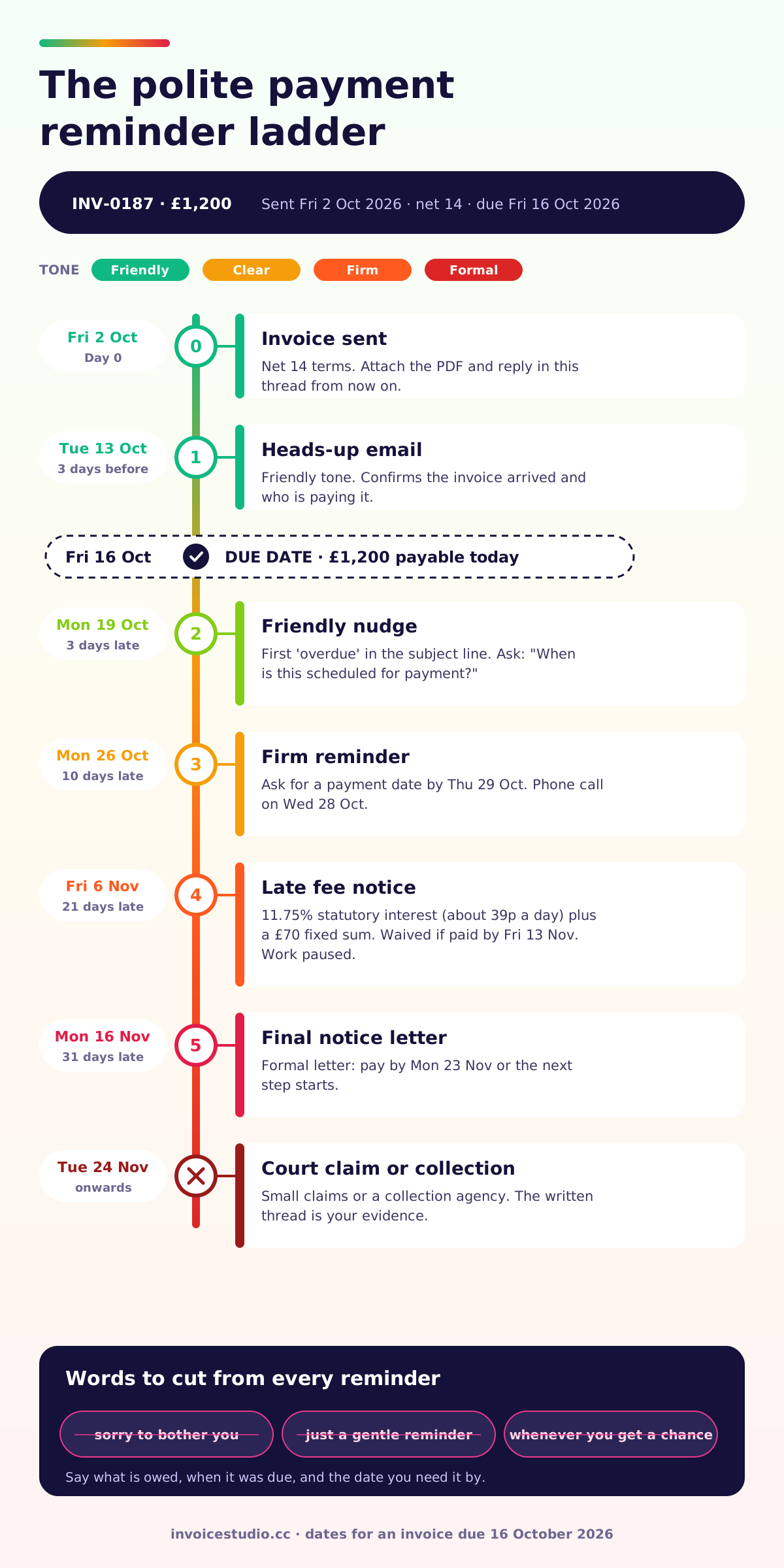
Send the first payment reminder 3 days before the due date, the second 3 days after it, and then step up at roughly 10, 21 and 30 days overdue. That rhythm catches honest mistakes early, gives the client time to fix them, and still gets you to a final notice within about a month.
Here's the ladder I use, worked through for a real example: a £1,200 design invoice dated Friday 2 October 2026, on net 14 terms, so it's due on Friday 16 October 2026. If you're unsure how due dates are counted, our guide to net 30 payment terms walks through the date maths.
| Step | Date (2026) | Timing | Tone | What changes |
|---|---|---|---|---|
| 1. Heads-up | Tue 13 Oct | 3 days before due | Friendly | Confirms the invoice arrived |
| 2. Nudge | Mon 19 Oct | 3 days overdue | Friendly, direct | First "overdue" wording |
| 3. Firm reminder | Mon 26 Oct | 10 days overdue | Businesslike | Asks for a payment date, plus a phone call |
| 4. Late fee notice | Fri 6 Nov | 21 days overdue | Formal | Late fee or interest, work paused |
| 5. Final notice | Mon 16 Nov | 31 days overdue | Formal, final | 7-day deadline (Mon 23 Nov), then legal steps |
Why 3 days before? Because the pre-due email is really a delivery check. Plenty of the "late" invoices I've chased were sitting in a spam folder or with someone who'd left the company, and it's better to find that out before the due date than three weeks after.
On net 30 or net 60, keep the same ladder: the heads-up a few days before the due date and the final notice about a month after it.
Payment reminder email templates you can copy
The five payment reminder emails below match the ladder above, from a friendly nudge to a formal final notice. Swap in your details, attach the invoice PDF each time, and reply in the same email thread so the client (and, if needed, a court) sees the whole history.
Email 1: The heads-up (3 days before the due date)
Subject: Invoice INV-0187 due Friday 16 October
Hi Sam,
A quick heads-up that invoice INV-0187 for £1,200 is due this Friday, 16 October. I've attached it again in case it got buried.
Bank details and the payment reference are on the invoice under "How to pay". If it needs to go to someone in accounts, just let me know who and I'll send it straight over.
Thanks,
Alex
Email 2: The friendly nudge (3 days overdue)
Subject: Overdue: invoice INV-0187 (£1,200, due 16 October)
Hi Sam,
I haven't seen payment come through for invoice INV-0187 yet. It was due on Friday 16 October. It's probably just stuck in a queue somewhere, so I've attached a copy again.
Could you let me know when it's scheduled for payment?
Thanks,
Alex
Email 3: The firm reminder (10 days overdue)
Subject: Second reminder: invoice INV-0187 is 10 days overdue
Hi Sam,
Following up on invoice INV-0187 for £1,200, which is now 10 days past its due date of 16 October. I haven't had a reply to my last email, so I want to make sure this is with the right person.
Could you confirm the date payment will be made by Thursday 29 October? If there's a problem with the invoice or the work, tell me and I'll sort it out quickly.
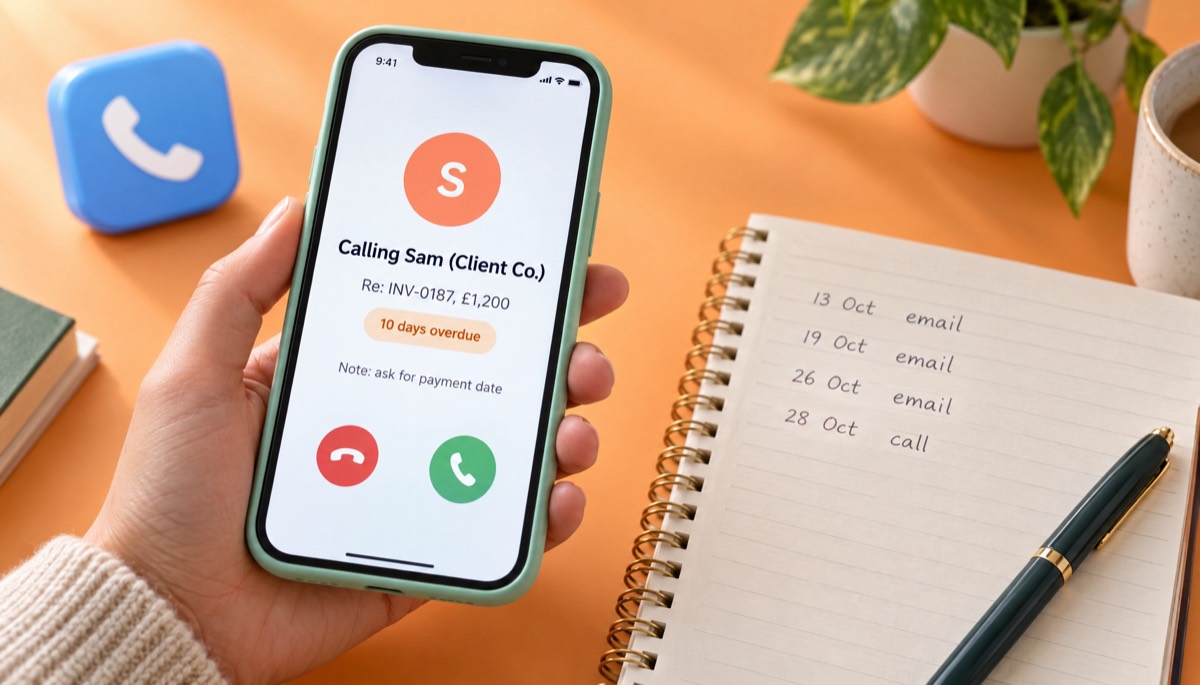
I'll give you a call on Wednesday if I don't hear back before then.
Best,
Alex
Two things changed: you asked for a specific date, and you announced a phone call. A voice is much harder to dodge than an inbox, and disputed items usually come out here.
Email 4: The late fee notice (21 days overdue)
Subject: Invoice INV-0187: 21 days overdue, late payment charges now apply
Hi Sam,
Invoice INV-0187 for £1,200 is now 21 days overdue, and I haven't received a payment date despite my emails on 13, 19 and 26 October.
Under the Late Payment of Commercial Debts (Interest) Act 1998, statutory interest now applies at 11.75% a year (8% plus the Bank of England base rate), which is about 39p a day, plus a fixed recovery fee of £70. To keep things simple, I'll waive both if the original £1,200 is paid by Friday 13 November.
I've also paused further work on the project until the account is up to date. I'm happy to pick it straight back up once it is.
Regards,
Alex
Offering to waive the charges for quick payment gives the client a reason to act this week, and shows you're being reasonable if this ever reaches a judge. Only quote charges you're entitled to, covered below.
Email 5: The final notice (31 days overdue)
The fifth email is your final notice, with the full letter in its own section below. From email 3 onwards, copy the client's accounts payable address, and keep a log of every date, channel and reply.
How to word a past due invoice notice
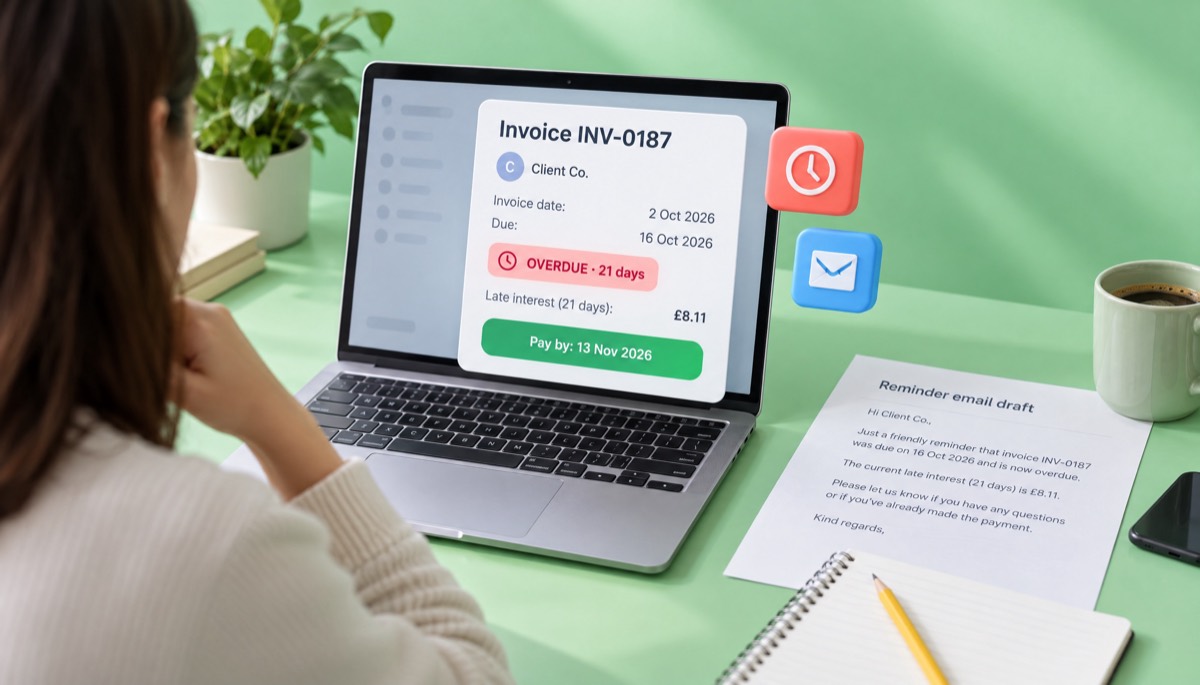
A past due invoice notice should say, in its first line, which invoice is late, by how many days and for how much. Put "PAST DUE" or "OVERDUE" clearly on the invoice itself, show the original due date, and list any late payment fee as a separate line so the client can see exactly what has changed.
Some clients pay from the invoice rather than the email, so reissue the overdue invoice with a status that can't be missed:
- A clear status: OVERDUE: 21 days past due.
- The original invoice date and due date, unchanged. Never redate the invoice, because it resets the clock in the client's system.
- Any late fee on the invoice as its own line, for example "Late payment interest, 16 Oct to 6 Nov (21 days): £8.11".
- A new "pay by" date in the notes.
- The same invoice number. If you add charges as a separate document, give it a new number and reference the original (our invoice number guide shows a clean way to do that). Gov.uk says to send a new invoice if you decide to add interest to the money you're owed.
Copy-paste wording for the invoice notes field:
This invoice is now 21 days past due. The original amount of £1,200.00 was due on 16 October 2026. Please pay the balance shown by 13 November 2026 using the bank details below, quoting INV-0187. If you've already paid, please send the remittance details so I can match the payment.
Sometimes the client has paid and the money sits unmatched under a different reference. A remittance advice clears that up.
How to write a final notice letter before collections
A final notice letter is a formal written demand that gives the client one last, dated deadline to pay, usually 7 or 14 days, and says exactly what you'll do if they don't. Keep it short, factual and free of emotion, list every reminder you've already sent, and only threaten actions you're genuinely prepared to take.
Here's the letter I send. In the UK it also works as your "letter before claim" (often called a letter before action), which the pre-action rules expect before you go to court. In the US, the same document is usually called a demand letter, and small claims courts in many states expect you to have sent one.
Subject: FINAL NOTICE: invoice INV-0187, £1,200.00 overdue since 16 October 2026
Dear Sam,
Despite my reminders on 13 October, 19 October, 26 October and 6 November 2026, and my phone call on 28 October, invoice INV-0187 for £1,200.00 remains unpaid. It was due on 16 October 2026 and is now 31 days overdue.
The amount now owed is:
- Invoice INV-0187: £1,200.00
- Fixed debt recovery sum (Late Payment of Commercial Debts (Interest) Act 1998): £70.00
- Statutory interest at 11.75% a year from 17 October 2026, currently £11.98 and rising by £0.39 a day
Please pay the full amount by Monday 23 November 2026. If I don't receive payment or a written payment plan by then, I'll start a court claim for the debt, interest and costs without further notice. I'd much rather not do that.
If you dispute any part of this invoice, please tell me in writing before that date, with your reasons, so we can resolve it.
Yours sincerely,
Alex Morgan
Morgan Design Studio
Notes on making a final notice letter work:
- Give a real deadline. Seven days minimum; fourteen is safer if you may sue in England and Wales.
- Don't bluff. If you won't actually go to court over £300, don't say you will.
- Offer a payment plan. A client who can't pay £1,200 now may pay £400 a month for three months.
Can you charge a late payment fee on an overdue invoice?
Yes, you can charge a late payment fee on an overdue invoice if it was agreed in your contract or terms before the work started, or if the law gives you a statutory right to one, as it does for business-to-business debts in the UK and the EU. In most US states you need the fee in writing first, and it must stay under the state's legal limits.
"Can I add a late fee if it wasn't in the contract?" depends on where you and the client are:
- UK: Yes, for business clients. The Late Payment of Commercial Debts (Interest) Act 1998 gives you statutory interest and a fixed recovery sum even if the contract says nothing.
- EU: Yes, for business and public-sector clients. The Late Payment Directive gives you statutory interest and a €40 flat fee per late invoice.
- US: Usually no. If the fee wasn't agreed, most courts won't enforce it. A surprise fee mostly starts an argument.
- Canada and Australia: There's no general automatic late fee for private business invoices, so rely on your contract and the local courts' interest rules.
- India: If you're a registered micro or small enterprise, the MSMED Act caps buyer payment terms at 45 days and gives you compound interest at three times the RBI bank rate on late payments. Otherwise, rely on your contract.
What's a normal late fee on an invoice? These are the common structures, worked on a $1,200 invoice:
| Late fee type | Typical wording | On a $1,200 invoice | Good for |
|---|---|---|---|
| Monthly percentage | 1.5% per month on the overdue balance | $18.00 a month | Most US freelancers and agencies |
| Lower monthly percentage | 1% per month | $12.00 a month | Long-term clients, stricter states |
| Flat fee | $25 fee if unpaid 15 days after the due date | $25.00 once | Small invoices under $500 |
| Flat percentage | 5% one-time late charge | $60.00 once | Trades and one-off jobs |
| UK statutory | 8% + base rate a year, plus fixed sum | 11.75% a year plus £70 (on £1,200) | UK business clients |
1.5% a month works out to 18% a year, which is above the usury cap in some US states. Limits vary by state, so check yours; 1% a month is the safer number.
Copy-paste late fee clause for your contract and invoice terms:
Payment is due within 14 days of the invoice date. Overdue balances are charged interest at 1% per month (12% per year), or the maximum rate allowed by law if lower, from the day after the due date until paid. Work may be paused while any invoice is more than 14 days overdue.
Put that wording in three places: your quote or proposal, your contract, and the footer of every invoice. The freelance invoice template guide shows where it sits on the page.
How much late payment interest can you charge in the UK, EU and US?
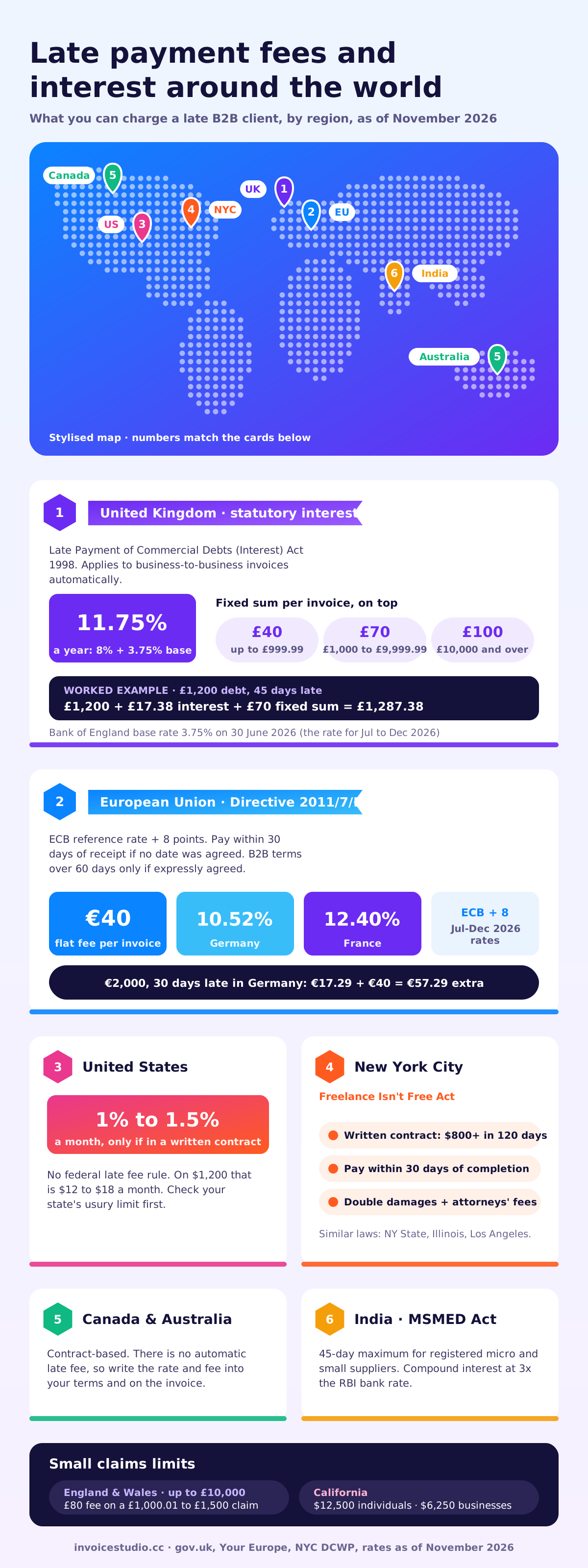
In the UK, you can charge statutory late payment interest of 8% plus the Bank of England base rate on overdue business debts, plus a fixed sum of £40, £70 or £100. In the EU, the minimum statutory rate is the European Central Bank reference rate plus 8 percentage points, plus €40. In the US, there's no single rule: you charge what your contract says, within state limits.
UK statutory interest, worked on a £1,200 debt
According to gov.uk's guide to charging interest on commercial debt, statutory interest is 8% plus the Bank of England base rate, and you can't claim it if your contract sets a different interest rate. The base rate is fixed per half-year: the rate on 31 December covers debts due January to June, and the rate on 30 June covers debts due July to December.
The Bank of England Bank Rate was 3.75% on 30 June 2026 and has been held there through the summer and autumn decisions. So for a debt that fell due on 16 October 2026, the statutory rate is 8% + 3.75% = 11.75% a year.
Here's the full calculation for our £1,200 invoice, due 16 October 2026 and finally paid on Monday 30 November 2026, which is 45 days late:
- Annual interest: £1,200 × 11.75% = £141.00
- Daily interest: £141.00 ÷ 365 = £0.3863, about 39p a day
- Interest for 45 days: 45 × £0.3863 = £17.38
- Fixed recovery sum: the debt is between £1,000 and £9,999.99, so £70
- Total you can claim: £1,200 + £17.38 + £70 = £1,287.38
The fixed sums, set out on gov.uk's page on claiming debt recovery costs, are:
| Amount of debt | Fixed sum you can claim |
|---|---|
| Up to £999.99 | £40 |
| £1,000 to £9,999.99 | £70 |
| £10,000 or more | £100 |
You can charge the fixed sum once per late payment, on top of interest, plus reasonable recovery costs beyond it. These rights cover business-to-business debts only. If no payment date was agreed, the debt is late 30 days after the client received the invoice or the work, whichever is later.
Is it worth claiming 39p a day? Usually not on its own. The value of statutory interest is that it gives you something to waive. "Pay the £1,200 by Friday and I'll drop the £87.38" has ended more standoffs for me than any stern email.
EU Late Payment Directive
Across the EU, the Late Payment Directive (2011/7/EU) sets the minimum rules for business-to-business and business-to-government payments. Your Europe's late payment page sums them up:
- If your contract sets a payment date, interest runs from the day after it.
- If there's no agreed date, interest is payable 30 calendar days after the client receives the invoice. If you invoiced before delivering, the 30 days start at delivery.
- The statutory rate is at least the ECB reference rate plus 8 percentage points, and each country publishes its own rate. For July to December 2026, examples given are 10.52% in Germany and 12.40% in France.
- You can claim a flat €40 per late invoice, and more where your actual recovery costs are higher. Some countries set a bigger flat amount for larger invoices.
- Interest is charged on the gross amount including VAT, but no VAT is charged on the interest itself.
- Business payment terms longer than 60 days are only allowed if expressly agreed and not grossly unfair, and public authorities generally have 30 days.
Worked example: a German freelancer's €2,000 invoice paid 30 days late at 10.52% costs the client €2,000 × 10.52% ÷ 365 × 30 = €17.29 in interest, plus the €40 flat fee, so €57.29 in total.
US: contract rules, state limits and NYC
The US has no federal statutory late fee for private business invoices. You charge the rate in your signed contract, as long as it's within your state's usury and late-fee limits.
There's one big exception for freelancers. New York City's Freelance Isn't Free Act, explained on the NYC Department of Consumer and Worker Protection's freelancer page, says:
- Any work worth $800 or more, counting all agreements with the same client over 120 days, needs a written contract stating the work, the pay and the payment date.
- If the contract has no payment date, the client must pay within 30 days of you finishing the work.
- If you're not paid on time, you can recover double the unpaid amount, plus attorneys' fees and costs.
- You can file a complaint online, by email to freelancer@dcwp.nyc.gov, or by calling 311. The client then has 20 days to respond.
New York State, Illinois and Los Angeles have since passed similar freelancer protection laws. If one applies, name it in your final notice.
What should you do when a client ghosts after delivery?
When a client ghosts after delivery, switch channels, widen the circle of people you contact, and put a dated deadline in writing. Most "ghosts" are avoiding an awkward conversation, so make replying easy.
This is the playbook I follow once emails 2 and 3 have gone unanswered:
- Change the channel. Call. Then text or message on whatever platform you usually talk on (Slack, WhatsApp, Teams). Keep it short: "Hi Sam, trying to sort out invoice INV-0187. Can you call me back today?"
- Go to accounts payable. Send the invoice to their accounts@ or finance@ address. Often your contact never forwarded it.
- Go one level up. If you're still getting nothing after 21 days, email the founder or your contact's manager. Keep the tone neutral: "I'm trying to resolve an unpaid invoice and haven't been able to reach Sam."
- Use the platform. If the work came through a marketplace, use its dispute process quickly, before its time limits run out.
- Hold back what you can. Don't hand over source files or admin logins for unpaid work unless your contract says ownership transfers on delivery. Don't post about the client publicly; that can turn you into the defendant.
- Send the final notice. Then do what it says.
Should you stop work until an unpaid invoice is paid?
Yes, in most cases you should pause new work once an invoice is seriously overdue, usually 14 to 21 days, as long as your contract allows it and you tell the client in writing first. Carrying on just adds to the amount at risk.
How I handle it:
- Warn before you stop. Say it in email 3 or 4: "If the invoice is still unpaid on 6 November, I'll pause work until it's settled." No surprises.
- Pause, don't quit. "Paused until the account is up to date" keeps the relationship alive. Walking away can be treated as a breach.
- Check your contract. The late fee clause above includes a suspension line.
On recurring retainer invoices, I make each month's invoice payable in advance and pause on day 7 if it isn't paid. A client who skips one invoice and keeps getting work has every reason to skip the next.
How to take an unpaid invoice to small claims court
To take an unpaid invoice to small claims court, send a final notice (a letter before action in the UK, a demand letter in the US), wait the deadline out, then file a claim with your local court, online where possible, for the debt plus any interest and fees you're entitled to. Small claims courts are built for people without lawyers.
England and Wales
You can file online through gov.uk's Make a court claim for money service. Claims up to £10,000 usually go to the small claims track, where each side mostly pays its own costs and hearings are informal. The court fee depends on the claim, per gov.uk's court fees table:
| Claim amount | Court fee |
|---|---|
| Up to £300 | £35 |
| £300.01 to £500 | £50 |
| £500.01 to £1,000 | £70 |
| £1,000.01 to £1,500 | £80 |
| £1,500.01 to £3,000 | £115 |
| £3,000.01 to £5,000 | £205 |
| £5,000.01 to £10,000 | £455 |
For our £1,200 invoice, the claim would be £1,200 plus £70 plus interest, which comes to about £1,287, so the court fee is £80. You add the fee to your claim, and you get it back if you win. Scotland and Northern Ireland use different systems.
United States
Every state runs its own small claims court, with its own limits and fees. California, for example, hears claims up to $12,500 for individuals but caps businesses at $6,250, according to the California Courts small claims guide. If your client is in another state, you usually sue where they're based, so for a small debt a collection agency can make more sense.
What to bring
- The signed contract, proposal or accepted quote.
- The invoice and every reminder, with dates.
- Proof of delivery: emails sending files, launch confirmations, or the client's own messages using the work.
In both of my court cases, the client paid in full within days of receiving the claim form. Being willing to file is often what gets the result.
How to prevent overdue invoices next time
The best way to prevent overdue invoices is to agree payment terms, a deposit and a late fee in writing before you start, send invoices the day work is delivered, and automate your reminders so chasing never depends on your mood.
- Take a deposit. 50% upfront for new clients, or 30% for repeat clients. On a $2,400 website project, that's $1,200 before you open a design file.
- Use short terms. Net 14 is enough for most freelance work. Save net 30 for clients with a track record.
- Put the late fee and suspension clause in the contract. Then repeat it in the invoice footer.
- Invoice on delivery, not at the end of the month.
- Send it properly. Our guide on how to send an invoice covers subject lines, PDFs and who to copy. A clear invoice from a free invoice generator with your payment details under "How to pay" removes the most common excuse.
- Bill in milestones and put reminders on a schedule. On a 3-month project, invoice monthly, and let the reminder schedule decide when to chase, not your mood.
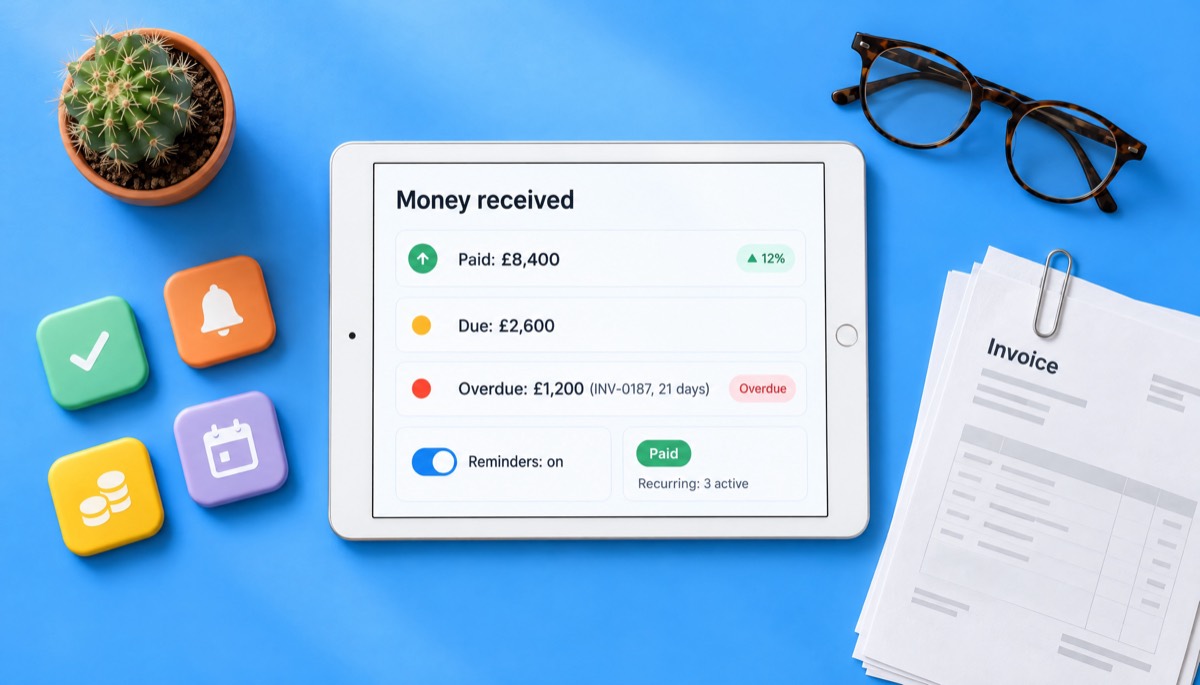
In Invoice Studio you can email invoices with the PDF attached, send reminders, record partial or full payments and see every overdue invoice on your dashboard. Recurring invoices handle retainers. Paid plans start at $3 a month; see pricing for what each includes. There's no live client portal yet (the client portal is in early access) and no online card checkout, so payments still go through your own bank, PayPal, Stripe or Wise details printed on the invoice.
Asking for payment politely isn't about magic words. It's about being so clear and consistent that paying you becomes the easiest thing on the client's list. Write your ladder once and use it every time.
Frequently asked questions
How do I write a polite payment reminder email?
When should I send a payment reminder?
How much can I charge for a late payment fee?
Can I add a late fee if it wasn't in the contract?
What is statutory interest on late payment in the UK?
What do I do if a client won't pay my invoice?
Can I take a client to small claims court for an unpaid invoice?
Monjur builds Invoice Studio and incorporated MotionTrust Digital in September 2022, where he leads Amazon strategy across the client base. Eight years in e-commerce and marketplace marketing taught him how much time invoices and late payments eat, so every guide here is tested against the real product and current tax rules before it goes live.
More guides by Monjur