Contractor Invoice Template: Free Samples for Every Trade
One page, two audiences: independent contractors (W-9, EIN, 1099-NEC) and trade contractors (labour plus materials, progress billing, retainage, change orders), with worked samples for five trades.
- Written by
- Monjur Hossain
- Published
- Last updated
- Reading time
- 20 min read

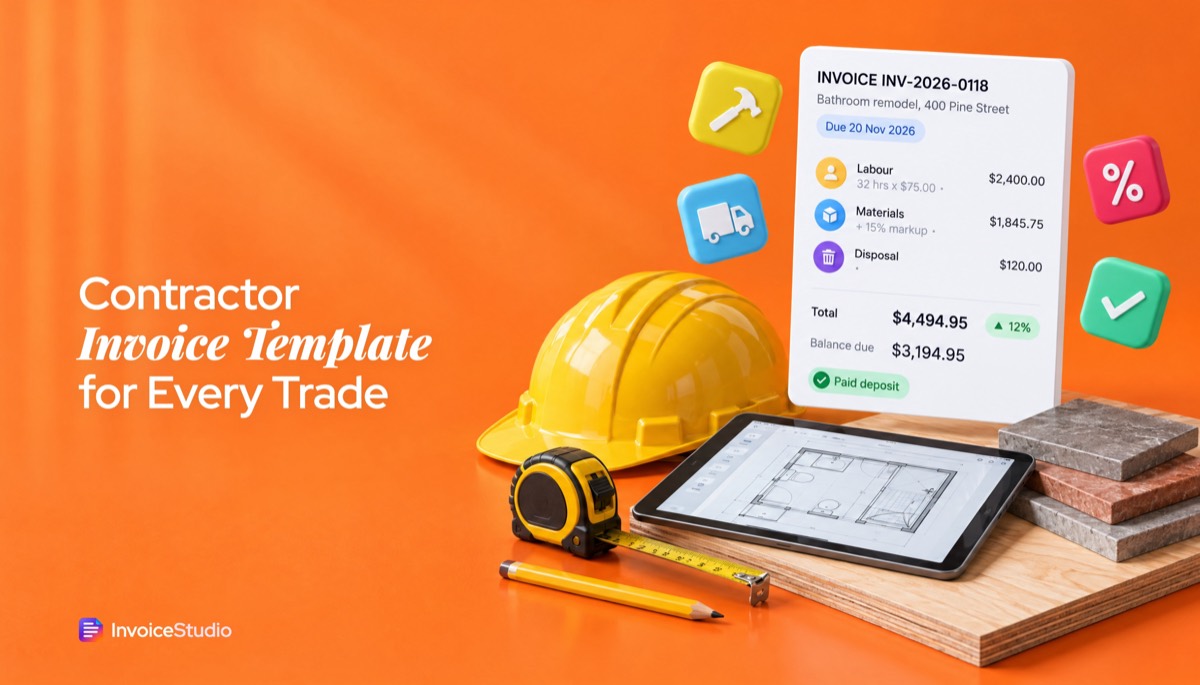
A contractor invoice template is a reusable layout for billing a client after work or a milestone. It should show your business and the client's details, the job address, a unique invoice number, invoice and due dates, labour and materials on separate lines, any deposit or retainage, tax, the total, payment terms and how to pay.
On this page 12 sections
- What is a contractor invoice?
- What should a contractor invoice template include?
- Sample contractor invoice with labour and materials
- Construction invoice template: progress billing and retainage
- How to invoice as an independent contractor (1099 and W-9)
- Independent contractor invoice vs employee timesheet
- Handyman, electrician, cleaning and lawn care invoice examples
- Trucking invoice template: fuel surcharge, detention and DOT number
- How to bill change orders and extra work
- What payment terms do contractors use?
- Which contractor invoice mistakes delay payment?
- FAQs
A contractor invoice template is a ready-made layout that a contractor fills in to bill a client for work done. It holds your business details, the client's details, an invoice number, dates, and line items for labour, materials and any extras, then the tax, total, payment terms and how to pay. The best ones are built for the kind of contractor you are, because a 1099 consultant and a roofing crew bill in very different ways. If you would rather fill in the fields on screen and get the maths done for you, use the contractor invoice generator.
I have sent hundreds of invoices, from hourly bills to agencies to renovation jobs with materials, deposits and change orders on one page. Most templates online use one generic layout: a "description" box, an "amount" box, nothing else. That works until you need to bill 10% retainage, charge a fuel surcharge on a load, or show a client why the bathroom cost $600 more than the estimate.
So this guide is split by contractor type. You will find a sample contractor invoice with labour and materials worked out to the cent, a construction invoice template with progress billing and retainage, a section on how to invoice as an independent contractor (W-9, EIN, 1099-NEC), and real examples for handyman, electrician, plumbing, cleaning, lawn care and trucking work. Every example uses real numbers you can check.
What is a contractor invoice?
A contractor invoice is a bill that a self-employed person or contracting business sends to a client to request payment for completed work, materials or an agreed milestone. It is a formal request for money and a record of the job for both sides' tax and accounting files.
The word "contractor" covers two quite different groups, and this matters for the template you pick:
- Independent contractors. Freelancers, consultants, developers, designers, bookkeepers, nurses on contract, drivers and anyone the IRS would treat as self-employed rather than an employee. They usually bill time or a project fee, and the client often files a 1099-NEC for them at year end.
- Trade and construction contractors. General contractors, subcontractors, electricians, plumbers, roofers, painters, handymen, landscapers and cleaning companies. They bill labour plus materials, often in stages, and often against a written contract or estimate.
Both groups need the same core fields. What changes is the middle of the invoice: the line items, the deductions and the payment terms. An independent contractor rarely deals with retainage. A builder almost always does on commercial jobs. If you are a solo creative or consultant, our freelance invoice template guide goes deeper on hourly and project billing for that world.
What should a contractor invoice template include?
A contractor invoice template should include your business name and contact details, the client's name and job address, a unique invoice number, the invoice date and due date, itemised labour and materials, subtotal, tax, total, payment terms and payment instructions. Trade contractors should also show the job or contract reference, and independent contractors may add their tax ID if the client asks for it.
Here is the full field list I use, with notes on which contractors actually need each one:
| Field | What to put | Who needs it |
|---|---|---|
| Your business details | Legal or trading name, address, phone, email, licence number if your trade is licensed | Everyone |
| Client details | Client name, billing address, and the job site address if different | Everyone |
| Invoice number | A unique, sequential number such as INV-2026-0118 | Everyone |
| Invoice date and due date | The date issued and the actual date payment is due | Everyone |
| Job, contract or PO reference | Contract number, purchase order, project name or estimate number | Trade contractors, and anyone billing a company with a PO system |
| Service period | Dates the work was done, such as 1 to 31 October 2026 | Hourly and recurring work |
| Labour lines | Task, hours or units, rate, line total | Everyone who bills time |
| Materials lines | Item, quantity, unit price, markup if shown | Trade contractors |
| Other charges | Permits, disposal, equipment hire, trip charge, fuel surcharge | Trade and trucking |
| Deductions | Deposit received, retainage held, previous payments | Staged and construction jobs |
| Tax | Sales tax, VAT or GST rate and amount, if you must charge it | Depends on location and what you sell |
| Payment terms | Net 15, net 30, due on receipt, late fee wording | Everyone |
| How to pay | Bank transfer details, card or PayPal link, check payee name | Everyone |
| Signature or approval line | Client sign-off on completed work or change orders | Trade contractors |
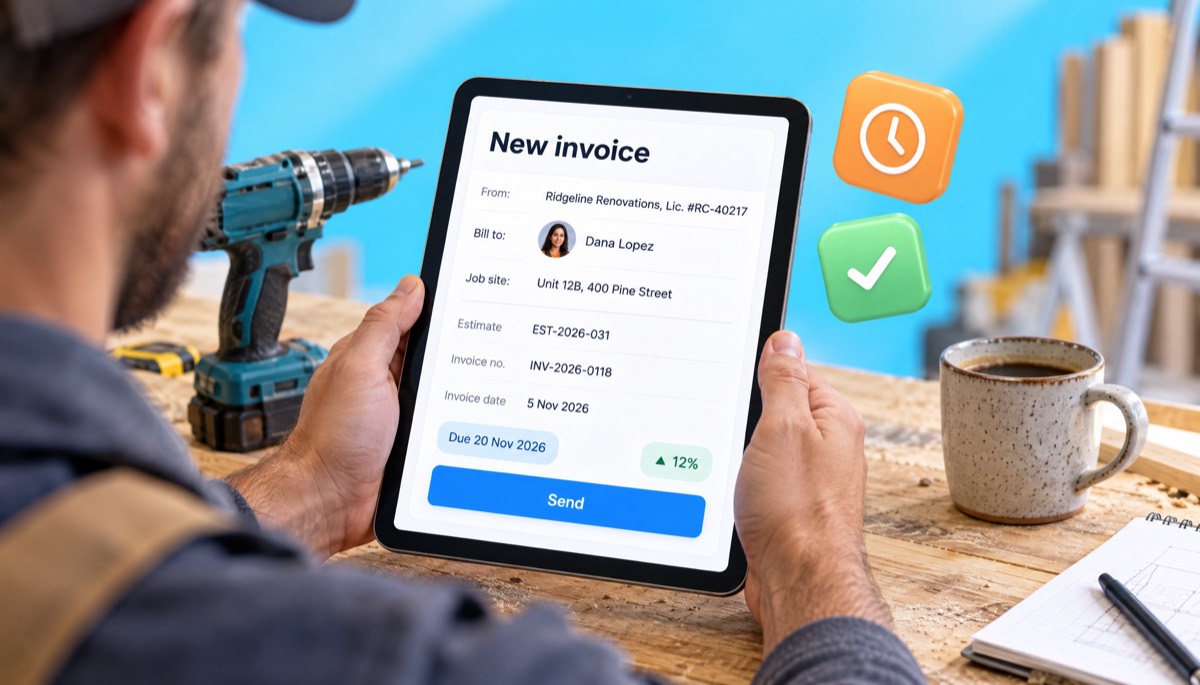
Two fields people skip and regret: the job site address (a property manager with forty units cannot match "Kitchen repair, $1,240" to anything) and the actual due date. "Due 5 December 2026" beats "Net 30". Our post on net 30 payment terms shows how to work out the date for any term.
For the invoice number itself, pick a pattern and never reuse a number, even if you cancel an invoice. I use the year plus a four-digit counter. If you want options, the invoice number format guide covers the common schemes, including ones that add a job code.
Sample contractor invoice with labour and materials
A sample contractor invoice for labour and materials lists the hours worked at your rate, then each material at cost or with a markup, then extra charges, tax and any deposit already paid. Keeping labour and materials on separate lines lets the client see where the money went and, in many US states, is needed to work out sales tax correctly.
Here is a real-style example: a small bathroom remodel by a solo contractor. The client paid a $1,300 deposit when they signed the estimate.
| Description | Qty | Rate | Amount |
|---|---|---|---|
| Labour: demo, tile install, vanity fit, plumbing hook-up | 32 hrs | $75.00 | $2,400.00 |
| Porcelain floor and wall tile | 120 sq ft | $6.50 | $780.00 |
| 36" vanity with top | 1 | $640.00 | $640.00 |
| Plumbing fittings, valves, supply lines | 1 lot | $185.00 | $185.00 |
| Materials handling and markup (15% of $1,605.00) | 1 | $240.75 | $240.75 |
| Debris disposal | 1 | $120.00 | $120.00 |
| Subtotal | $4,365.75 | ||
| Sales tax 7% on materials incl. markup ($1,845.75) | $129.20 | ||
| Total | $4,494.95 | ||
| Less deposit received 2 October 2026 | -$1,300.00 | ||
| Balance due by 20 November 2026 | $3,194.95 | ||
The maths, step by step:
- Labour: 32 hours at $75 is $2,400.00.
- Materials at cost: $780 + $640 + $185 = $1,605.00.
- Markup: 15% of $1,605.00 is $240.75. Materials with markup come to $1,845.75.
- Subtotal: $2,400.00 + $1,845.75 + $120.00 disposal = $4,365.75.
- Tax: in this example the state taxes materials but not labour, so 7% applies to $1,845.75 only. That is $129.2025, which rounds to $129.20.
- Total: $4,365.75 + $129.20 = $4,494.95.
- Balance: take off the $1,300 deposit and $3,194.95 is due.
Should you show the markup as its own line? On a cost-plus job you must. On a fixed-price job, most contractors build it into the material prices. Showing a 15% markup to a homeowner who never agreed to one invites an argument you don't need. And check your state's sales tax rules before copying the tax line, because they vary for repairs, remodels and new construction.
Copy-paste note for the bottom of a labour and materials invoice: "Materials are billed at cost plus 15% as agreed in estimate EST-2026-031. Receipts are available on request. Thank you for your deposit of $1,300.00 received on 2 October 2026."
Construction invoice template: progress billing and retainage
A construction invoice template for progress billing charges the client for the share of the contract completed in each period, then subtracts retainage (usually 5% to 10% held back until the job is finished) and any amounts already billed. Retainage is money the owner or general contractor keeps as security against defects or unfinished work, and releases at the end.
Progress billing means you bill monthly or at milestones based on percent complete, instead of one huge invoice at the end. It works a lot like recurring monthly invoices, except the amount changes each time. Bigger commercial jobs often use the AIA G702 and G703 forms, but plenty of smaller contractors send a normal invoice with the same numbers. The logic is identical.
Worked example: $120,000 contract with 10% retainage
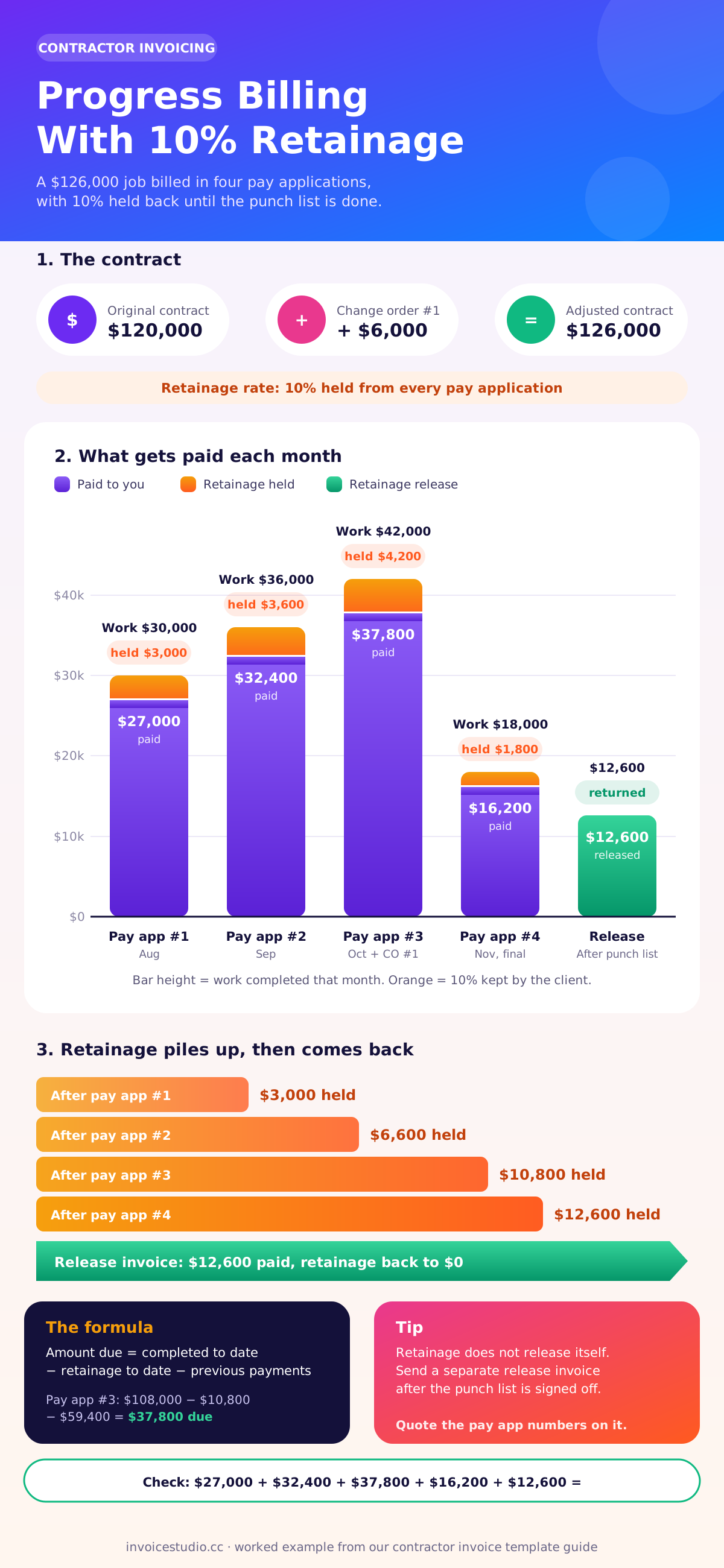
Say you sign a $120,000 contract to fit out a small retail unit. The contract allows monthly progress billing with 10% retainage. Halfway through, the owner approves change order #1 for an extra $6,000 of electrical work, so the adjusted contract sum becomes $126,000.
First, work out how much is earned and how much is held back each month:
| Pay app | Work this period | Completed to date | Retainage held (10%) |
|---|---|---|---|
| #1 (Aug) | $30,000 | $30,000 | $3,000 |
| #2 (Sep) | $36,000 | $66,000 | $6,600 |
| #3 (Oct, incl. CO #1) | $42,000 | $108,000 | $10,800 |
| #4 (Nov, final) | $18,000 | $126,000 | $12,600 |
| Retainage release | $0 | $126,000 | $0 |
Then subtract what the client has already paid to get the amount due on each invoice:
| Pay app | Earned less retainage | Less previous payments | Amount due |
|---|---|---|---|
| #1 (Aug) | $27,000 | $0 | $27,000 |
| #2 (Sep) | $59,400 | $27,000 | $32,400 |
| #3 (Oct) | $97,200 | $59,400 | $37,800 |
| #4 (Nov, final) | $113,400 | $97,200 | $16,200 |
| Retainage release | $126,000 | $113,400 | $12,600 |
The formula on every application is the same: total completed to date, minus retainage held to date, minus everything previously paid, equals amount due. Add up the right-hand column and you get $27,000 + $32,400 + $37,800 + $16,200 + $12,600 = $126,000, which is exactly the adjusted contract sum. If your column does not add up to the contract, something is wrong.
What a progress invoice must show
- The original contract sum and the adjusted sum after approved change orders.
- The period covered, such as 1 to 31 October 2026.
- Work completed this period and to date, ideally by line on a schedule of values (site prep, framing, electrical, finishes and so on).
- Retainage held this period and to date, with the percentage.
- Previous payments received.
- The amount due now and the balance to finish, including retainage.
Most templates leave out "balance to finish". On pay app #3 it is $18,000 of work left plus $10,800 retainage to come, which tells the owner exactly where the job stands.
How retainage works in practice
Retainage (also called retention, or holdback in Canada) is usually 5% or 10% of each progress payment. Many contracts drop it to 5%, or stop withholding, once the job passes 50% complete. Some US states cap it on public jobs and set deadlines for releasing it, so check your contract and state rules.
To get retainage back, send a separate "Retainage release" invoice once you reach substantial completion and finish the punch list, with whatever the contract asks for (often lien waivers and warranties). I have seen contractors wait months simply because nobody sent it. It does not release itself.
Country notes for construction billing
- United States: retainage of 5% to 10% is common. Lien waivers often travel with each payment. Sales tax treatment of construction varies by state.
- United Kingdom: retention of 3% to 5% is usual. Under the Construction Industry Scheme (CIS), a contractor deducts 20% from a registered subcontractor's labour (30% if unregistered, 0% with gross payment status), so subcontractor invoices should show the labour and materials split. Many building services between VAT-registered businesses fall under the VAT domestic reverse charge, and the invoice must say so instead of charging VAT.
- Canada: provinces such as Ontario require a 10% holdback under their construction lien laws. GST or HST applies to most construction services.
- Australia: retention is common on commercial jobs, and state security of payment laws set out how payment claims must be made. Show GST of 10% on a tax invoice if you are registered.
- India: works contracts generally attract GST, and the client may deduct TDS. Show your GSTIN and the correct GST rate for the work.
How to invoice as an independent contractor (1099 and W-9)
To invoice as an independent contractor, send a numbered invoice with your name or business name, the client's details, the service dates, a description of the work, your hours or project fee, the total, the due date and how to pay. Before the first payment, US clients will usually ask you for a Form W-9, and at year end they may send you a Form 1099-NEC showing what they paid you.
Here is a simple independent contractor invoice template in action: a sample invoice for independent contractor work, billing an agency for one month of bookkeeping:
| Description | Qty | Rate | Amount |
|---|---|---|---|
| Bookkeeping and payroll support, 1 to 31 October 2026 | 42 hrs | $85.00 | $3,570.00 |
| Reimbursable: cloud accounting add-on (receipt attached) | 1 | $49.00 | $49.00 |
| Total due by 20 November 2026 (Net 15) | $3,619.00 | ||
No sales tax (bookkeeping is not taxable in most US states, but check yours) and no retainage. Just time, a receipted expense, a date and a total.
Step by step
- Agree the rate and terms first, in an email or contract.
- Send a W-9 when asked. A US client uses the IRS Form W-9 to collect your legal name, business type and taxpayer ID. Send it securely, not as a plain email attachment if you can avoid it.
- Track your time daily. Memory always loses you hours.
- Create the invoice. Use a template or a free invoice generator. Put the service period on it.
- Attach receipts for reimbursables. Bill expenses at cost unless your contract allows a markup.
- Send it to accounts payable, not just the manager you work with.
- Keep a copy and follow up. Log it, and chase it the day after it is due with a one-click invoice reminder or a short email.
EIN vs SSN on a contractor invoice
You do not need an EIN to send an invoice. A sole proprietor can use their Social Security number on the W-9. But I would not print your SSN on an invoice, ever. Invoices get forwarded, printed and left on desks. If a client insists on a tax ID on the invoice itself, get a free Employer Identification Number from the IRS. It takes a few minutes online and keeps your SSN off paperwork. If you form an LLC with employees or a corporation, you will generally need an EIN anyway.
What a 1099 invoice really means
People search for a "1099 invoice template", but there is no special 1099 invoice. The 1099-NEC is a tax form your client files with the IRS reporting what they paid you during the year. Your invoice is just a normal invoice. What makes it "1099 work" is that you are paid gross, with no tax withheld, and you are responsible for your own income tax and self-employment tax. For payments through 2025, the 1099-NEC reporting threshold was $600 per client per year; recent tax law raises it to $2,000 for payments made from 2026. Check the current IRS Form 1099-NEC page before you rely on any number, and remember that all your income is taxable whether or not a 1099 arrives.
Your invoices are your best defence if a 1099 is wrong. If a client reports $14,500 and your invoices for that client add to $13,900, you can show exactly which invoices were paid and when.
Outside the US: UK contractors invoice gross and charge VAT only if registered. In Canada, show your GST/HST number once registered. In Australia, quote your ABN, or the client may have to withhold tax at the top rate. In India and Bangladesh, show your GSTIN or BIN if registered.
Independent contractor invoice vs employee timesheet
An independent contractor invoice is a bill from one business to another that the client pays in full, with no tax withheld. An employee timesheet is an internal record of hours that payroll uses to calculate wages, with tax and benefits deducted. The paperwork difference reflects a legal difference in how the worker is classified.
| Independent contractor invoice | Employee timesheet | |
|---|---|---|
| Who creates it | The contractor | The employee or employer |
| Purpose | Request payment | Record hours for payroll |
| Tax withheld | None; contractor pays own tax | Income tax and payroll taxes withheld |
| US year-end form | 1099-NEC (if over threshold) | W-2 |
| Sets own rate and methods | Yes | No |
| Payment terms | Net 15, net 30 and so on | Regular payday |
| Expenses | Billed to client or deducted as business expense | Reimbursed through expense claims |
Sending invoices does not make you a contractor. The IRS looks at behavioural control, financial control and the relationship between the parties, and an invoice will not change that. The IRS explains the tests on its independent contractor or employee page. The UK has IR35 rules for the same question, and most countries have something similar.
Handyman, electrician, cleaning and lawn care invoice examples
Handyman, electrician, plumbing, cleaning and lawn care invoices are short, frequent and often paid by homeowners, so they need clear line items, a visit date and an easy way to pay. The examples below show the line items each trade actually uses, with totals worked out.
Handyman invoice template
Handyman work is usually billed by the hour with a minimum, plus parts and a trip charge. Here is a typical service call:
| Description | Qty | Rate | Amount |
|---|---|---|---|
| Trip charge (within 15 miles) | 1 | $45.00 | $45.00 |
| Labour: replace faucet, rehang two doors, patch drywall | 3.5 hrs | $90.00 | $315.00 |
| Faucet, hinges, drywall patch kit | 1 lot | $68.40 | $68.40 |
| Total due on receipt | $428.40 | ||
Write each task on the labour line. "General repairs, 3.5 hours" makes the client wonder what took so long; "replace faucet, rehang two doors, patch drywall" makes $315 feel fair. A photo of the finished work cuts disputes almost to zero.
Electrician and plumbing invoice example (with permit fees)
Electricians and plumbers bill like handymen, with two extras: a licence number on the invoice and permit fees passed through at cost. A panel upgrade might read: labour 6 hrs × $110 = $660; 200A panel and breakers $845; city electrical permit $175 (receipt attached); total $1,680. Put the permit on its own line, not inside labour, because many clients and inspectors ask to see it. Plumbers do the same for water heater or gas line permits.
Cleaning invoice template
Cleaning businesses mostly bill a flat rate per visit, often weekly or every two weeks, with add-ons. A monthly invoice for a three-bedroom house might look like this:
| Description | Qty | Rate | Amount |
|---|---|---|---|
| Weekly standard clean, 3 bed 2 bath (6, 13, 20, 27 Oct) | 4 | $140.00 | $560.00 |
| Add-on: inside oven (20 Oct) | 1 | $45.00 | $45.00 |
| Total due by 7 November 2026 | $605.00 | ||
List the visit dates so a cancelled week is obviously not billed, and set regular clients up on a recurring invoice. For commercial contracts, add the site address and PO number, because facility managers often cannot pay without one. Our guide to purchase orders explains why that number matters so much to their accounts team.
Lawn care invoice template
Lawn care and landscaping mix recurring visits with one-off jobs and materials. A typical October invoice:
| Description | Qty | Rate | Amount |
|---|---|---|---|
| Mow, edge and blow (weekly visits) | 4 | $55.00 | $220.00 |
| Hedge trimming, front boundary | 1.5 hrs | $60.00 | $90.00 |
| Hardwood mulch, supplied and spread | 3 cu yd | $48.00 | $144.00 |
| Total | $454.00 | ||
Some US states tax landscaping and lawn services, and some only tax the materials, so check before you add a tax line. In the UK, Canada and Australia you only add VAT, GST or HST if you are registered. Seasonal lawn businesses also do well with a prepaid season invoice: for example, 26 mows at $55 = $1,430, billed as two payments of $715 in April and July.

Which line items each trade needs
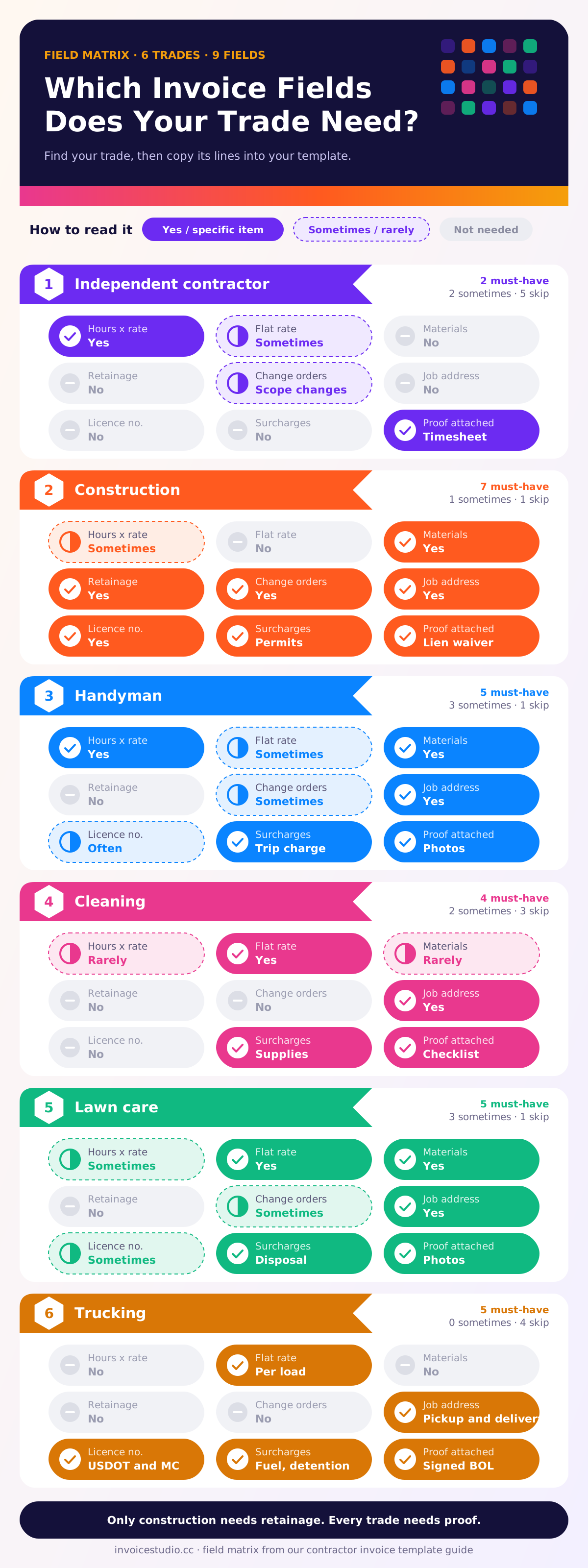
This table shows, one row per trade, which invoice fields matter for each kind of contractor. It is the quickest way to check whether a template fits your work.
| Trade | How it bills | Extras and IDs | Proof to attach |
|---|---|---|---|
| Independent contractor | Hours x rate or a project fee; no materials | Scope changes billed as extras | Timesheet |
| Construction | Progress billing with retainage, materials and change orders | Permits; licence number; job site address | Lien waiver |
| Handyman, electrician, plumber | Hours with a minimum, plus parts | Trip charge, permits; licence number | Photos |
| Cleaning | Flat rate per visit; rarely materials | Supplies; service address | Checklist |
| Lawn care | Flat rate per visit, plus materials and some hours | Disposal; service address | Photos |
| Trucking | Per load | Fuel surcharge, detention; USDOT and MC numbers | Signed BOL |
Trucking invoice template: fuel surcharge, detention and DOT number
A trucking invoice template bills a shipper or broker for a load. It shows the linehaul rate, a fuel surcharge, accessorial charges such as detention or lumper fees, and the carrier's USDOT and MC numbers, with the load number and signed bill of lading (BOL) attached. Brokers and factoring companies will often reject a freight invoice that is missing any of these.
Here is a worked example for a single dry van load from Dallas to Atlanta, 781 miles:
| Description | Qty | Rate | Amount |
|---|---|---|---|
| Linehaul, Dallas TX to Atlanta GA, Load #48213, BOL #77120 | 781 mi | $2.10 | $1,640.10 |
| Fuel surcharge | 781 mi | $0.41 | $320.21 |
| Detention at receiver (2 hrs free; billed hours 3) | 3 hrs | $75.00 | $225.00 |
| Lumper fee (receipt attached) | 1 | $150.00 | $150.00 |
| Total due (Net 30) | $2,335.31 | ||
How the fuel surcharge is worked out
Most fuel surcharges follow a simple formula from the rate confirmation: (current diesel price minus base price) divided by the truck's miles per gallon. Say the agreed base is $1.20 a gallon, the weekly national diesel average you both use is $3.85, and the agreed fuel economy is 6.5 mpg. ($3.85 - $1.20) / 6.5 = $0.4077, which rounds to $0.41 a mile. Multiply by 781 miles and you get $320.21. Always use the method in your rate confirmation, because brokers check it line by line.
What a freight invoice must carry
- Your carrier name, USDOT number and MC number.
- The broker or shipper's load number or PRO number, exactly as on the rate confirmation.
- Pickup and delivery locations and dates.
- A signed BOL or proof of delivery attached. No POD, no payment.
- Accessorials only if the rate confirmation allows them, with times in and out for detention.
- Remit-to details. If you factor your invoices, the factoring company's remit address goes here, not yours.
Detention is where carriers leave the most money behind. "Detention, 3 hours" on its own gets disputed. "Arrived 07:00, unloaded 12:00, 2 hours free, 3 hours billed at $75" gets paid.
How to bill change orders and extra work
To bill a change order, get the client to approve the extra work in writing with its price before you do it, give the change order a number, then add it to your next invoice as its own line referencing that number. Approved change orders also increase the contract sum on progress invoices.
Change orders cause more payment disputes than anything else I know. The client asks for "just a few more lights", you do the work, and the invoice arrives $602 higher than the estimate. The fix is boring and it works: put every change in writing first.
A simple change order needs:
- A change order number (CO #2) and the original contract or estimate number.
- What is changing, in plain words.
- The price, broken into labour and materials.
- Any change to the finish date.
- The client's signature or written approval (an email reply counts for small jobs, but a signature is better).
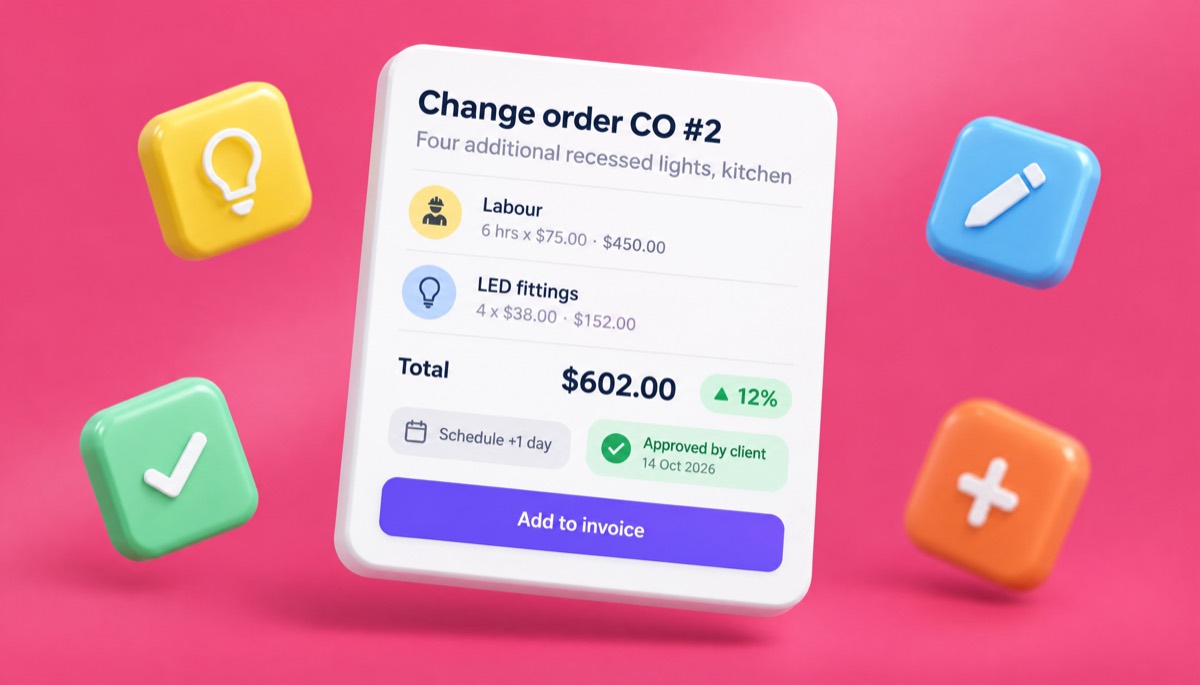
Example: the client asks for four extra recessed lights in the kitchen.
- Labour: 6 hours at $75 = $450.00
- Four LED recessed fittings at $38 = $152.00
- Change order total: $602.00, adds one day to the schedule
Copy-paste wording for the change order email:
Hi Dana, as discussed today, here is change order CO #2 for four additional recessed lights in the kitchen: labour 6 hours at $75 ($450.00) and four LED fittings at $38 ($152.00), total $602.00. This adds one day to the schedule. Please reply "approved" or sign the attached copy and I will start tomorrow morning. This amount will appear as a separate line on the next invoice.
On the invoice, the line reads "Change order CO #2: four additional recessed lights, approved 14 October 2026, $602.00". If the client later says they never agreed, you have the email. If the change reduces the work instead, issue a credit rather than quietly lowering a line. Our guide to credit memos and credit notes explains how.
What payment terms do contractors use?
Contractors most often use due on receipt for small service calls, net 15 or net 30 for business clients, a 30% to 50% deposit for residential projects, and monthly progress payments with 5% to 10% retainage for construction. The right term depends on the job size, who the client is and how much of your money is tied up in materials.
| Term | Typical use | My view |
|---|---|---|
| Due on receipt | Handyman calls, small repairs, one-off cleans | Best for homeowners; take payment before you leave if you can |
| Net 15 | Independent contractors, small business clients | A good default for freelancers |
| Net 30 | Commercial clients, property managers, freight brokers | Standard, but chase on day 31 |
| Deposit up front (30% to 50%) | Residential remodels, custom orders | Covers materials so you are not funding the client's job |
| Milestone payments | Projects with clear stages | Agree the milestones and amounts in the contract |
| Monthly progress billing | Commercial construction | Expect retainage and a pay application deadline |
| Pay when paid | Subcontractors under a general contractor | Read the clause carefully; some states restrict it |
For milestone payments, I tie each payment to something you can see. On a $24,000 kitchen, for example: 30% ($7,200) on signing, 30% ($7,200) when cabinets are installed, 30% ($7,200) when countertops are in, and 10% ($2,400) on final walk-through. Each milestone gets its own invoice, referencing the contract and saying which milestone was reached and on what date.
Late fees work only if they are in the contract the client signed. A common line is "Invoices unpaid after 30 days incur a late fee of 1.5% per month", but check what your state allows. In the UK, the Late Payment of Commercial Debts rules let businesses claim interest at 8% above the Bank of England base rate on overdue B2B invoices.
A polite reminder on the due date is normal business. Our post on how to ask for payment politely has emails you can copy for day 1, day 7 and day 30. And the SBA's guide to paying business taxes is worth a read if you are new to setting money aside from each invoice.
Which contractor invoice mistakes delay payment?
The contractor invoice mistakes that delay payment most are vague line items, missing job or PO references, no actual due date, unapproved extra work, missing proof such as receipts or a signed BOL, and sending the invoice to the wrong person. Each one gives the client's accounts team a reason to put your invoice on hold.
The ones I have made or seen most often:
- "Labour, $2,400" with no detail. Write the tasks and the hours. Clients pay what they understand.
- No job address or PO number. A company with a purchase order system often cannot pay an invoice without the PO. Ask for it before you start.
- Billing change orders nobody approved. Get it in writing first, every time.
- Wrong tax treatment. Charging sales tax on labour that is exempt, or forgetting it on taxable materials, means a corrected invoice and a delay. Check your state or country rules once and write them down.
- Forgetting the retainage release. Diary the date. Send the invoice with the paperwork the contract asks for.
- No proof attached. Receipts for reimbursables, photos for service work, the signed BOL for freight, lien waivers for construction.
- Editing a sent invoice. If you got something wrong, issue a credit note and a new invoice, or a revised invoice with a new number. Never change the numbers on an invoice the client already has.
A decent template set up once fixes most of these. For more hourly and project layouts, see the services invoice template examples.
In our free invoice generator, you can add line items with quantity, unit and price, set a per-line tax (so materials can be taxed and labour not), record a deposit or partial payment, print your payment methods under "How to pay", and add the client's signature. You can also make estimates, and set up recurring invoices for weekly cleaning or monthly lawn contracts. Pick a layout from the 44 invoice templates, add your brand colour and logo, and download a PDF in A4 or Letter.
The template matters less than the habits. Number every invoice, name the job, split labour from materials, get changes approved in writing, put a real date on the due line, and send the invoice the same day you finish. Do that and most of your payment problems go away.
Frequently asked questions
How do I invoice as an independent contractor?
Do I need an EIN to send an invoice?
What is retainage on a construction invoice?
How do I invoice for milestone payments?
Do contractors charge sales tax on labor?
What is a 1099 invoice?
Should I stop work until the invoice is paid?
Monjur builds Invoice Studio and incorporated MotionTrust Digital in September 2022, where he leads Amazon strategy across the client base. Eight years in e-commerce and marketplace marketing taught him how much time invoices and late payments eat, so every guide here is tested against the real product and current tax rules before it goes live.
More guides by Monjur