Invoice Number: Format Examples and How to Number Invoices
Six invoice numbering formats with examples, the country rules on sequential numbers, and straight answers on restarting each year, skipped numbers and voided invoices.
- Written by
- Monjur Hossain
- Published
- Last updated
- Reading time
- 16 min read

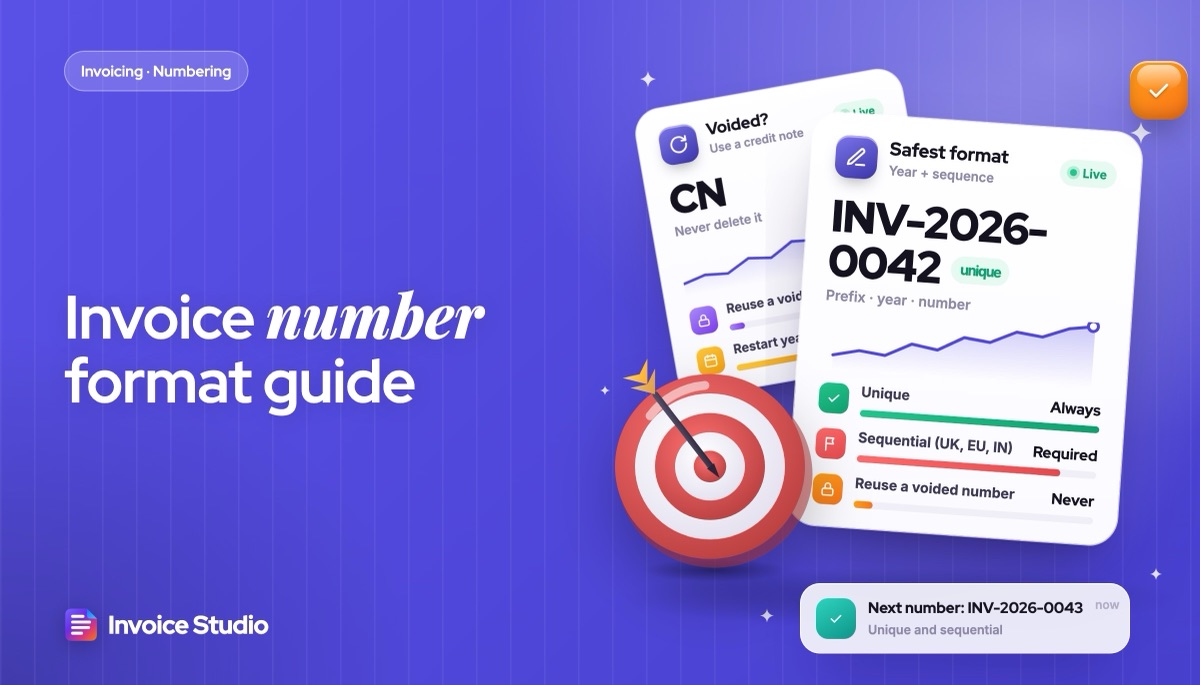
An invoice number is a unique ID that identifies one invoice in your records. Use one format, such as INV-2026-0042, and count up by one for every invoice without reusing or skipping numbers. UK, EU and Indian VAT and GST rules require a unique sequential number; elsewhere it is standard practice.
On this page 13 sections
- What is an invoice number?
- Invoice number format: how to number invoices (6 examples)
- Which number should your first invoice start at?
- Are sequential invoice numbers required by law?
- Restarting invoice numbers each year: is it allowed?
- What happens if I skip or void an invoice number?
- Can you reuse an invoice number for a different client?
- Invoice number vs PO number vs reference number
- Invoice date vs due date vs supply date
- What are the most common invoice numbering mistakes?
- How long should you keep invoice records?
- Should you use an invoice number generator?
- FAQs
An invoice number is the unique ID you give each invoice so that you, your client and the tax office can point at one document and know exactly which one it is. The rule that matters most is simple: every number is used once, and the numbers run in order. The format is up to you. INV-0042, 2026-0042 and ACME-007 can all be correct.
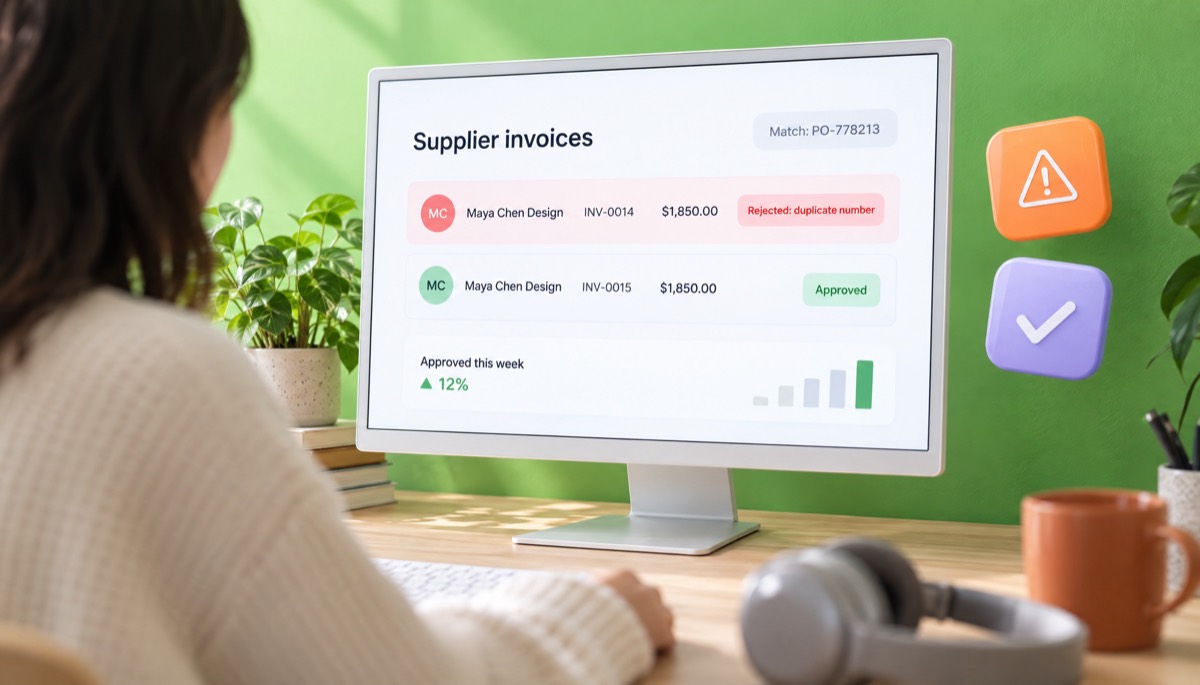
I've numbered invoices badly and well. In my first freelance year I ended up with two invoices both called 14, one from Word and one from a spreadsheet. The client's accounts payable team bounced the second as a duplicate and I waited three extra weeks for $1,850. This guide is everything I wish I'd known then: six numbering formats with examples, the actual rules in the US, UK, EU, India, Canada, Australia and Bangladesh, and straight answers on restarting each year, skipped numbers and voided invoices.
What is an invoice number?
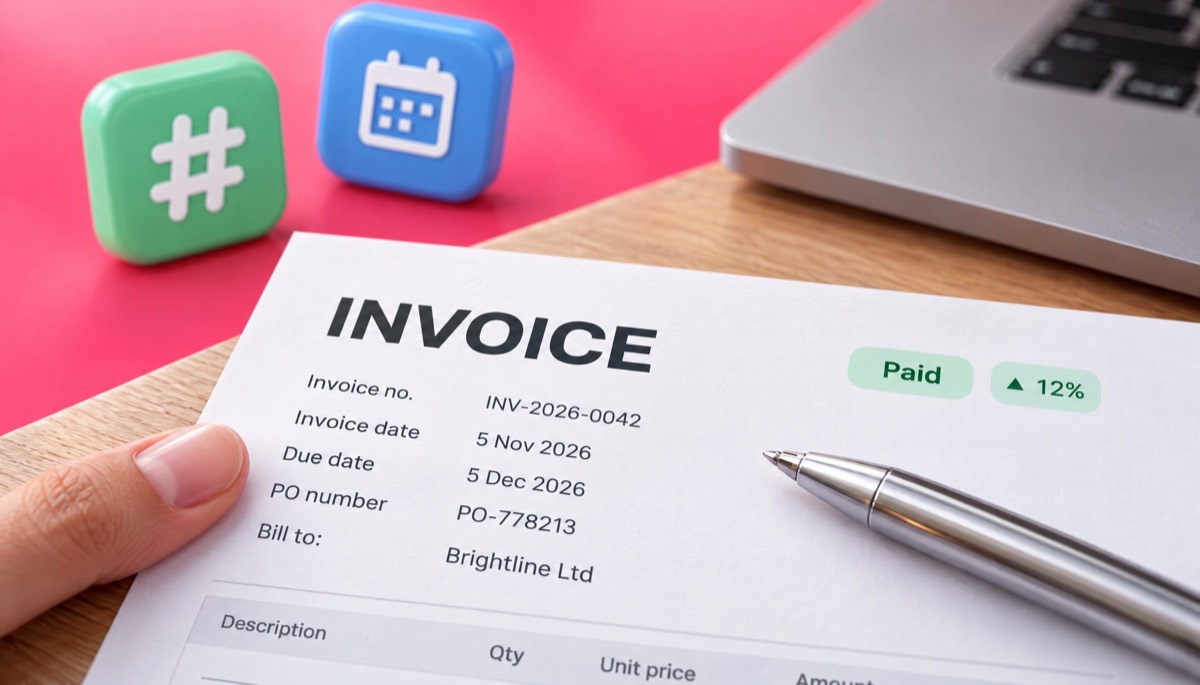
An invoice number is a unique reference, made of digits and sometimes letters, that identifies one invoice in your records and no other. It sits near the top of the invoice, usually next to the invoice date, and it is how both sides talk about a bill: "we paid INV-0042 on Friday".
The invoice number meaning goes beyond a label. It does three jobs:
- Tracking. When a payment lands, the number on the remittance tells you which invoice to mark as paid. If you've ever stared at a deposit wondering what it covers, read our guide to remittance advice.
- Audit trail. A tax inspector can check that numbers 0001 to 0187 all exist and match your declared income. A gap or a duplicate is the first thing they ask about.
- Client processing. Many accounts payable systems reject an invoice whose number they've already seen from you. A duplicate number isn't a typo to them. It's a possible double charge.
You'll also see it called an invoice ID, bill number or, in India, a serial number. Your client's system calls it the "vendor invoice number". Same thing. If you're still getting the basics in place, our guide on what an invoice is covers every other field.
Where is the invoice number on an invoice?
Look at the top right, near the invoice date. It is usually labelled "Invoice No.", "Invoice #" or "Invoice number", and it is the reference your client should quote when they pay. Can't find it? Check the email subject or the PDF file name.
Invoice number format: how to number invoices (6 examples)
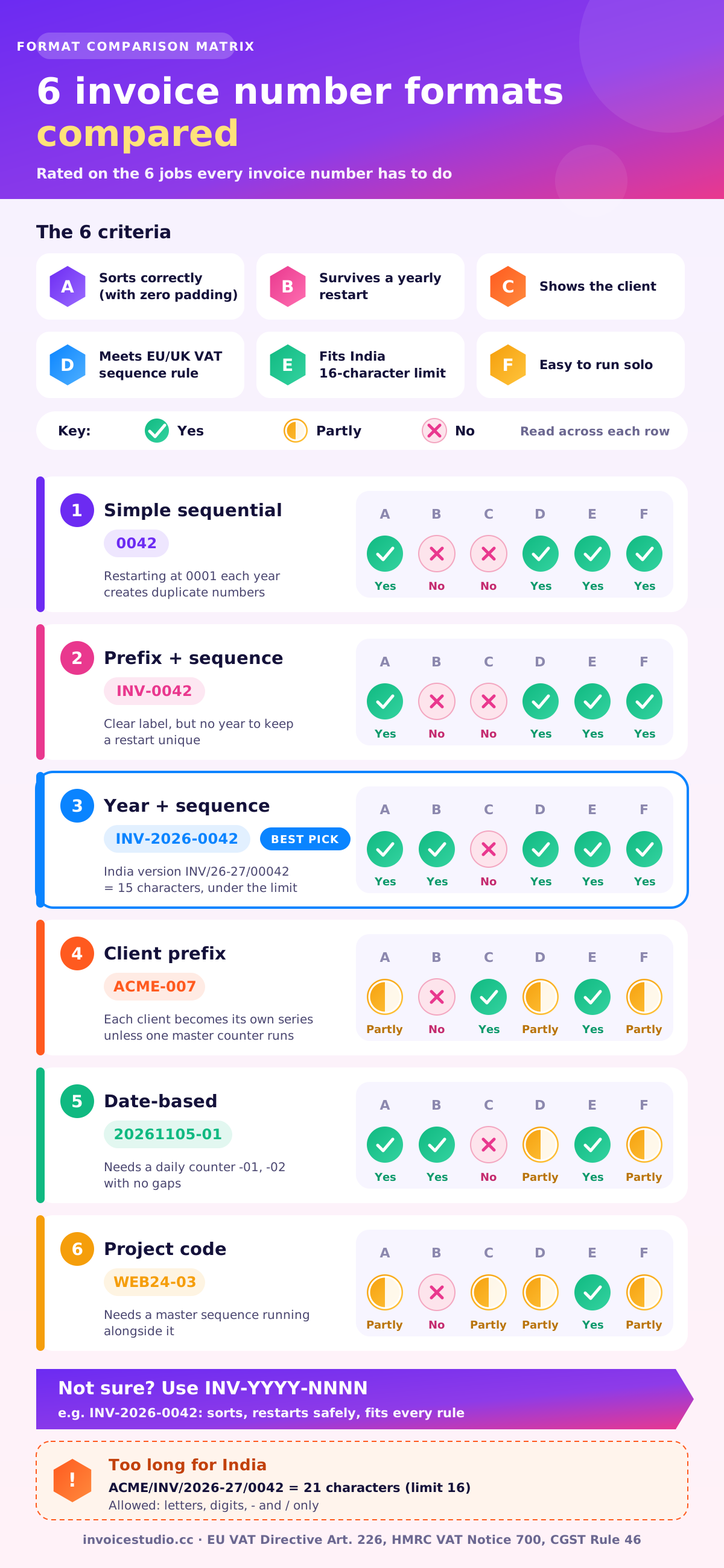
To number invoices, pick one format, start at a number you choose, and add 1 for every new invoice without reusing or skipping. The six invoice number formats below cover almost every small business, and any decent small business invoicing software will apply one for you. They differ in how much information the number carries, not in whether they're legal.
| Format | Example | Best for | Watch out for |
|---|---|---|---|
| 1. Simple sequential | 0042 | Solo freelancers, low volume | Says nothing about year or client |
| 2. Prefix + sequence | INV-0042 | Almost everyone | Pad with zeros so it sorts properly |
| 3. Year + sequence | INV-2026-0042 | Anyone who wants a yearly restart | Year must stay in the number if you restart |
| 4. Client prefix | ACME-007 | A few big repeat clients | Needs a master counter too, or numbers collide in your books |
| 5. Date-based | 20261105-01 | Shops, trades, several invoices a day | Long, and gaps between days look odd |
| 6. Project code | WEB24-03 | Agencies billing in milestones | Projects that never end make messy codes |
1. Simple sequential numbers
0001, 0002, 0003. This is the plainest format and it satisfies every tax rule I know of. I'd use four digits from day one, because "0042" and "0142" sort correctly anywhere, while in a text column of a spreadsheet or an export file "42" lands between "419" and "43".
2. Prefix plus sequence
INV-0042 is what most invoicing software defaults to, and for good reason. The prefix tells anyone reading your bank statement or inbox that this is an invoice, not a quote (QUO-0042) or a credit note (CN-0042). You can use your initials too: MC-0042 for Maya Chen.
3. Year plus sequence
INV-2026-0042 means the 42nd invoice of 2026. This is my favourite for freelancers because you can see at a glance how many invoices you've sent this year, and you can restart the counter in January without ever creating a duplicate. INV-2026-0001 and INV-2027-0001 are different numbers. If your tax year doesn't match the calendar year, use it instead: INV/2026-27/0042 for an Indian financial year that runs April to March.
4. Client prefix
ACME-007 tells you this is the seventh invoice for Acme. It's handy when you have four or five big clients and want to see the history with each. The catch: if Acme and Brightline each have an invoice 007, your own records now hold two "007"s. The fix is to combine a client code with one master sequence, like ACME-0042, BRT-0043, ACME-0044. The client code is a label; the number underneath still counts up across your whole business.
5. Date-based numbers
20261105-01 is the first invoice on 5 November 2026. Shops and trades sending several invoices a day like it. Under EU and UK VAT rules the numbers must still form a sequence, so keep a daily counter (-01, -02) and never leave one out. A date alone isn't unique.
6. Project or job code
WEB24-03 is the third milestone invoice on project WEB24. Agencies and builders use it to tie bills to jobs. Like client prefixes, it works best with a master sequence alongside.
My advice: if you're unsure, use INV-YYYY-NNNN. It's short, sorts properly, survives a yearly restart, and nobody in any country will question it.
How to set up your invoice numbering in five steps
- Pick a format from the table above and write it down, including the separator (hyphen or slash) and how many digits.
- Choose your starting number. 0001 is fine. More on this below.
- Decide on separate series for other documents: QUO- for quotes, CN- for credit notes, PO- for purchase orders.
- Keep one place that issues numbers. One app, one spreadsheet, one person. Two sources is how duplicates happen.
- Never edit a number after sending. If the invoice is wrong, cancel it with a credit note and issue a new one.
An invoice number generator does all of this for you. In a free invoice generator like Invoice Studio, you set the prefix once and every new invoice gets the next number automatically, so you never have to remember where you got to. If you want the full walk-through of the other fields, see how to make an invoice.
Which number should your first invoice start at?
Your first invoice number can be anything you like, as long as every number after it follows on in sequence. INV-0001 is perfectly legal. No tax authority in the US, UK, EU, India, Canada or Australia requires you to start at 1, and none of them forbids it.
The real question people are asking on freelance forums is whether starting at 0001 makes you look new. Honestly, a little. A client who gets INV-0001 knows they're your first. Some people don't care. Some do. If it bothers you, start higher:
- Start at 0100 or 1001. Common, harmless, and it doesn't pretend to be anything it isn't.
- Use a year-based number. INV-2026-0001 reads as "first invoice this year", which is true every January for even the biggest firms.
- Carry on from your old system. If you sent 37 invoices from Word last year and you're moving to software, start the new system at 0038 so the run continues.
What I wouldn't do is jump around to look busy. Starting at 1001 is fine. Sending 1050 next, to fake 48 invoices in between, creates a gap you'd have to explain under EU or UK VAT rules. Pick a starting point and count honestly.
If you have more than one business or trading name, give each its own series. Your design studio and your photography side business shouldn't share a counter.
Are sequential invoice numbers required by law?
In the UK, the EU and India, yes: VAT and GST law requires invoice numbers to be unique and to follow a sequence. In the US, Canada and Australia there's no federal rule on sequential invoice numbering, but tax authorities still expect records that make sense, and an unbroken sequence is the easiest way to show that.
Here's what each country actually says, as of 2026:
| Country | Rule on invoice numbers | Source |
|---|---|---|
| European Union | VAT invoices need "a sequential number, based on one or more series, which uniquely identifies the invoice" (VAT Directive, Article 226) | European Commission |
| United Kingdom | A unique number that follows on from the previous invoice. Keep any spoiled or cancelled numbered invoices to show HMRC | HMRC VAT Notice 700 |
| India | Rule 46 of the CGST Rules: a consecutive serial number, up to 16 characters, letters, digits, hyphen and slash only, unique for the financial year; one or more series allowed | CBIC, CGST Rules 2017 |
| United States | No federal numbering rule. The IRS requires records that support your income and expenses | IRS recordkeeping |
| Canada | GST/HST input tax credit rules list the supplier name, date, amount and more, but not a number. Numbering is standard practice | CRA |
| Australia | Tax invoice requirements don't strictly include a number, but the ATO and every bookkeeper expect one | ATO |
| Bangladesh | VAT-registered sellers issue Mushak 6.3 tax invoices, which carry a serial number | NBR |
Even in the UK, invoices that aren't VAT invoices need "a unique identification number", according to gov.uk's invoice guidance. So uniqueness is close to universal. Sequence is required where VAT or GST applies.
What "sequential" means, and what it doesn't
Sequential means each number follows the last in a predictable order. It does not mean one single list. The EU and India both say "one or more series", so you can run INV-0042 for UK clients and EXP-0042 for export clients, as long as each series counts up on its own with no duplicates. That's also why credit notes can have their own series, CN-0001 onwards, separate from invoices. We go deeper on that in credit memo vs credit note.
The India 16-character limit, worked through
If you're GST-registered in India, count the characters before you settle on a format. INV/2026-27/0042 is exactly 16 characters: INV (3), slash (1), 2026-27 (7), slash (1), 0042 (4). That's right at the limit. Add a client code and you're over. A safer pattern is INV/26-27/00042, which is 15. Spaces, underscores and full stops aren't allowed; only letters, digits, the hyphen and the slash. Our GST invoice format guide covers the other mandatory fields.
Restarting invoice numbers each year: is it allowed?
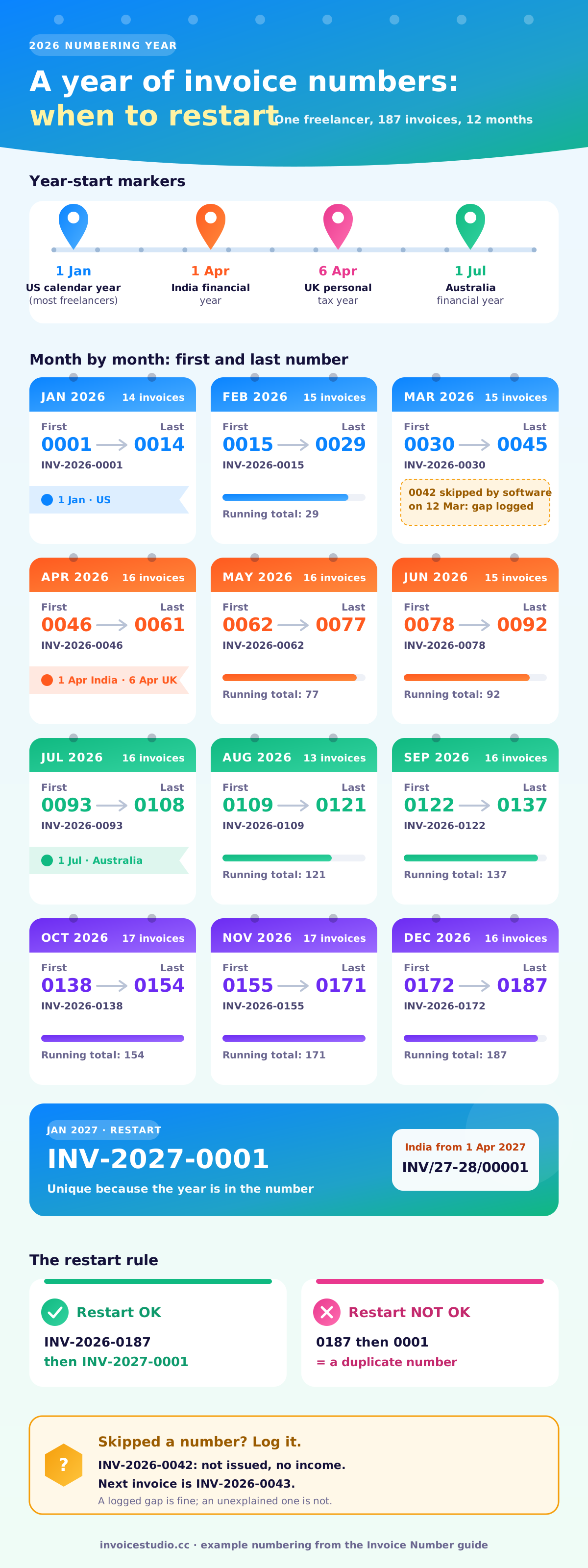
Yes, you can restart invoice numbers each year in most countries, provided every number stays unique. The safe way is to put the year in the number, so INV-2026-0187 is followed by INV-2027-0001. Restarting plain numbers (0187, then 0001 again) creates duplicates and you shouldn't do it.
Other guides contradict each other on this one, so here's the detail:
- India: restarting each financial year is normal, because Rule 46 only demands uniqueness within the financial year. Most businesses restart on 1 April with a new year code, for example INV/27-28/00001.
- EU: allowed in many member states as long as the year or another series marker makes each number unique. Some countries are stricter than others, so check with your local tax office or accountant before you switch.
- UK: HMRC wants each number to follow on from the last. A year prefix that starts a new series is widely used and accepted. Plain restarts with no year are a bad idea.
- US, Canada, Australia: no rule against it. Use the year so your own records stay clean.
Which year should you use? The one your books run on. The calendar year (1 January) suits most US freelancers. India's financial year starts 1 April. The UK personal tax year starts 6 April, though many UK sole traders still invoice by calendar year. Australia's financial year starts 1 July. Whatever you pick, restart on that date and stick with it.
You don't have to restart at all. A single counter that never resets is the simplest audit trail there is. Either choice is fine. Switching back and forth isn't.
What happens if I skip or void an invoice number?
If you skip an invoice number by mistake, nothing dramatic happens: write down why the number is missing and keep going. If you void an invoice, keep it in your records marked as cancelled, and never reuse its number. Deleting it leaves an unexplained gap, which is the part auditors don't like.
Skipped invoice numbers
Say you send INV-2026-0041, then your software crashes and the next one comes out as 0043. Number 0042 was never issued. In the US this barely matters. Under EU and UK VAT rules, a gap is something an inspector might ask about, and the honest answer is enough if you've written it down. Keep a short log. A line in a spreadsheet works:
INV-2026-0042: not issued. Number skipped by software on 12 Mar 2026. No invoice sent, no income. Next invoice is 0043.
Don't go back and fill 0042 with a later invoice. That puts a March number on an April invoice, which is worse than the gap.
Voided or cancelled invoices
Voiding is different. The invoice existed, maybe the client even saw it, and now it shouldn't count. What to do depends on whether it was sent:
| Situation | What to do | Number used |
|---|---|---|
| Drafted, never sent | Mark it "void" and keep it, or delete the draft before a number is locked | Not reused |
| Sent with a mistake, not yet paid | Issue a credit note for the full amount, then a new corrected invoice | Old number kept; new invoice gets the next number |
| Sent and paid, then refunded | Issue a credit note and record the refund | Original stands; credit note in its own CN- series |
| Sent to the wrong client | Credit note to cancel it, new invoice to the right client | Two numbers used, both kept |
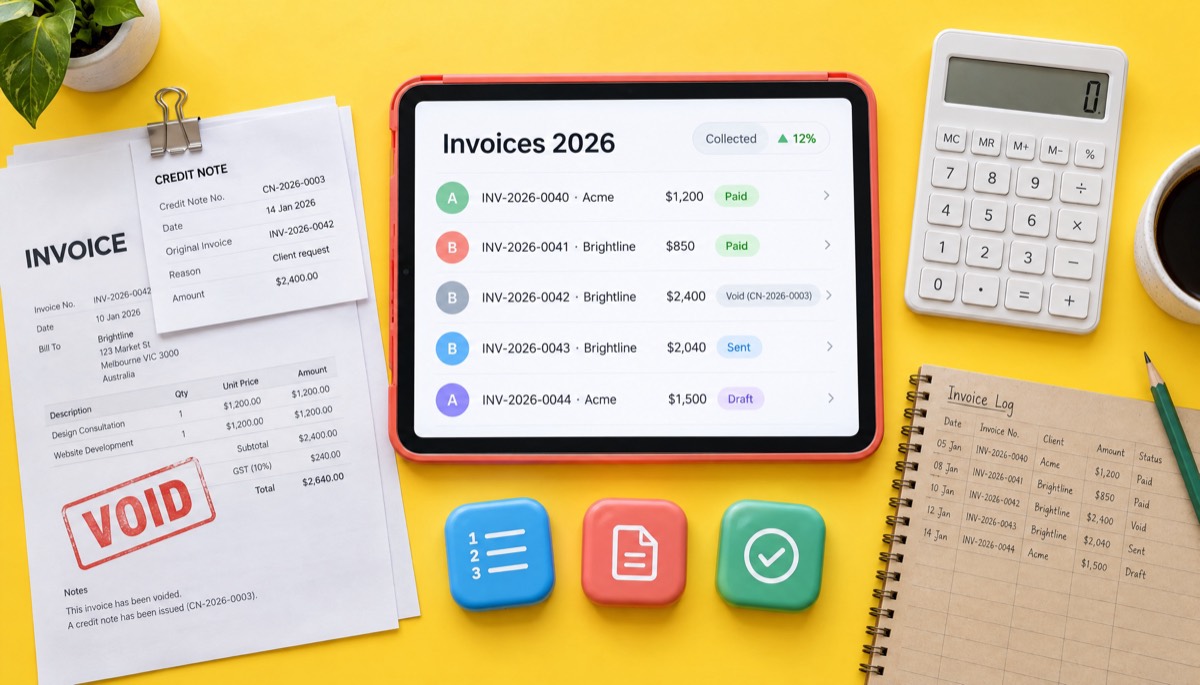
A worked example: you send INV-2026-0042 for $2,400 to Brightline, but it should have been $2,040. Don't edit 0042. Issue CN-2026-0003 for $2,400 referencing INV-2026-0042, then send INV-2026-0043 for $2,040. Your books show the full story and the client's accounts payable team doesn't see one number with two amounts.
You can copy this wording into the note on the replacement invoice:
This invoice replaces INV-2026-0042, which was cancelled in full by credit note CN-2026-0003 dated 5 Nov 2026. Please pay this invoice only.
And for the voided invoice itself, if your software allows a note:
VOID: issued in error on 4 Nov 2026. Cancelled by CN-2026-0003. Replaced by INV-2026-0043.
HMRC says this directly in its VAT guidance: keep spoiled or cancelled numbered invoices so you can show them to a VAT officer. The VAT record keeping notice covers how long and in what form.
Can you reuse an invoice number for a different client?
No. Two of your clients should never receive invoices with the same number, because invoice numbers must be unique across your whole business, not per client. If client A gets INV-0042, client B can't also get INV-0042, even if the amounts and dates are different.
This trips up people who use client prefixes with separate counters: ACME-001, ACME-002, BRT-001, BRT-002. Technically the full strings are different, so each is unique. But under EU and UK VAT rules each client then becomes its own series, and you'd have to show each series is complete. With 30 clients that's 30 series to defend. It's much simpler to use a client code as a label in front of one master counter:
- ACME-0042 (Acme, 5 Nov)
- BRT-0043 (Brightline, 6 Nov)
- ACME-0044 (Acme, 12 Nov)
The flip side: your client's printer may also send them an INV-0042. That's no conflict, because accounts payable systems match on supplier plus number.
Invoice number vs PO number vs reference number
An invoice number is created by the seller to identify the bill. A PO number is created by the buyer to identify their order, and they'll often refuse to pay an invoice that doesn't quote it. A reference number is anything else that helps match payment: a project code, a contract ID or a payment reference.
| Invoice number | PO number | Reference number | |
|---|---|---|---|
| Who creates it | You, the seller | The client, the buyer | Either side, or the bank |
| When | When you bill | Before the work, when they order | Any time |
| Example | INV-2026-0042 | PO-778213 | Project WEB24, payment ref PAY-88213 |
| Required? | Yes, on every invoice | Only if the client uses POs | Optional |
| Where it goes | Top of the invoice, labelled clearly | Near the invoice number, labelled "PO number" | Notes or a reference field |
Is a PO number the same as an invoice number? No, and mixing them up is a classic cause of late payment. Big clients' systems do a "three-way match": the purchase order, the delivery or timesheet, and your invoice. If your invoice says "PO: INV-0042", the match fails and the invoice sits in a queue. Put both, clearly labelled:
Invoice number: INV-2026-0042
PO number: PO-778213
Please quote INV-2026-0042 as the payment reference.
Our guide to what a purchase order is explains the PO side in full.
Invoice date vs due date vs supply date
The invoice date is the day you issue the invoice. The due date is when payment is owed, usually the invoice date plus your terms. The supply date (also called the tax point or time of supply) is when the goods or services were actually delivered, and VAT rules sometimes need it shown separately.
| Date | What it means | Example for INV-2026-0042 |
|---|---|---|
| Invoice date | Day the invoice is issued | 5 Nov 2026 |
| Supply date | Day the work was completed or goods delivered | 31 Oct 2026 |
| Due date | Invoice date plus payment terms | 5 Dec 2026 (net 30) |
A quick worked example. You finish a $2,400 website project on 31 October and invoice on 5 November with net 30 terms. Counting 30 calendar days from 5 November gives a due date of 5 December 2026. If you're VAT-registered in the UK and the supply date differs from the invoice date, show both, because the tax point affects which VAT return the sale falls into. For more on terms, read net 30 payment terms explained.
Always write the due date as an actual date, "Due 5 Dec 2026", not just "Net 30". Clients pay on dates, not on arithmetic.
What are the most common invoice numbering mistakes?
Most invoice number problems come from the same handful of habits. These are the ones I see most often, including a few I've made myself:
- Two places issuing numbers. A Word template on the laptop and an app on the phone, each counting on its own. This is the number one cause of duplicates.
- Reusing a voided number. It feels tidy. It's the opposite, because now one number has two histories.
- Editing a sent invoice. Now two versions of 0042 exist. Use a credit note.
- No zero padding. In a text sort, such as a CSV export or a client's AP report, "10" comes before "9". Use 0009 and 0010.
- Using the same series for quotes and invoices. If quote 0042 turns into invoice 0043, your invoice run now has a gap at 0042. Give quotes their own QUO- series.
- Restarting without a year marker. Invoice 0001 in 2026 and invoice 0001 in 2027 are duplicates in any search.
- Too long for the rules. GST-registered in India with ACME/INV/2026-27/0042? That's 21 characters, five over the limit.
How long should you keep invoice records?
Keep every invoice, including voided ones, for as long as your tax authority can audit you. In the US, the IRS generally says three years from filing, longer in some cases; see how long should I keep records. UK VAT-registered businesses keep records for six years. India requires GST records for 72 months from the due date of the annual return. Canada generally expects six years and Australia five. Rules vary and change, so check with your local tax authority or accountant.
An unbroken invoice number sequence makes this storage easy to check. If you have 0001 to 0187 for 2026 and a note explaining the one gap, you can prove nothing is missing.
Should you use an invoice number generator?
An invoice number generator is the part of invoicing software that assigns the next number automatically, so you never type one by hand. It's the single best way to avoid duplicates and gaps, because there's only one counter and it can't forget.
In Invoice Studio you set your number prefix (for example INV-2026-) and the next number once in settings, and each new invoice takes the next number, padded to four digits. The same sequence applies to recurring invoices, so a monthly retainer never jumps the queue. Quotes, credit notes and purchase orders get their own prefixes, so they never eat into your invoice run. Pick one of 44 templates, add your logo, then download the PDF or email it, and export to CSV for your accountant.
If you'd rather start from a layout and fill it in, browse our invoice templates or see invoice format and samples for full examples. Whichever you use, the rule doesn't change: one counter, one number per invoice, never reused, and a short note for any gap. Do that and nobody, from a client's accounts payable clerk to a VAT inspector, will ever have a reason to question your invoice numbers.
Frequently asked questions
How do I number my invoices?
What should my first invoice number be?
Can I restart invoice numbers each year?
What happens if I skip an invoice number?
Do invoice numbers have to be sequential?
Is there a free invoice number generator?
Can two clients have the same invoice number?
Monjur builds Invoice Studio and incorporated MotionTrust Digital in September 2022, where he leads Amazon strategy across the client base. Eight years in e-commerce and marketplace marketing taught him how much time invoices and late payments eat, so every guide here is tested against the real product and current tax rules before it goes live.
More guides by Monjur