VAT Invoice Requirements: UK Rules, Examples and Template
HMRC's Notice 700/21 turned into one checklist, with a worked 20% VAT invoice, the £250 simplified invoice, the 30-day and 14-day rules, sole trader vs limited company lines and copy-paste reverse charge wording.
- Written by
- Monjur Hossain
- Published
- Last updated
- Reading time
- 16 min read

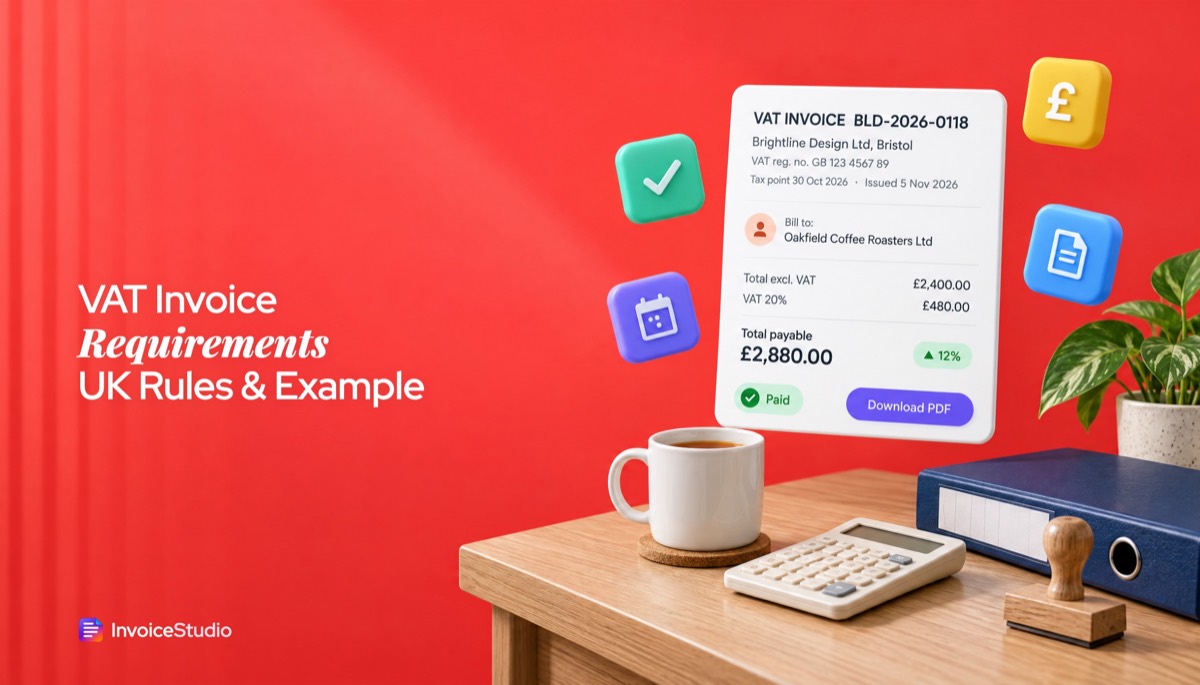
A UK VAT invoice must show a unique sequential number, the time of supply, the issue date, your name, address and VAT number, the customer's name and address, a description, quantity, unit price, the VAT rate and net amount per line, the total excluding VAT, any cash discount rate and the total VAT in sterling.
On this page 11 sections
- What is a VAT invoice?
- HMRC VAT invoice requirements: what must a UK VAT invoice include?
- VAT invoice example with 20% VAT worked out
- What is a simplified VAT invoice and the £250 limit?
- VAT invoice time limit: how soon do you have to send it?
- What does a sole trader or limited company need on an invoice?
- Invoice template UK for self-employed people not registered for VAT
- How to word a reverse charge invoice for EU and UK clients
- Is e-invoicing mandatory in the UK and EU?
- What are the most common VAT invoice mistakes?
- FAQs
A VAT invoice is the document a VAT-registered UK business must give another VAT-registered business when it sells standard-rated or reduced-rated goods or services. It shows your VAT number, a unique sequential invoice number, the time of supply, the customer's name and address, what you sold, the VAT rate on each line and the total VAT in sterling. HMRC sets these rules in VAT Notice 700/21, and you normally have 30 days from the supply to issue it.
My first batch of VAT invoices came back from a client's accounts team with a polite note: "Can you reissue with the tax point and unit prices, please?" They couldn't reclaim the VAT without them. Several hundred VAT invoices later, I can tell you the rules aren't hard. They're just spread across half a dozen gov.uk pages. This guide puts them in one place: the HMRC checklist, a worked 20% VAT invoice, the £250 simplified invoice, the 30-day and 14-day rules, sole trader and limited company lines, a template for the self-employed who aren't registered, reverse charge wording and a note on e-invoicing.
What is a VAT invoice?
A VAT invoice is a tax invoice issued by a VAT-registered business that lets the buyer reclaim the VAT they paid as input tax. Without a valid VAT invoice, your customer usually can't claim that VAT back from HMRC, which is why accounts teams are so fussy about it.
Three points trip people up at the start:
- Only VAT-registered businesses can issue VAT invoices. If you aren't registered, you can't charge VAT or show it on an invoice. You issue an ordinary invoice instead.
- You must issue one when you sell to another VAT-registered business. HMRC's VAT Notice 700/21 says you must issue a VAT invoice whenever you supply standard rate or reduced rate goods or services to another VAT-registered person.
- Zero-rated and exempt sales are different. An invoice that covers only exempt or zero-rated UK sales doesn't have to be a VAT invoice, and an invoice for a zero-rated supply is not treated as one.
You register once your taxable turnover for the last 12 months goes over £90,000, the current threshold on gov.uk's VAT registration page. You can also register voluntarily below it, which suits freelancers who sell mostly to VAT-registered companies, since those clients reclaim the VAT anyway.
A "tax invoice" is the general name for this document worldwide. In the UK you'll see both "VAT invoice" and "Tax invoice" as headings; HMRC cares about the content, not the heading. If you want the general version first, read what an invoice is and how it differs from a receipt.
HMRC VAT invoice requirements: what must a UK VAT invoice include?
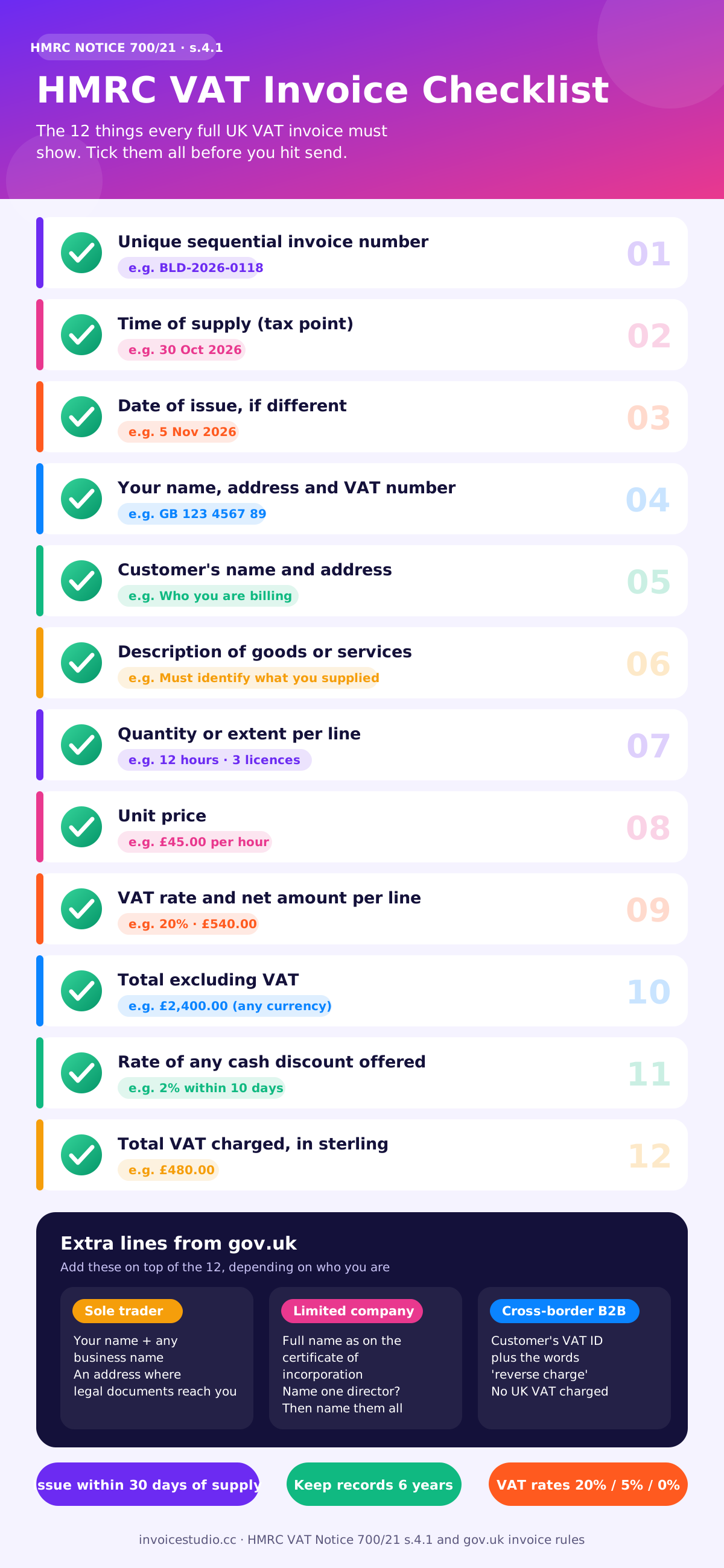
A full UK VAT invoice must show 12 details listed in section 4.1 of HMRC Notice 700/21, from a unique sequential number to the total VAT in sterling. Miss one and the invoice can be rejected by your client or challenged by HMRC on a check.
Here is the HMRC list in plain English, in the order I'd lay it out on the page:
- A unique sequential invoice number. It can follow one or more series, such as BLD-2026-0118, as long as each number identifies only one document. Gaps and repeats are what draw questions.
- The time of supply, also called the tax point. For services, this is normally the date the work was finished.
- The date of issue, if different from the time of supply.
- Your name, address and VAT registration number. UK VAT numbers are 9 digits, usually printed as GB 123 4567 89.
- Your customer's name and address.
- A description of the goods or services clear enough to identify them. "Design work" is weak. "Brand identity: logo, colour palette and type system" is fine.
- The quantity of goods or extent of services for each line, such as 12 hours or 3 licences.
- The unit price.
- The rate of VAT and the amount payable excluding VAT for each line. This can be in any currency, so you can invoice in euros or dollars.
- The total amount payable excluding VAT. Also in any currency.
- The rate of any cash discount offered, such as 2% if paid within 10 days.
- The total VAT chargeable, in sterling. Always pounds, even when the rest of the invoice is in euros or dollars.
The gov.uk page on what every invoice must include adds a few things on top for all businesses: your contact details, the total amount owed, and the extra lines for sole traders and limited companies covered further down. In practice I add the payment terms and bank details too. HMRC doesn't require them, but your client's payables team does.
The UK VAT rates you'll print are 20% (standard), 5% (reduced, for things like home energy) and 0% (zero rate, for most food and children's clothes). Check the current list on gov.uk VAT rates before you put a rate on anything unusual. If one invoice mixes rates, show the rate on every line and break the VAT down by rate.
VAT number on invoice: GB and XI formats
Print your VAT number on invoice headers in full: GB plus 9 digits. Businesses in Northern Ireland that sell goods to or buy goods from the EU use an XI prefix instead (XI 123 4567 89) on those invoices, because Northern Ireland still follows EU VAT rules for goods. Check a client's number with HMRC's UK VAT number checker.
Rounding the VAT
Section 17.5 of the VAT guide (Notice 700) lets invoice traders round the total VAT down to a whole penny. If you work VAT out line by line, you can round each line to the nearest 1p, which is what most invoice software does.
VAT invoice example with 20% VAT worked out
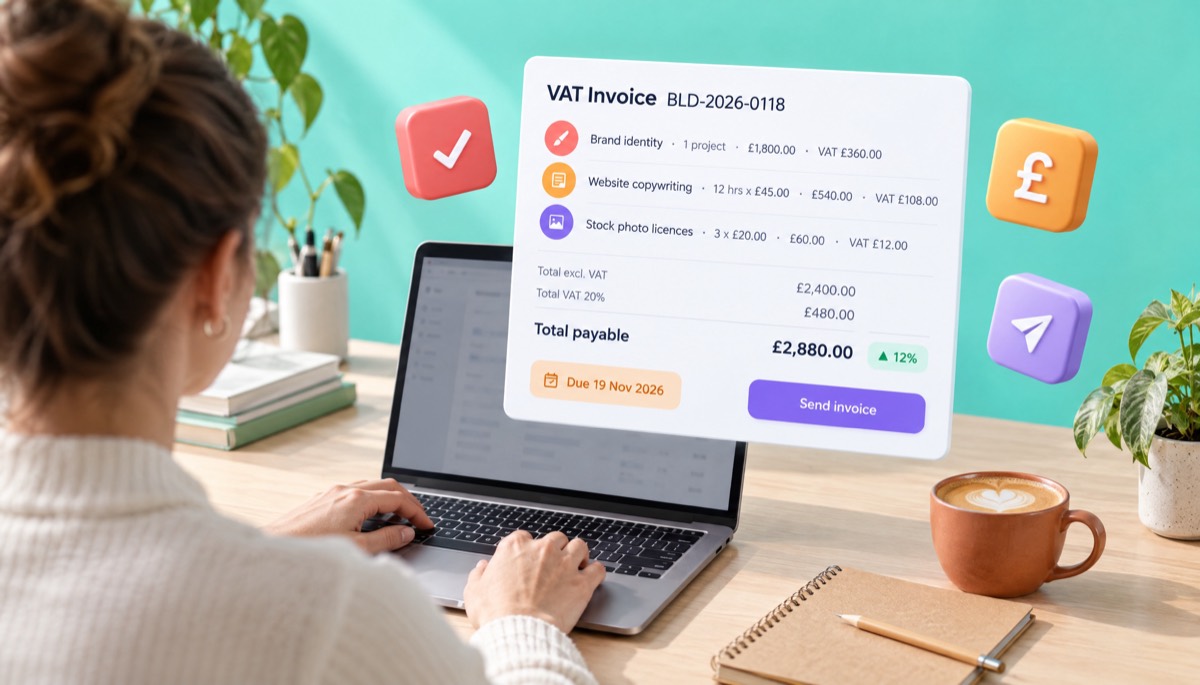
To work out VAT at 20%, multiply each net amount by 0.2 and add it to the net to get the gross. On a £2,400 net invoice that's £480 of VAT and £2,880 to pay. Here is a realistic example from a small design studio.
- Supplier: Brightline Design Ltd, 14 Harbour Street, Bristol BS1 4QA. VAT reg. no. GB 123 4567 89. Company no. 09876543.
- Customer: Oakfield Coffee Roasters Ltd, Unit 3, Mill Lane, Leeds LS2 7HD.
- Invoice no.: BLD-2026-0118. Tax point: 30 October 2026. Date of issue: 5 November 2026.
| Description | Qty | Unit price | VAT rate | Net | VAT |
|---|---|---|---|---|---|
| Brand identity: logo, palette and type system | 1 project | £1,800.00 | 20% | £1,800.00 | £360.00 |
| Website copywriting, 6 pages | 12 hours | £45.00 | 20% | £540.00 | £108.00 |
| Stock photo licences | 3 | £20.00 | 20% | £60.00 | £12.00 |
| Total excluding VAT | £2,400.00 | ||||
| Total VAT at 20% | £480.00 | ||||
| Total payable | £2,880.00 | ||||
Under the table I print: "Payment due by 5 December 2026. 2% cash discount if paid within 10 days." HMRC asks you to state any cash discount rate; if you don't offer one, leave it off.
Notice the two dates. The work finished on 30 October, the basic tax point. I issued the invoice within 14 days, so under section 14.2.2 of Notice 700 the issue date becomes the actual tax point. More on that below.
Working VAT backwards from a gross price
Sometimes a client agrees a price "including VAT". To pull the VAT out of a 20% gross figure, divide by 6. HMRC calls this the VAT fraction, which is 1/6 at 20% and 1/21 at 5%. A £1,200 inclusive fee holds £200 of VAT and £1,000 net. Most people get this wrong by taking 20% of the gross, which gives £240 and an invoice that doesn't add up.
Invoicing a UK client in euros or dollars
You can show the line amounts in any currency, but the total VAT must be in sterling. Notice 700 section 7.6 lets you use the UK market selling rate at the time of supply, or HMRC's published period rate. A line I use: "VAT: £480.00 (converted at €1 = £0.8700, HMRC period rate, November 2026)." Use whatever rate is current on the tax point, and say which source you used.
What is a simplified VAT invoice and the £250 limit?
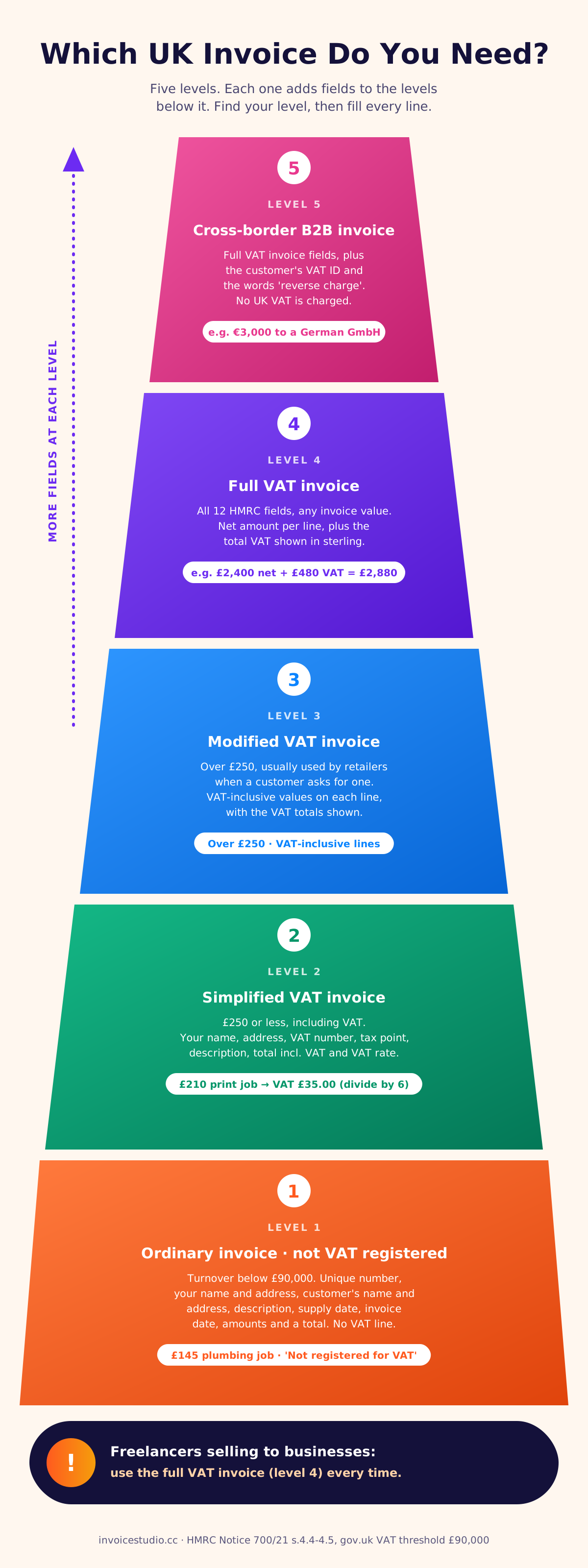
A simplified VAT invoice is a shorter VAT invoice you can issue when the total value of the supply, including VAT, is £250 or less. It needs only your name, address and VAT number, the tax point, a description, and for each VAT rate the total payable including VAT and the rate charged.
That's the rule in sections 4.4 and 4.5 of Notice 700/21. The customer's details and the VAT-exclusive amounts drop away. Exempt supplies must not appear on a simplified invoice.
Example: a photographer sells a £210 print to a VAT-registered café. The simplified invoice says "Framed print, harbour series, 40 x 50 cm. Total £210.00 including VAT at 20%." The café can work out the VAT itself: £210 divided by 6 is £35.00, leaving £175.00 net. I still print "VAT £35.00" on mine, because it saves the client the sum and saves me the email.
Above £250, you have two choices if the customer asks for a VAT invoice:
| Invoice type | When you can use it | How amounts are shown | Customer's name and address? |
|---|---|---|---|
| Full VAT invoice | Any value | Net per line, VAT rate per line, total VAT in sterling | Yes |
| Modified VAT invoice | Above £250, usually retailers, when the customer asks | VAT-inclusive values per line, with the VAT totals shown | Yes |
| Simplified VAT invoice | £250 or less, including VAT | Total including VAT, per VAT rate | No |
| Ordinary invoice | You're not VAT registered | No VAT at all | Yes (gov.uk list) |
Retailers selling to the public don't need to issue a VAT invoice at all unless a customer asks. If you're a freelancer selling to businesses, I'd skip the simplified and modified formats altogether and send a full VAT invoice every time. It's one template, it works at any value, and no accounts team ever bounces it.
Other countries set their own limits. EU member states commonly allow simplified invoices up to €100, and in Australia a tax invoice under A$1,000 can leave out the buyer's details. Check the national rules.
VAT invoice time limit: how soon do you have to send it?
You must normally issue a VAT invoice within 30 days of the date you make the supply. That's section 3.1 of Notice 700/21.
There's a second clock that matters more for your VAT return: the 14-day rule. The basic tax point for services is the date the work is done. If you issue the VAT invoice within 14 days after that, the invoice date becomes the tax point instead. If you issue it later than 14 days without HMRC's approval, the VAT is due at the basic tax point.
Here's how that plays out with real dates:
- Work finished 30 October, invoice issued 5 November. Within 14 days, so the tax point is 5 November. If your VAT quarter ends 31 October, the VAT falls into the next quarter.
- Work finished 30 October, invoice issued 25 November. That's 26 days. Still inside the 30-day issue limit, but past 14 days, so the tax point stays 30 October and the VAT belongs in the quarter ending 31 October.
- Client paid a £1,000 deposit on 2 October before work began. The payment creates its own tax point on 2 October for that £1,000. Issue a VAT invoice for the deposit, then invoice the balance when you finish.
Monthly billers can ask HMRC's VAT Written Enquiries Team to extend the 14-day rule. And preparing an invoice doesn't count: you have to send or give it to the customer.
Two more timings worth knowing. Credit notes for an overcharge should be issued within 14 days of the refund (Notice 700, section 18). And you must keep VAT records, invoices included, for at least 6 years. For correcting a mistake properly, see credit memo vs credit note.
Separate from VAT, the payment due date is your choice. If you agree nothing, UK late payment law treats a business invoice as late 30 days after the customer gets it. Our guide to net 30 payment terms covers the date maths.
What does a sole trader or limited company need on an invoice?
A sole trader must show their own name and any business name they trade under, plus an address where legal documents can be delivered if they use a business name. A limited company must show its full name exactly as it appears on its certificate of incorporation, and if it names any directors on the invoice, it must name all of them.
If a customer such as a publisher or platform raises VAT invoices on your behalf (self-billing), you need a written agreement and the invoice must carry your VAT number; HMRC sets the rules in VAT Notice 700/62.
Those lines come from gov.uk and apply whether or not you're registered for VAT. Put them side by side and the difference is clear:
| Line on the invoice | Sole trader | Limited company |
|---|---|---|
| Name | Your own name, plus any trading name (e.g. "Sam Patel trading as Brightline Design") | Full registered name, e.g. "Brightline Design Ltd" |
| Address | An address for legal documents if you use a business name | Contact address; most also print the registered office |
| Company number | Not applicable | Not on gov.uk's invoice list, but Companies House rules require it on business letters and order forms, so most print it |
| Directors | Not applicable | Optional, but if you name one you must name all |
| VAT number | Only if VAT registered | Only if VAT registered |
| VAT rate and amount | Only if VAT registered | Only if VAT registered |
| Unique invoice number, dates, description, amounts, total | Always | Always |
A common mix-up: a sole trader prints only the trading name. Your legal name has to be on there too. For numbering that survives an HMRC check, our invoice number format guide walks through schemes like BLD-2026-0118.
Invoice template UK for self-employed people not registered for VAT
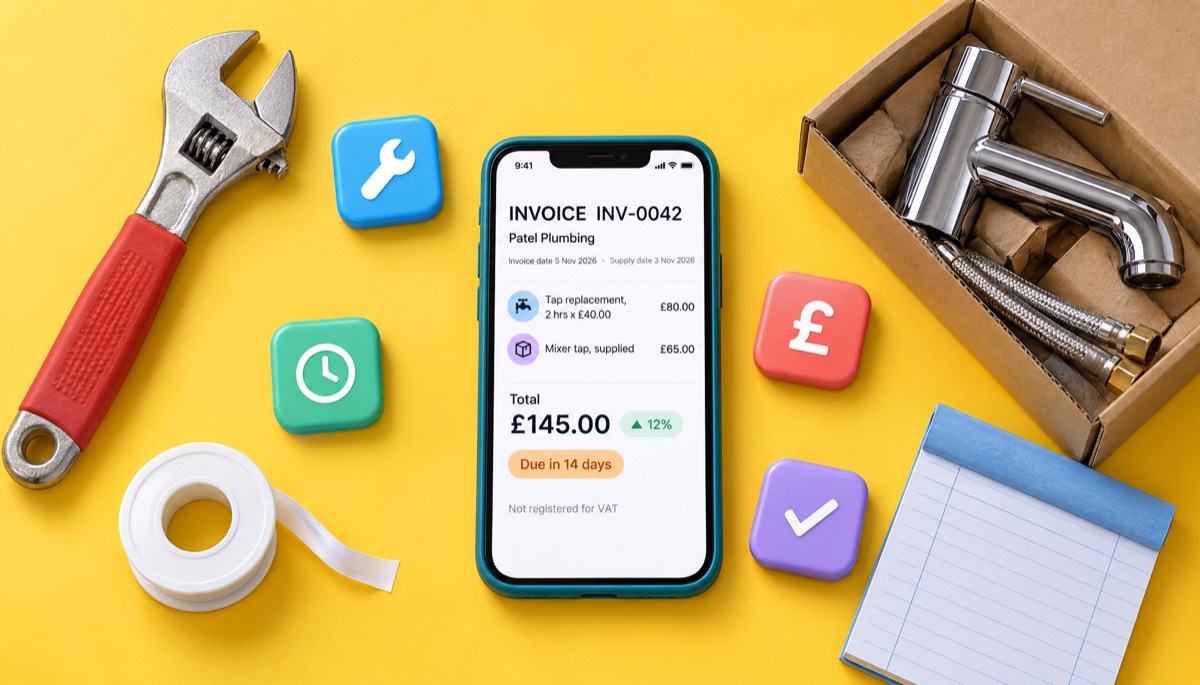
If you're self-employed and not VAT registered, your invoice needs the gov.uk basics only: a unique number, your name and address, the customer's name and address, a description, the supply date, the invoice date, the amounts and the total. You must not show VAT, a VAT rate or a VAT number.
Most people searching for a "self employed invoice template UK" are a sole trader below £90,000. Here's the layout I'd use:
- Header: "Invoice", your name (and trading name), address, email and phone.
- Bill to: client name and address.
- Invoice number and dates: INV-0042, invoice date 5 November 2026, supply date 3 November 2026.
- Lines: "Bathroom tap replacement, 2 hours at £40" = £80.00; "Mixer tap, supplied" = £65.00.
- Total: £145.00. No VAT line.
- Payment terms and bank details: "Payment due within 14 days. Sort code 12-34-56, account 12345678."
- Footer note: "Not registered for VAT."
That last line isn't a legal requirement, but it stops the "Where's your VAT number?" email from a client's bookkeeper. Copy it as is:
Not registered for VAT. No VAT has been charged on this invoice.
Two traps I see often. First, adding "VAT 20%" to look established. That's charging VAT you have no right to collect, and HMRC can make you pay it over. Second, passing on VAT you paid on materials as a separate line. A £65 tap is just £65 on your invoice.
Watch your rolling 12-month turnover, not your tax year. The £90,000 test looks back over any 12 months, and once you're registered you issue VAT invoices from your registration date.
For layouts you can copy for different trades, see our freelance invoice template guide and the invoice format and samples page.
How to word a reverse charge invoice for EU and UK clients
A reverse charge invoice is one where you don't charge VAT and the customer accounts for it in their own VAT return instead. You must show the customer's VAT number and print the words "reverse charge" on the invoice, which is what the European Commission's rules require for EU-side supplies.
Since Brexit, this comes up in three common situations for UK businesses.
1. UK business selling services to an EU business
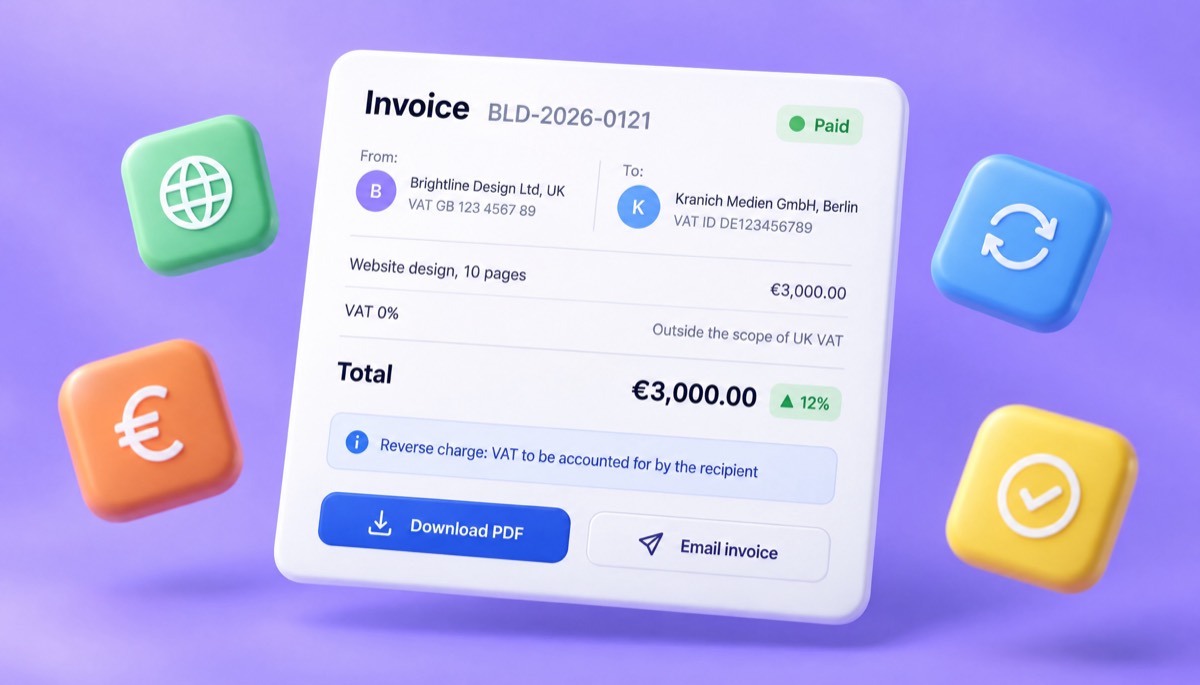
For most business-to-business services, the place of supply is where the customer belongs (HMRC Notice 741A). So a UK designer billing a German GmbH charges no UK VAT. The German client accounts for German VAT under the reverse charge. Your invoice shows:
- Your UK VAT number and the client's EU VAT ID, e.g. DE123456789. Check it on the EU's VIES service before you invoice.
- The net amount, say €3,000.00, with VAT shown as 0 or "outside the scope of UK VAT".
- The reverse charge note.
Wording EU accounts teams have always accepted from me:
Reverse charge: VAT to be accounted for by the recipient under Article 196 of Council Directive 2006/112/EC. Supply outside the scope of UK VAT.
2. EU business selling services to a UK business
Flip it round, and the EU supplier invoices without VAT and the UK customer accounts for UK VAT under the reverse charge on their own return. If you're the UK buyer, check the invoice shows your GB VAT number and the words "reverse charge". If you're the EU supplier, the European Commission's invoicing rules list the full EU VAT invoice content: date, sequential number, both VAT IDs where the customer is liable, both full names and addresses, description and quantity, unit price before VAT, the VAT rate and amount by rate, and the words "reverse charge" where it applies.
3. UK construction: the domestic reverse charge
Inside the UK, the VAT domestic reverse charge for building and construction services applies when a VAT-registered contractor supplies CIS-reported work to another VAT-registered contractor who isn't the end user. You show the VAT rate and the VAT amount the customer must account for, but you don't add it to the total. Wording along these lines works:
Reverse charge: customer to pay the VAT to HMRC. VAT at 20%: £400.00 (not included in the total due).
On a £2,000 job the total due is £2,000, not £2,400. The contractor declares the £400 on their return. Check HMRC's guidance if you're unsure whether the customer is an end user.
Our guide to invoicing EU and overseas clients covers currency and payment. Not every cross-border sale is reverse charge. Sales of goods, digital services to consumers and land-related services follow their own rules. If you sell to EU consumers rather than businesses, look at the EU One Stop Shop before you send the first invoice.
Is e-invoicing mandatory in the UK and EU?
Not yet in the UK. The government confirmed in its e-invoicing consultation response of November 2025 that the UK will introduce mandatory e-invoicing for all VAT invoices from 2029, with a detailed roadmap due at Budget 2026.
An e-invoice in this sense is a structured data file that one system sends to another and reads without a human typing it in. A PDF emailed to a client is not one: the consultation excluded PDFs, Word files, images and HTML invoices. What we know so far:
- Scope: VAT invoices, so business-to-business and business-to-government sales. B2C is out because VAT invoices aren't issued to consumers, and businesses that aren't VAT registered aren't required to adopt it.
- Model: a decentralised model, where businesses exchange invoices through accredited providers rather than one government portal.
- Standard: not chosen yet. Many respondents favoured Peppol, but the government hadn't confirmed it at the time of the response.
- Real-time reporting: not part of the 2029 start.
In the EU, the VAT in the Digital Age (ViDA) package was adopted on 11 March 2025. The headline date is 1 July 2030, when digital reporting with structured e-invoices starts for cross-border B2B sales between member states. Countries can also mandate e-invoicing for domestic sales sooner. Belgium, Poland and France have been rolling out their own national mandates through 2026, and Germany already requires businesses to be able to receive e-invoices. The European Commission's ViDA page has the official dates. National timelines move, so check the current date for each country you bill before relying on any blog, this one included.
Don't confuse e-invoicing with Making Tax Digital. Under Making Tax Digital for VAT, every VAT-registered business must keep digital records and file returns through compatible software. It doesn't change the invoice format, so PDF invoices are fine.
India already runs e-invoicing above a turnover limit; see our GST invoice format guide.
So in November 2026, a PDF VAT invoice that carries every field above is fully valid. Invoice Studio makes exactly that: a PDF invoice with your VAT number, per-line tax, a "Tax & fees" row for VAT and totals that add up. It doesn't produce structured e-invoices, and you should plan for whatever format HMRC picks for 2029 once the roadmap lands. For now, the job is to get the content right.
What are the most common VAT invoice mistakes?
The most common VAT invoice mistakes are a missing tax point, VAT shown only in a foreign currency, a mistyped VAT number, reused invoice numbers, charging VAT before registration and leaving out reverse charge wording. I've made two of these myself:
- No tax point, so the client can't tell which quarter the VAT belongs to.
- VAT total in euros only. On a UK VAT invoice, the VAT must also be in sterling.
- A wrong VAT number, usually a typo.
- Reusing an invoice number after editing an old invoice. Raise a credit note and a new number instead.
- Charging VAT before your registration date. You can't issue VAT invoices until you're registered.
- Leaving out "reverse charge" on an EU business invoice.
The fix for all six is a template with every field built in. Set up your VAT number, company number and a default 20% VAT row once in a free invoice generator, and every invoice after that comes out with the same fields in the same place. You can browse layouts among the invoice templates. For the step-by-step on any invoice, VAT or not, see how to make an invoice.
One last habit: before you send a VAT invoice, read it as your client's bookkeeper would. VAT number, tax point, VAT in pounds that adds up to the penny. Rules here are current as of November 2026; check Notice 700/21 for anything borderline.
Frequently asked questions
What makes a valid VAT invoice?
What is the limit for a simplified VAT invoice?
How soon must I issue a VAT invoice?
What does a sole trader need on an invoice?
What does "reverse charge" mean on an invoice?
What is an e-invoice and is it mandatory?
Do I need to show VAT if I'm not VAT registered?
Monjur builds Invoice Studio and incorporated MotionTrust Digital in September 2022, where he leads Amazon strategy across the client base. Eight years in e-commerce and marketplace marketing taught him how much time invoices and late payments eat, so every guide here is tested against the real product and current tax rules before it goes live.
More guides by Monjur