Ad spend that finance can audit
Media goes on its own line marked at cost, with your management fee shown next to it as a percentage. Clients who check their ad account see the same number you billed.
Load a real marketing agency invoice template with the retainer, last month's ad spend at cost and your management fee already worked out, then swap in your client and download the PDF. InvoiceStudio: create invoices by voice, automate billing, and get paid faster.
Pick an example below, change the client, the month and the numbers, then download a branded PDF.
Media goes on its own line marked at cost, with your management fee shown next to it as a percentage. Clients who check their ad account see the same number you billed.
SEO, PPC, social, content, email and creative production each get a clear description and period. Nobody in accounts payable has to guess what "Marketing services" meant.
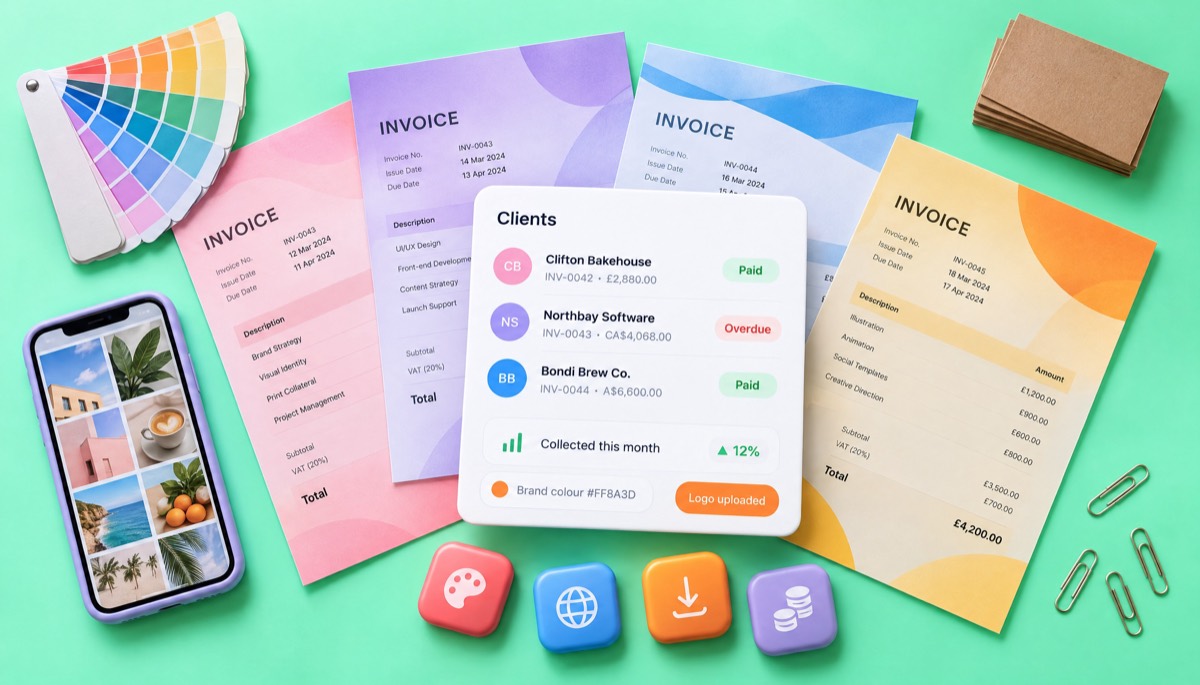
Add your logo, brand colour and font, then pick from 28 templates in A4 or Letter. A marketing invoice that looks off-brand undercuts the work it bills for.
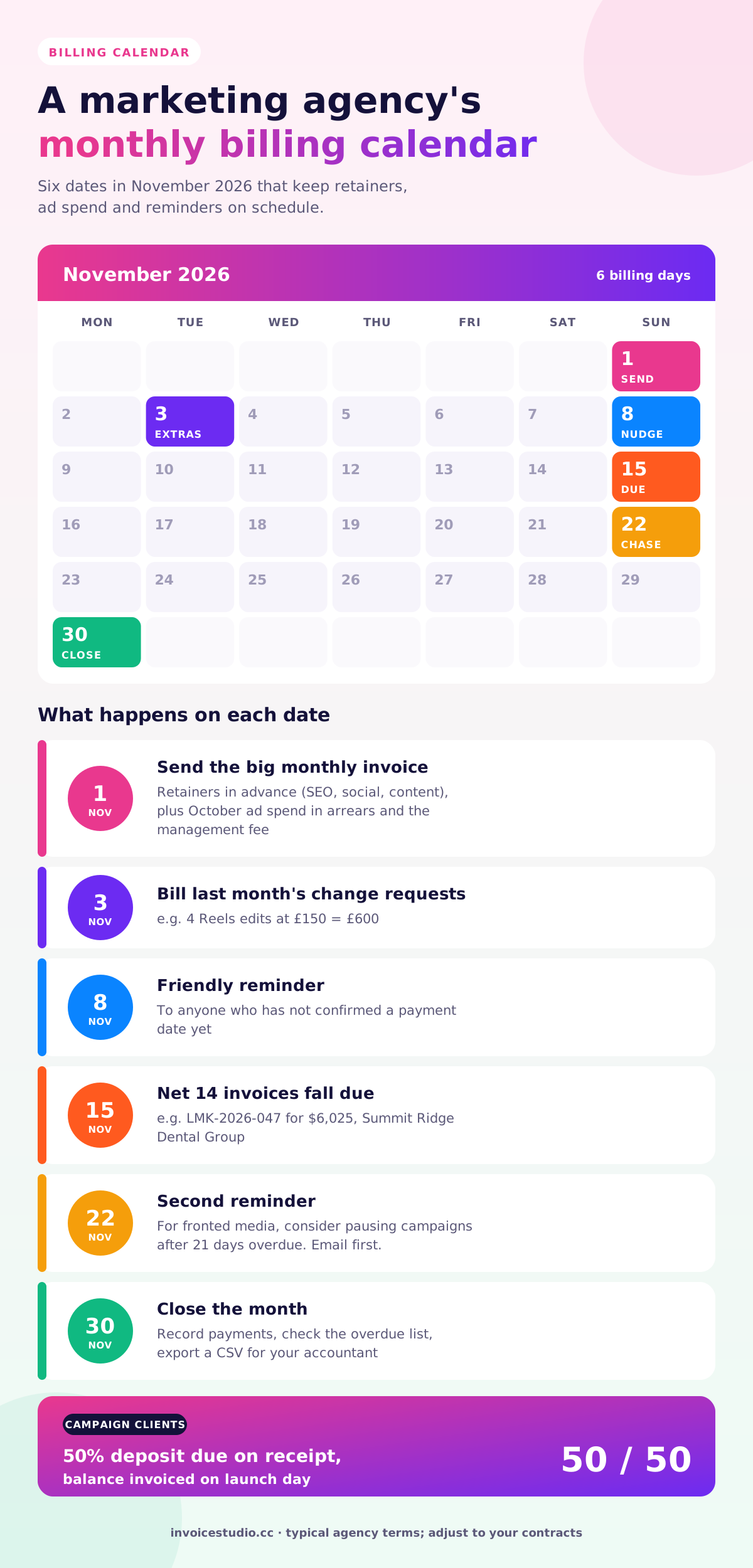
On the Pro plan ($7 a month), save a monthly SEO or social retainer as a recurring invoice. It goes out on the same day each month without being rebuilt.
Bill in 14 currencies with per-line tax for UK VAT, Australian GST, Canadian HST or Indian GST. Add reverse-charge wording for EU business clients.
On any paid plan, email the PDF from the app and send a one-click reminder, then record part or full payments. The dashboard shows which clients are late before campaigns are.
Pick SEO and PPC, social, launch deposit, content or India GST. Each one opens in the editor with real lines you can edit.
Add the client's accounts payable email and PO number, update the retainer month, paste last month's spend and recalculate your fee.
Upload your logo, set your colour, check the total and due date, then download or email the invoice on the 1st.

Pick one to load it into the tool above, then change anything.
A $2,000 SEO retainer, $3,500 of October Google Ads spend at cost and a $525 management fee worked out as 15% of spend.
A £1,800 social media management package plus four £150 Reels edits under a change request, with 20% VAT on both lines.
Half of a A$12,000 launch campaign billed up front as a tax invoice with 10% GST, tied to the quote number.
Eight SEO articles at CA$350 and four newsletters at CA$200, with 13% Ontario HST and the client's PO.
₹40,000 social management and ₹25,000 performance marketing management with 18% GST split as CGST and SGST.
Plain answers, worked examples and the rules that apply, all checked against the live product.
A marketing agency invoice template is a ready-made invoice laid out for agency billing: a retainer line for the month's SEO, social or content work, a separate line for ad spend billed at cost, and a management fee shown as a percentage of that spend. InvoiceStudio's free template fills these lines in, adds tax and exports a branded PDF.
A marketing agency invoice template is an invoice already laid out for the way agencies bill: a retainer line for the month's SEO, social or content work, a separate line for ad spend passed through at cost, and a management fee shown as a percentage of that spend. The template above fills those lines in for you and exports a branded PDF, free and without signup. This guide shows how to word each line, how to work out the fee, what tax to add in seven markets, and the notes I paste onto almost every marketing invoice I send.
Here is the thing nobody tells you when you start an agency. Clients rarely dispute the strategy. They dispute the invoice. A line that just says "Digital marketing services, $6,025" gets forwarded to three people and parked for a month. The same invoice split into a retainer, the Google Ads spend and a 15% fee gets approved on first read.
A marketing agency invoice template is a reusable invoice layout with fields for the charges a marketing agency actually bills: retainers, media spend, management fees, campaign deposits and creative production. A generic invoice template gives you a blank table. A marketing one gives you the structure, and the same layout works as a digital marketing agency invoice template, an SEO invoice template or a content marketing invoice, because only the line wording changes. It also means the January invoice looks like the December one and your client's finance team learns where to look.
The difference matters most when you run paid media. Generic templates have no idea that $3,500 of the total is the client's own money passing through your hands, and that only $525 of it is your fee. If the layout doesn't separate them, the client sees one big number and starts asking what your margin is. The ad-spend line is the one that causes the most questions, so it gets its own row here.
If you mostly bill one project at a time, the general free invoice templates will do. If you bill several retainer clients every month, keep reading, then look at the full invoicing software for agencies setup.
A marketing agency invoice should include your agency's details and tax number, the client's legal name and accounts payable email, a unique invoice number, issue and due dates, the client's purchase order number, one line per service with its period, ad spend at cost, your fee, tax, the total and how to pay. Miss any of the first six and a large client will bounce it back.
The full checklist:
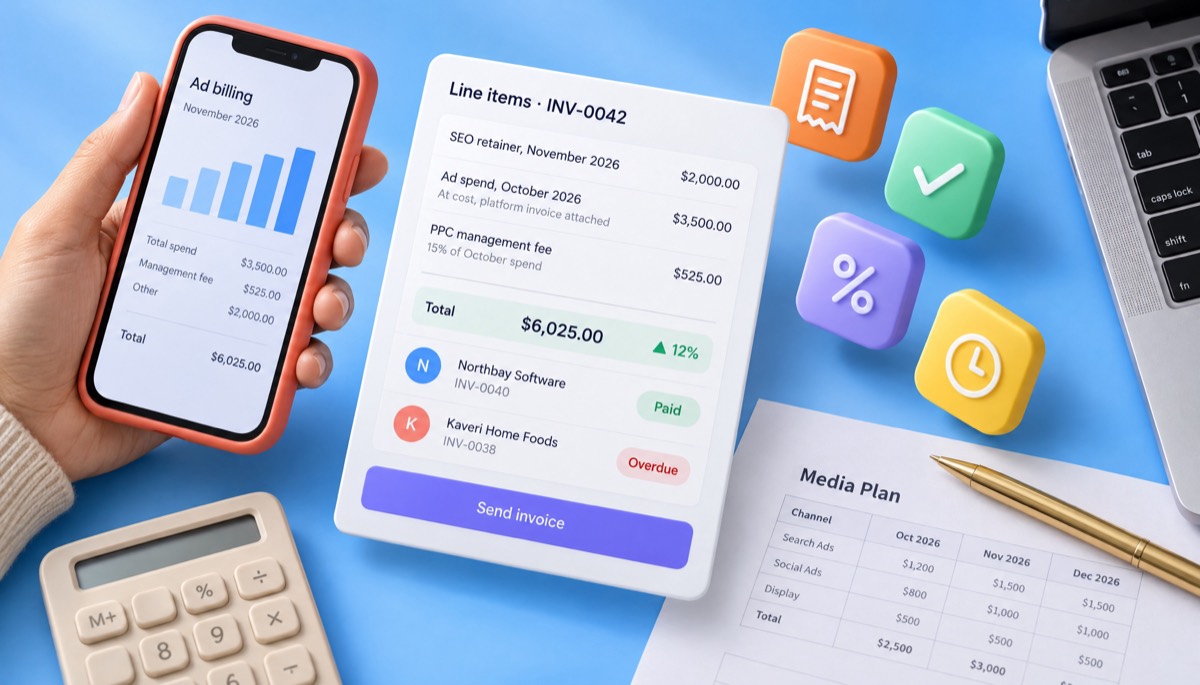
Bill ad spend as a pass-through on its own line marked "at cost", naming the platform and the month, and attach the platform invoice. Then bill your management fee on a separate line, usually a percentage of that spend, with the sum written in the details so anyone can check it.
Worked example. Your client, a Denver dental group, spent $3,500 on Google Ads in October. Your contract says 15% management fee and a $2,000 SEO retainer. The invoice you send on 1 November reads:
| Line | Details | Amount |
|---|---|---|
| SEO retainer, November 2026 | Technical fixes, 4 articles, link outreach, ranking report | $2,000.00 |
| Google Ads spend, October 2026 | At cost, platform invoice attached | $3,500.00 |
| PPC management fee | 15% of October spend ($3,500 x 15%) | $525.00 |
| Total due by 15 November 2026 | $6,025.00 | |
Notice the timing. The retainer is billed in advance for November. The spend is billed in arrears for October, because you only know the real figure once the month closes. One invoice, two periods, both named. That is the single most useful habit in agency billing.
Before you send an ad spend invoice at all, check who pays the platform. There are two setups, and they invoice differently:
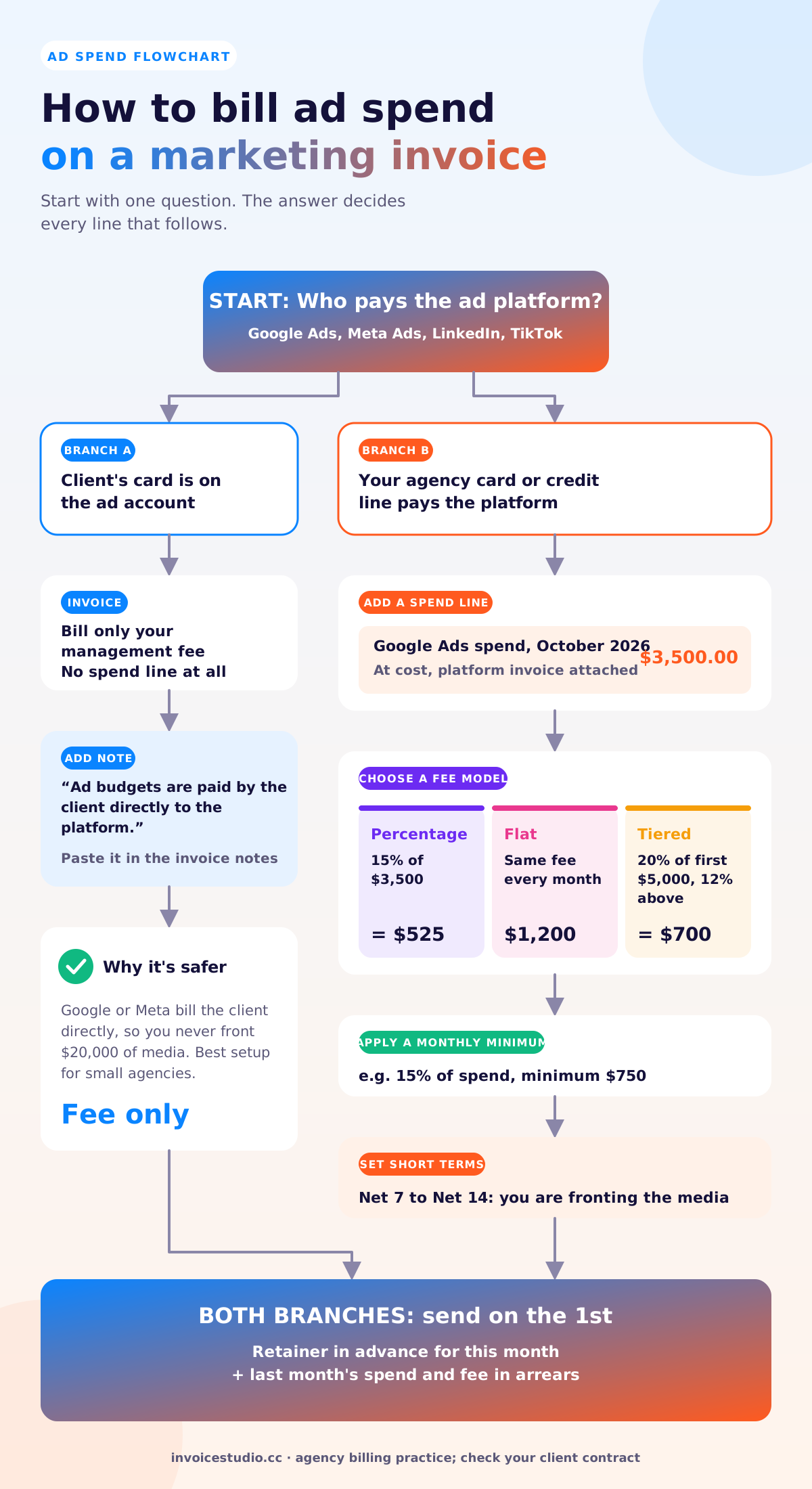
Most agencies use one of four models. Here is how each looks on the invoice, using a client who spent $3,500 one month and $12,000 the next:
| Fee model | Invoice line | Fee at $3,500 spend | Fee at $12,000 spend |
|---|---|---|---|
| Flat percentage (15%) | "Management fee, 15% of October spend" | $525 | $1,800 |
| Percentage with minimum (15%, min $750) | "Management fee, 15% of spend, minimum $750" | $750 | $1,800 |
| Flat monthly fee ($1,200) | "PPC management, November 2026" | $1,200 | $1,200 |
| Tiered (20% to $5k, 12% above) | "Management fee: 20% of first $5,000, 12% of remainder" | $700 | $1,840 |
My opinion: the minimum is the one most new agencies forget. Managing a $2,000 budget takes almost as long as a $10,000 one, and 15% of $2,000 is $300. Put the minimum in the contract and on the invoice line, and nobody can say they weren't told.
Write each line as service, period and scope: what you did, for which month, and the deliverables in the details. Clients approve lines they can match to the proposal. Here is a wording bank you can copy straight into the template:
Using quantity and rate rather than one lump sum helps in two ways. The client sees the unit price, and when they ask for two more articles next month, the price is already agreed. For more service wording, see the services invoice examples.
Use a retainer invoice for ongoing monthly work with a fixed fee, and a campaign or project invoice for one-off work with a defined start and end. Most agencies need both, and plenty of clients get both in the same month.
| Marketing retainer invoice | Campaign or project invoice | |
|---|---|---|
| Typical work | SEO, social, content, PPC management | Product launch, rebrand, website, event campaign |
| When you send it | The 1st of each month, in advance | Deposit up front, then milestones or on launch |
| Typical terms | Net 14 | Deposit due on receipt, balance Net 14 |
| Line wording | "Social media management, November 2026" | "Summer launch campaign, 50% deposit, per quote Q-2026-014" |
| Repeats | Yes, save it as a recurring invoice on Pro | No, one per stage |
| Main risk | Scope creep; list the deliverables | Starting work before the deposit clears |
For campaigns, I always take 50% before work starts. Example: a Sydney agency quotes A$12,000 plus GST for a six-week summer launch. The deposit invoice is A$6,000 plus 10% GST, so A$6,600, due on receipt, labelled "Tax invoice" and tied to the quote number. The balance invoice goes out on launch day. If the client goes quiet halfway through, you have been paid for the half you did.
These are three of the examples you can load into the template above. Each one uses a different country, tax setup and design, so pick the one closest to your agency and edit it.
A Bristol agency bills a bakery for November: social media management at £1,800 and four Reels edits at £150 each under change request CR-07. Subtotal £2,400, VAT at 20% adds £480, total £2,880, Net 14. The agency's VAT number sits under its address, and the notes mention statutory late-payment interest.
A Toronto content shop bills a software client for eight SEO articles at CA$350 and four newsletters at CA$200. Subtotal CA$3,600, Ontario HST at 13% adds CA$468, total CA$4,068. The client works on Net 30 and requires PO NB-44817 on every invoice. The note says usage rights transfer on payment, which quietly speeds things up.
A Bengaluru agency bills a food brand in the same state: ₹40,000 for social media management and ₹25,000 for performance marketing management. GST at 18% is ₹11,700, shown as CGST 9% plus SGST 9% because it's an intra-state supply, total ₹76,700. The client pays Meta and Google directly, so there's no spend line, just the note saying so.
Each of those took me under three minutes in the editor, including the logo. Using a digital marketing invoice generator like this one, or the free invoice generator, instead of rebuilding a Word file every month is the fastest win most small agencies have.
A purpose-built invoice template calculates totals, tax and fee lines for you and exports a clean PDF. Word and Google Docs templates look fine but every number is typed by hand. Project management templates track the work well but usually don't produce an invoice a client's finance team will accept.
| InvoiceStudio template | Word or Google Docs | Project management template | |
|---|---|---|---|
| Automatic totals and tax | Yes | No, or spreadsheet formulas | Partly |
| Ad spend and fee lines | Yes, any number of lines | If you build the table | Custom fields |
| Branded PDF | Yes, 28 templates, your logo and colour | Yes, if you design it | Rarely |
| Signup needed for the PDF | No | No | Usually |
| Recurring retainers | Yes, on the Pro plan | Copy and edit | Task reminders |
| Payment tracking | Yes, in a free account | No | No |
| Time tracking | No | No | Often yes |
Where the project tools win is time tracking. InvoiceStudio has none, so if you bill hourly you enter the hours as a quantity. For most marketing agencies billing retainers and spend, that's fine.
It depends on where you and your client are. Marketing services are taxable at the standard rate in most VAT and GST countries, usually untaxed in most US states, and often zero-rated or reverse-charged when you bill a business abroad. These notes are correct as of November 2026, but rules change, so check with your local tax authority or accountant.
Billing a client in another currency? The international invoice generator and multi-currency invoicing pages cover exchange rates and payment routes.
Use Net 14 for retainers and spend, a 50% deposit due on receipt for campaigns, and Net 30 only for large clients with a fixed payables cycle. Then print a real due date and one short note that says what happens if payment is late. If you want the background on Net terms, read Net 30 payment terms explained.
Copy-paste notes for the invoice footer:
Retainer billed in advance for November 2026. Ad spend is billed at cost with no markup; the platform invoice is attached. Please quote the invoice number with your payment.
Campaigns may be paused if this invoice is more than 21 days overdue. We'll always email before pausing anything.
Deposit of 50% secures the launch date. Work starts once the deposit clears; the balance is invoiced on launch day.
Content usage rights transfer to the client once this invoice is paid in full.
And the email I send when a retainer invoice is seven days late:
Hi Rachel, a quick nudge on invoice LMK-2026-047 for $6,025, which was due on 15 November. I've attached it again in case it got buried. Could you let me know when it's scheduled? November's campaigns are running as normal. Thanks, Sam
It's polite, it names the amount and date, and it hints that campaigns are still running, without a threat. More templates for the second and third nudge are in how to ask for payment politely, and on a paid plan you can send them in one click from invoice reminders. In the UK, the late commercial payments rules let you claim statutory interest on overdue business invoices, which is worth mentioning once a client passes 30 days.
The most common mistakes are bundling ad spend into one lump sum, hiding the fee, missing the PO number and billing the retainer late. Each one adds days, sometimes weeks, to payment. The full list I see most often:
Good record keeping helps here too. The SBA's guide to managing business finances is a useful read if you're setting up your agency's books for the first time.
Load an example, change the client and numbers, brand it and download the PDF. The whole thing takes about two minutes the first time and under a minute after that.
Starter at $3 a month adds emailing and reminders, and Pro at $7 adds recurring invoices and AI voice invoicing in 20 languages, handy when you want to bill a client from your phone between meetings. If you bill hours rather than retainers, the consulting invoice template fits better. Browse all 16 invoice templates, compare plans on the pricing page, or read more billing guides on the InvoiceStudio blog.
One last thing. The best marketing invoice is boring. Same day each month, same layout, same line order, a real due date. Your clients' finance teams learn the pattern and pay it without thinking, and that is exactly what you want.

Monjur builds Invoice Studio and incorporated MotionTrust Digital in September 2022, where he leads Amazon strategy across the client base. Eight years in e-commerce and marketplace marketing taught him how much time invoices and late payments eat, so every guide here is tested against the real product and current tax rules before it goes live.

InvoiceStudio: create invoices by voice, automate billing, and get paid faster. Load the SEO and PPC example, swap in your client, this month's spend and your fee, and download a branded PDF in about two minutes.