Freelance Invoice Template: Free Samples and How to Use Them
Five worked freelance invoice samples for writers, designers, developers, VAs and marketers, with deposit and retainer wording and a cross-border section on currency, Wise, Payoneer, W-8BEN and reverse charge.
- Written by
- Monjur Hossain
- Published
- Last updated
- Reading time
- 20 min read

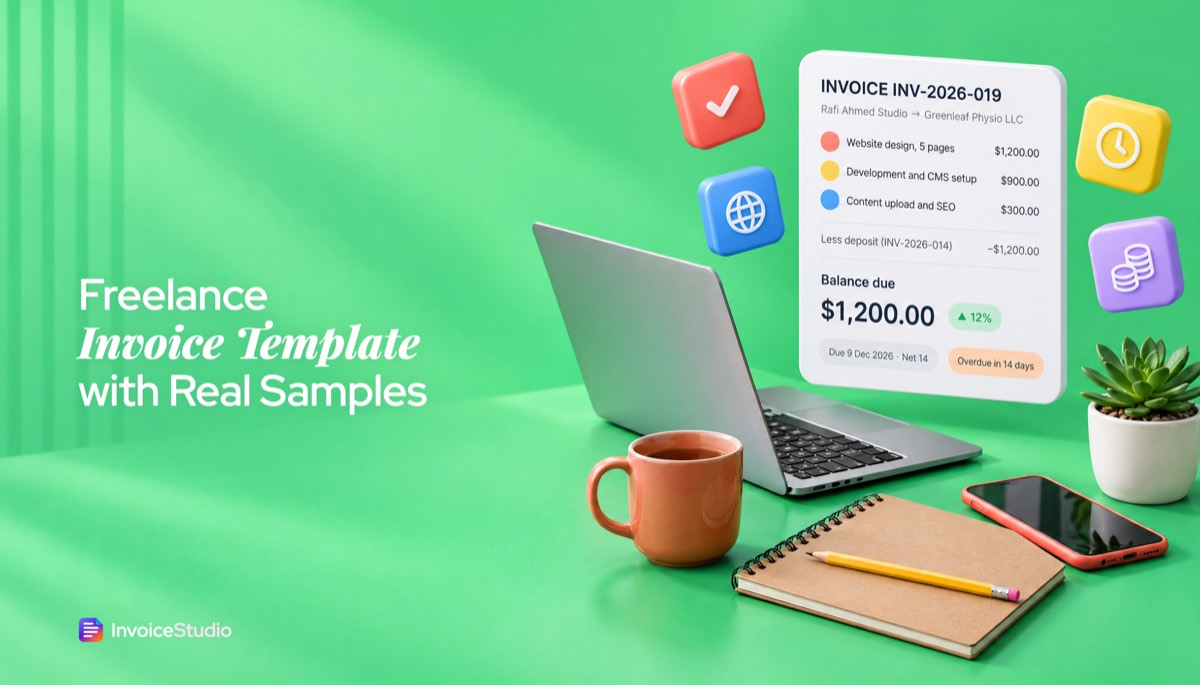
A freelance invoice template should show the word Invoice, a unique invoice number, issue and due dates, your details and the client's, each piece of work with quantity and rate, the total with a currency code, payment terms and how to pay. Add a tax line only if you are registered. Send it as a PDF on delivery.
On this page 14 sections
- What should a freelance invoice template include?
- Sample freelance invoice: a $2,400 website with 50% upfront
- What should a freelance writer's invoice template show?
- Freelancer invoice format for designers and developers
- Templates by role: what changes on the invoice
- How to write an invoice for freelance work (your first one)
- How to ask for a deposit on a freelance invoice
- How to send a freelance invoice to foreign clients in another currency
- What payment terms should freelancers use?
- Do freelancers need to charge VAT, GST or sales tax?
- How to set up a retainer invoice for monthly clients
- What do freelancers get wrong on invoices?
- Freelance invoice template vs invoice generator: which should you use?
- FAQs
A freelance invoice template is a ready-made layout with every field a client needs to pay you: your details, their details, an invoice number, dates, line items, the total, payment terms and how to pay. You fill in the job, save it as a PDF and send it. The template matters less than what you type into it, and that is what this guide is about.
I have freelanced for years as a writer and later ran a small design and web practice. I have sent hundreds of invoices, some to a café down the road and some to agencies in London, Berlin and Austin. Most of the template pages that rank today show you a blank form with "Item 1, Item 2" in it and stop there. Below you get five worked samples by role (writer, designer, developer, virtual assistant and marketer), with real numbers: per word, hourly, a $2,400 website with 50% upfront, and a monthly retainer. Then the cross-border part almost nobody covers well: currency, Wise, Payoneer, bKash and Nagad lines, the W-9 vs W-8BEN question, and the EU reverse-charge wording you can copy.
What should a freelance invoice template include?
A freelance invoice template should include eleven things: the word "Invoice", a unique invoice number, the issue date, a due date, your name and contact details, the client's name and billing address, a description of each piece of work, quantity and rate, the total in a named currency, payment terms, and payment instructions. Add a tax ID and tax line only if you are registered for tax.
Here is the full list, with what I actually put in each field:
- Title: "Invoice". Not "Bill", not "Statement". Accounts payable teams sort documents by that word.
- Invoice number: unique and in sequence, for example INV-2026-014. Our guide to invoice number formats covers the schemes that hold up in an audit.
- Issue date: the day you send it.
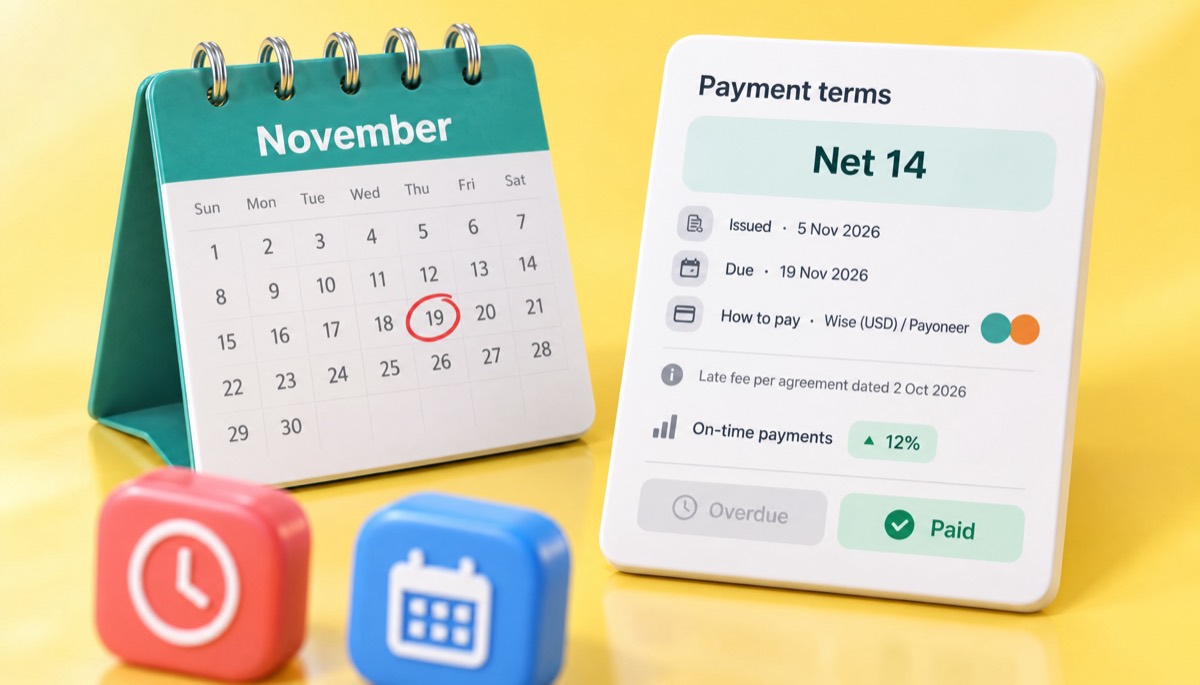
- Due date: an actual date, such as 19 November 2026, not only "Net 14". People pay against dates.
- Your details: your name or trading name, email, and an address. In the UK a sole trader has to show their name and a business address, according to GOV.UK's list of what an invoice must include.
- Client details: the legal company name (check their website footer), the contact person and billing address. Add their PO number if they gave you one.
- Line items: what you did, described so a stranger in finance understands it.
- Quantity, unit and rate: words, hours, pages, articles, or "1 project".
- Totals: subtotal, any discount, any tax, the total, and amounts already paid.
- Payment terms: Net 7, Net 14, due on receipt, plus a late fee line if your contract allows one.
- How to pay: bank details, PayPal email, Wise or Payoneer details. Pick one or two methods, not seven.
Put the client's PO or project reference on the invoice even if they never asked. Big companies match invoices to purchase orders, and an invoice without one can sit in a queue for weeks.
What you can leave off: a logo, a signature and long legal terms. The contract holds the terms; the invoice just points to it: "Per agreement dated 2 October 2026."
Sample freelance invoice: a $2,400 website with 50% upfront
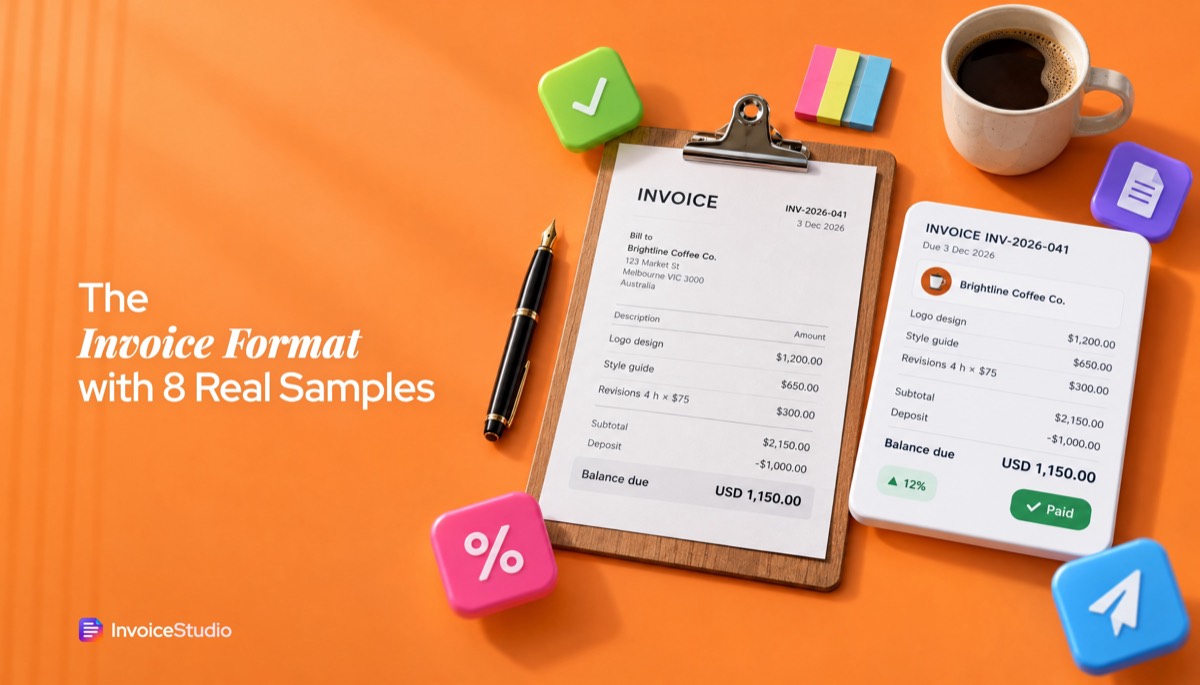
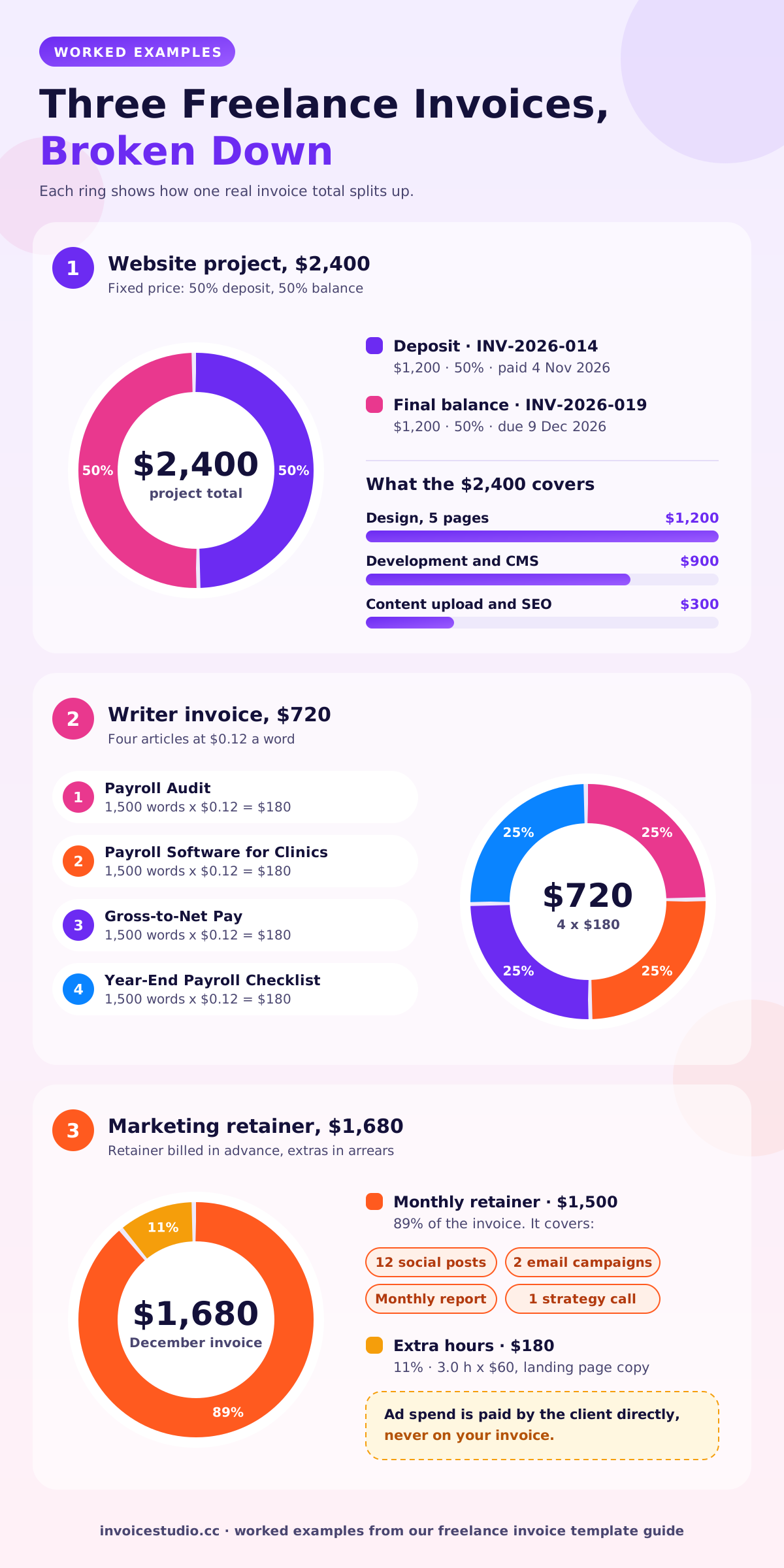
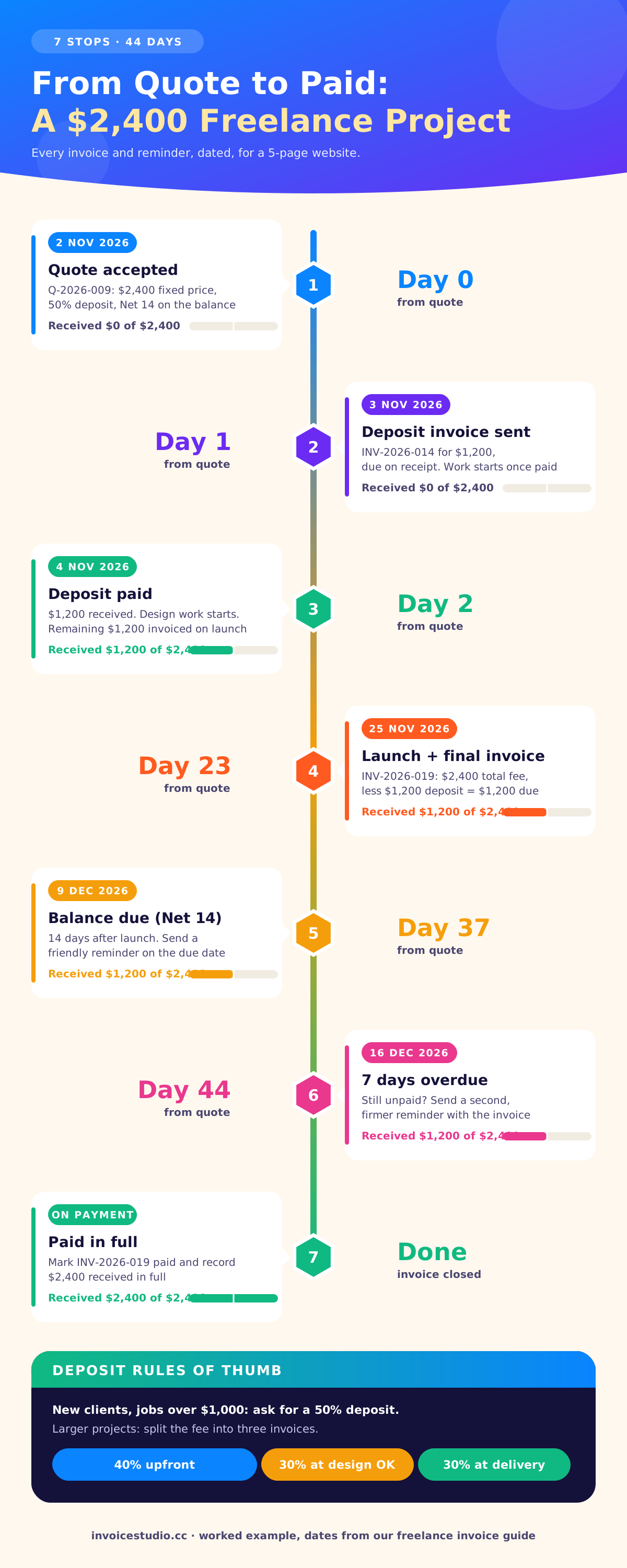
The cleanest way to bill a fixed-price project is two invoices: a deposit invoice for 50% before you start, and a final invoice for the balance on delivery. On a $2,400 website that means $1,200 upfront and $1,200 at launch, and the final invoice shows the full price minus the deposit already received.
Here is a real-shaped example. A freelance web designer, Rafi Ahmed, builds a five-page site for Greenleaf Physio LLC in Ohio. The quote was accepted on 2 November 2026.
Invoice 1: the deposit invoice
| Field | What it says |
|---|---|
| Invoice number | INV-2026-014 |
| Issue date | 3 November 2026 |
| Due date | On receipt (work starts when paid) |
| Line item | 50% deposit for 5-page website, per quote Q-2026-009 dated 2 Nov 2026 |
| Amount | $1,200.00 |
| Note | Remaining $1,200.00 will be invoiced on launch. |
Invoice 2: the final invoice
| Description | Qty | Rate | Amount |
|---|---|---|---|
| Website design, 5 pages (home, about, services, team, contact), 2 revision rounds | 1 | $1,200.00 | $1,200.00 |
| Development and CMS setup, mobile layout, contact form | 1 | $900.00 | $900.00 |
| Content upload and basic on-page SEO (titles, meta, alt text) | 1 | $300.00 | $300.00 |
| Total project fee | $2,400.00 | ||
| Less deposit received 4 Nov 2026 (INV-2026-014) | -$1,200.00 | ||
| Balance due by 9 Dec 2026 (Net 14) | $1,200.00 | ||
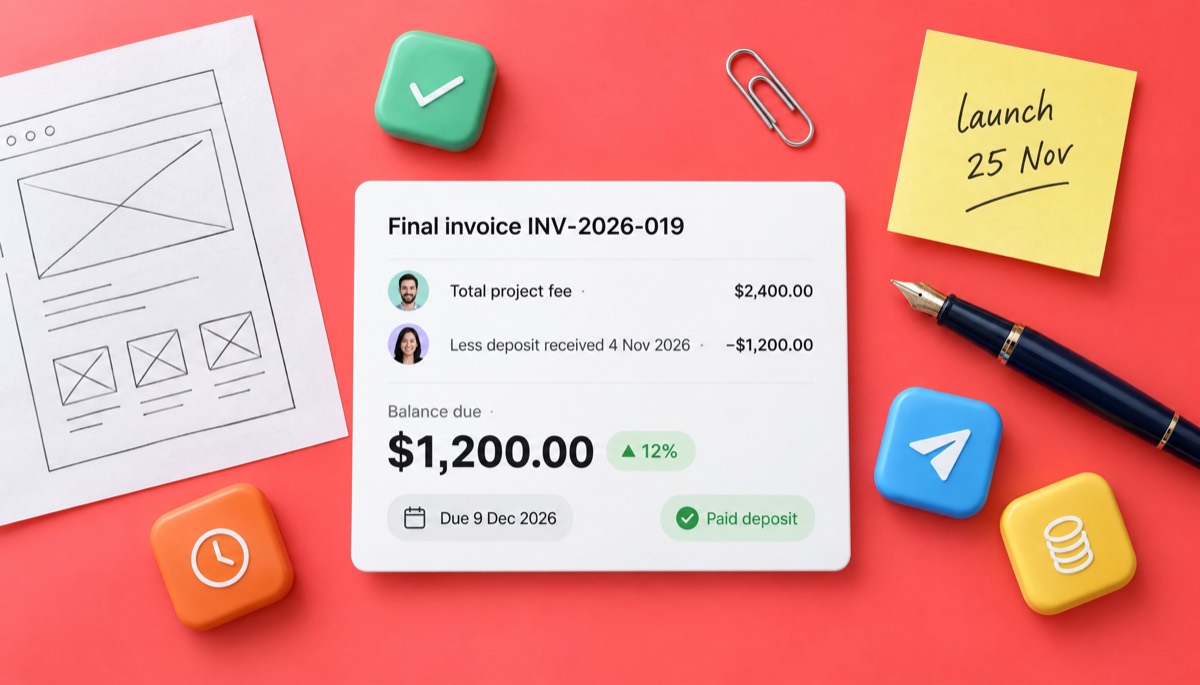
Three details make this invoice work. The full price is on it, so the client's books show the whole $2,400 job. The deposit line names the earlier invoice number and payment date. And the balance has a real due date: launch was 25 November, so Net 14 lands on 9 December.
Most people get the deposit wrong in one of two ways. Some bill only $1,200 with no mention of the full fee, which confuses the bookkeeper. Others put $2,400 as the amount due and expect the client to subtract the deposit. They will either pay twice or email you, and both slow things down.
What should a freelance writer's invoice template show?
An invoice template for a freelance writer needs a line per piece, with the title or topic, the word count or flat fee, and the date it was delivered or published. Editors approve invoices by matching titles to their content calendar, so the title is the most useful thing you can put on the line.
Writers usually bill one of three ways, and the template changes a little for each.
Per word
Say you write four blog posts for a SaaS client at $0.12 a word, each around 1,500 words. Bill the agreed word count, not the final count after you got carried away, unless the brief allowed overage.
| Description | Words | Rate | Amount |
|---|---|---|---|
| "How to Run a Payroll Audit" (delivered 6 Oct) | 1,500 | $0.12 | $180.00 |
| "Payroll Software for Clinics" (delivered 13 Oct) | 1,500 | $0.12 | $180.00 |
| "What Is Gross-to-Net Pay?" (delivered 20 Oct) | 1,500 | $0.12 | $180.00 |
| "Year-End Payroll Checklist" (delivered 27 Oct) | 1,500 | $0.12 | $180.00 |
| Total | $720.00 | ||
Per article or flat fee
For a case study, white paper or newsletter, a flat fee reads better: "Customer case study, Brightwater Dental, approx. 1,200 words, interview included, 1 × $350.00." If the client added a second interview, that is its own line: "Additional interview (45 min) and notes, 1 × $75.00." That one line saves you the awkward conversation about scope creep, because it is written down.
You do not need a special "writer" template. You need any clean layout plus a description column wide enough for article titles.
Copy-paste note for the bottom of a writer's invoice:
Thank you for the commissions this month. All four articles were approved by Dana on the dates listed. Payment by bank transfer, reference INV-2026-031, due 10 November 2026.
Invoice template: freelance writer sample with a kill fee
A kill fee is what a publisher pays when it cancels a commissioned piece after you started. Put it on its own line so nobody confuses it with the full fee: "Feature, 'Why clinics lose patients', commissioned at $800, cancelled after first draft. Kill fee 25%, 1 × $200.00." Agree the percentage in the commission email; 25% to 50% is common.
Freelancer invoice format for designers and developers
The freelancer invoice format for designers and developers is the same core layout with one addition: show hours or deliverables clearly, plus revision rounds and any third-party costs such as fonts, stock photos or hosting. Clients dispute design and development invoices mostly over hours and extras, so make those two things impossible to misread.
Designer, hourly
A brand designer billing $65 an hour for revision work might write:
| Description | Hours | Rate | Amount |
|---|---|---|---|
| Logo refinements, round 3 (colour and spacing), 12 Oct | 2.5 | $65.00 | $162.50 |
| Packaging mock-ups, 3 sizes, 14-15 Oct | 4.0 | $65.00 | $260.00 |
| Font licence (desktop, 1 user), billed at cost | 1 | $49.00 | $49.00 |
| Total | $471.50 | ||
I bill in quarter-hour steps. Six-minute steps invite questions, and whole hours look padded.
Developer, hourly with a timesheet
Developers often work across many small tasks. Put a summary on the invoice and attach the detail:
- Bug fixes and checkout form validation, 6 Oct to 31 Oct: 18 hours × $85 = $1,530.00
- Attached: timesheet with date, ticket number and hours for each task.
Designer or developer, fixed project
Use the $2,400 website pattern above. Break the fee into two to four parts that match the deliverables in your quote, so the client sees the invoice is the quote they signed.
India note, if you freelance from there: If you are registered for GST, your invoice must show your GSTIN, the client's GSTIN if they have one, a SAC code for the service, and CGST plus SGST (same state) or IGST (other state). If you export services to a foreign client under a Letter of Undertaking, you usually charge no IGST and write "Supply meant for export under LUT without payment of IGST." Check the current rules with a GST practitioner, since thresholds and forms change.
Templates by role: what changes on the invoice
Every freelance role uses the same invoice skeleton, but the unit of billing and the line most likely to be disputed are different. This table is the quick reference I wish I had when I started.
| Role | Usual billing unit | Example line | Add this to avoid disputes |
|---|---|---|---|
| Writer | Per word or per article | 4 × 1,500-word posts at $0.12/word = $720 | Article titles and delivery dates |
| Designer | Per project or hourly | Packaging mock-ups, 4.0 h × $65 = $260 | Revision round number, costs passed through |
| Developer | Hourly or milestone | 18 h × $85 = $1,530 | Timesheet with ticket numbers |
| Virtual assistant | Hourly or hour packages | 40 h × $18 = $720 | Hours used vs hours in the package |
| Marketer | Monthly retainer | November retainer = $1,500 | What the retainer covers, ad spend kept separate |
A virtual assistant on a 40-hour monthly package at $18 an hour would invoice $720, with a note such as "Hours used in October: 37.5 of 40. Unused hours do not roll over, per agreement." If they went over: "Additional hours: 3.0 × $18 = $54." That one note prevents most VA billing arguments I have seen.
For more service-business layouts, including consultants and agencies, see our services invoice template examples. If you do on-site or trade work (painting, electrical, renovation), the contractor invoice template guide covers materials and labour lines.
How to write an invoice for freelance work (your first one)
To write an invoice for freelance work the first time, confirm the price and terms in writing, pick a template or free invoice generator, fill in your details and the client's, list the work with quantities and rates, set a due date, add how to pay, save it as a PDF and email it to the person who approves payment. It takes about fifteen minutes the first time and five after that.
Invoicing as a freelancer gets easier fast, and if you hate typing you can try drafting invoices with AI or your voice. This is the exact checklist I give friends who are just starting out:
- Check you have agreement in writing. An email that says "Yes, $720 for four posts, Net 14" is enough for small jobs. In New York, the Freelance Isn't Free Act (statewide since August 2024, and in New York City since 2017) requires a written contract for work worth $800 or more, including smaller jobs that add up to $800 within 120 days, and payment within 30 days of completion if no date was agreed.
- Ask who receives invoices. Often it is not your contact. It might be accounts@ or an AP portal. Ask once, at the start.
- Ask what they need on it. PO number, a vendor ID, a tax form on file. Better to know before you send than after it bounces.
- Choose your number. You can start at INV-2026-001. Nobody will think less of you. If you prefer, start at 101.
- Fill in the template. Use the field list at the top of this article. Use the client's legal name.
- Set the due date as a date. "Due 19 November 2026 (Net 14)."
- Add payment instructions. Account name, bank, account and routing number or IBAN, or your PayPal or Wise details.
- Proofread the maths. Quantity × rate on every line, then the subtotal, then tax, then the total.
- Save as a PDF. Never send an editable Word file. Name it clearly: "INV-2026-001 Rafi Ahmed Greenleaf Physio.pdf".
- Send it with a short email and log it in a spreadsheet or app so you know when to follow up. Our guide on how to send an invoice has email wording.
You do not need an LLC or limited company to start; a sole proprietor or sole trader invoices under their own name and reports the income. US clients will often ask for a Form W-9 so they can report what they paid you, typically on Form 1099-NEC. Send it once, securely. Many freelancers get a free EIN from the IRS so they are not handing their SSN to every client; the IRS EIN page explains how.
How to ask for a deposit on a freelance invoice
Ask for a deposit in the quote or contract first, then send a separate deposit invoice before any work starts. Say the percentage, the amount, and that work begins when it is paid. Clients rarely push back when the deposit is in writing from the first message. They push back when it appears as a surprise.
How much? For new clients I ask 50% on anything over $1,000, and 25% to 50% on smaller jobs. On larger projects, three parts work well: 40% upfront, 30% at design approval, 30% at delivery.
Copy-paste wording for your quote or email:
To book your project into my calendar I ask for a 50% deposit of $1,200.00. I'll send that invoice today. As soon as it is paid I'll start on the design, and the remaining $1,200.00 will be invoiced when the site goes live, payable within 14 days.
Copy-paste line for the deposit invoice itself:
50% deposit for 5-page website per quote Q-2026-009. Non-refundable once design work has started. Work begins on receipt of payment.
Be careful with "non-refundable". A deposit far bigger than your real loss can be challenged in some places, so keep it reasonable and refund what you have not earned if a project is cancelled early.
Timing rule of thumb: small jobs are invoiced on delivery, fixed projects get a deposit before and the balance after, and retainers are billed at the start of each month. Never wait until the end of a three-month project to invoice anything.
How to send a freelance invoice to foreign clients in another currency
A freelance invoice for foreign clients works like any other, with three additions. Agree the currency before you start, put the three-letter currency code next to every amount (USD 1,530.00, not $1,530), and give payment details that work for them, such as Wise account details in their currency or a Payoneer request. Name who pays the transfer fees. If you are not in the US and the client is, expect them to ask for Form W-8BEN instead of a W-9.
Currency first. The "$" sign is used by the US, Canada, Australia, Singapore and others, so always write the code: USD, CAD, AUD, GBP, EUR, INR, BDT. Bill in the client's currency and you take the exchange-rate risk; bill in yours and they do. I bill in theirs because it gets approved faster. See our page on invoicing international clients for more.
Payment lines that work, by method:
| Method | Good for | What to print under "How to pay" |
|---|---|---|
| Wise | Clients in the US, UK, EU, Australia who pay by local bank transfer | Account holder, the local account or IBAN details Wise gives you in that currency, and "Reference: INV-2026-022" |
| Payoneer | US and EU clients, marketplaces, freelancers in Bangladesh, India, Pakistan | "Pay via Payoneer request sent to accounts@client.com" or your Payoneer receiving account details |
| PayPal | Small amounts, clients who prefer cards | Your PayPal email and "Please send as goods and services" or the payment link |
| Bank (SWIFT) | Large corporate clients | Bank name, SWIFT/BIC, account number or IBAN, account name, bank address |
| bKash / Nagad | Local clients in Bangladesh | "bKash Personal: 01XXXXXXXXX (Rafi Ahmed)" or Nagad number, with the invoice number as reference |
A note for freelancers in Bangladesh: bKash and Nagad are mobile wallets for domestic payments, so a US client will not pay into them directly. Most freelancers there invoice foreign clients through Payoneer or a bank, then move the money home. Some link Payoneer to bKash. For local clients in Dhaka or Chattogram, a bKash or Nagad line on the invoice is often the fastest way to be paid. Invoice Studio prints all of these under "How to pay", and you can show amounts in BDT or any of its 14 currencies.
Copy-paste fee line:
All amounts in USD. Please pay the full invoice amount; any bank or transfer fees on the sender's side are paid by the client.
W-9 vs W-8BEN: which form do you send a US client?
A W-9 is for US persons: citizens, residents, and US companies. It gives the client your taxpayer ID. A W-8BEN is for foreign individuals. It tells the US client you are not a US person, and it can claim a reduced withholding rate under a tax treaty. If you are a freelancer living in India, Bangladesh, the UK or anywhere outside the US and you are paid by a US client, the client will normally ask you for a W-8BEN. Companies use the W-8BEN-E instead.
For services you perform outside the US, the income is generally not US-source, so withholding usually does not apply. But your situation can differ, so read the instructions on the IRS page for Form W-8BEN and ask a tax adviser in your country. You still report the income at home. You send the form to the client, not to the IRS.
| You are | Your client is | Form you give them |
|---|---|---|
| US freelancer | US company | W-9 |
| Non-US individual freelancer | US company | W-8BEN |
| Non-US company (your own Ltd or Pvt Ltd) | US company | W-8BEN-E |
| US freelancer | Non-US company | Usually none, unless they ask |
EU reverse charge: the wording to use
If you are VAT-registered in one EU country and you bill a VAT-registered business in another EU country for most services, you normally do not charge your VAT. The customer accounts for it in their country under the reverse-charge rule. Your invoice must show the client's VAT number and state that the reverse charge applies. The European Commission's VAT invoicing page lists the mandatory mentions.
Copy-paste line I use:
Reverse charge: VAT to be accounted for by the recipient under Article 196 of Council Directive 2006/112/EC. Customer VAT number: DE123456789.
A UK freelancer billing an EU business client for general services is in a similar position after Brexit: the service is usually outside the scope of UK VAT, and the invoice notes that. Write "Outside the scope of UK VAT, place of supply is the customer's country" or similar, and check HMRC's guidance on the place of supply for your service.
What payment terms should freelancers use?
Most freelancers should use Net 7 or Net 14 for small and medium clients, and accept Net 30 for large companies that will not change their process. Write the due date as a calendar date, add a late fee clause that is allowed where you live, and for fixed projects use a deposit so you are never owed the whole fee.
| Term | Meaning | When I use it |
|---|---|---|
| Due on receipt | Pay as soon as it arrives | Deposits, small one-off jobs |
| Net 7 | Due 7 days after the invoice date | New small clients, individuals |
| Net 14 | Due 14 days after the invoice date | My default for most businesses |
| Net 15 | Due 15 days after the invoice date | US clients whose payment runs use 15 |
| Net 30 | Due 30 days after the invoice date | Agencies and large companies with fixed payment runs |
| Net 60 or longer | Due 60 or more days after the invoice date | Only if the rate reflects the wait |
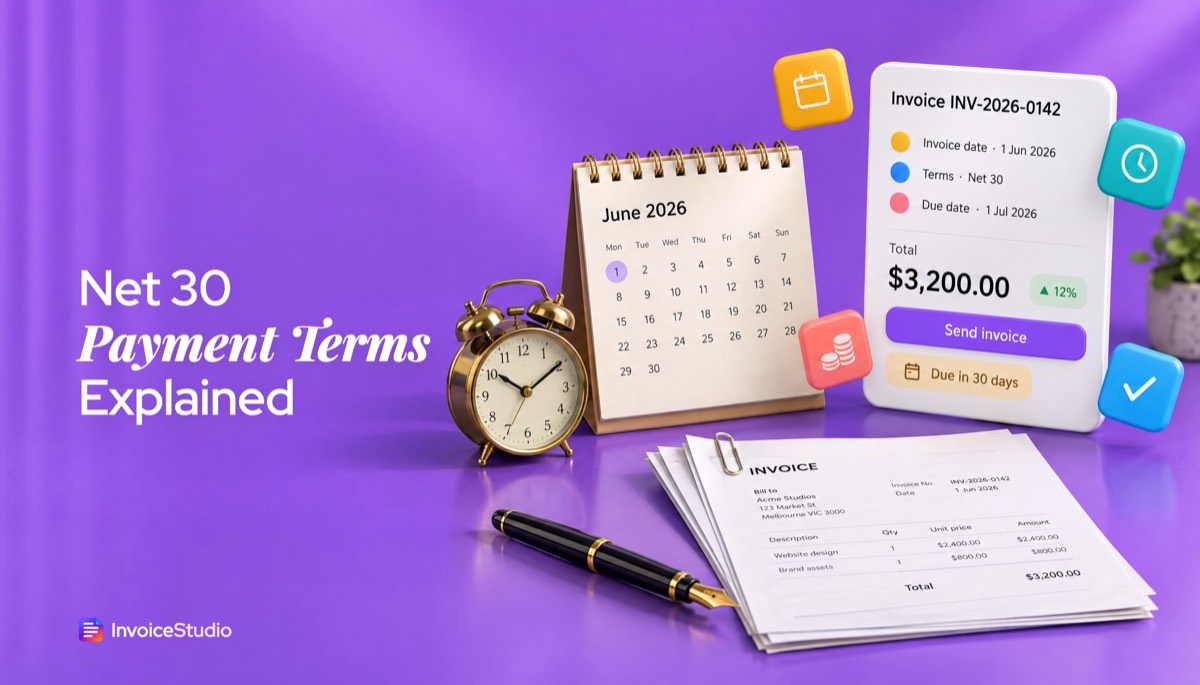
If you are unsure how the dates work, our guide to Net 30 payment terms has worked calendar examples, including weekends and month ends.
Late fees: in the UK, if no payment date is agreed, a business payment is due 30 days after the invoice, and you can claim statutory interest and fixed recovery costs on late B2B payments. The details are on GOV.UK's late commercial payments page. In the US, late fee limits vary by state, so keep any fee modest and put it in the contract. Something like "1.5% per month on balances more than 30 days overdue" is common, but check your state's rules first.
Whether you bill an hourly rate, a day rate (say $600 for an eight-hour day) or a project fee, the terms work the same way. Clients you find on Upwork or Fiverr are different: the platform invoices them and pays you on its own schedule, so your terms only apply to clients you bill directly. UK clients sometimes ask for your UTR (Unique Taxpayer Reference); it is not required on an invoice, so give it only when asked.
Copy-paste terms line:
Payment due within 14 days of the invoice date (by 19 November 2026). Invoices unpaid after 30 days may incur a late fee as set out in our agreement dated 2 October 2026.
Do freelancers need to charge VAT, GST or sales tax?
Freelancers only charge VAT, GST or sales tax once they are registered for it, which in most countries is required after your turnover passes a threshold. Below the threshold, you leave the tax line off and you must not show a tax number you do not have. Most freelance services are also not subject to US sales tax, though rules vary by state.
Country notes, kept short. Thresholds change, so confirm with your tax authority before you rely on any figure:
- US: no federal sales tax. Some states tax certain services or digital products. Most writing, design and consulting is not taxed, but check your state. You pay income and self-employment tax on what you invoice.
- UK: VAT registration is compulsory once taxable turnover goes over £90,000 in a rolling 12 months. Once registered, charge 20% standard rate and show your VAT number.
- EU: each country sets its own threshold and rate. Many offer a small-business exemption. Cross-border B2B services usually use the reverse charge shown above.
- Canada: register for GST/HST once you pass $30,000 in taxable supplies over four consecutive quarters. Show your GST/HST number on invoices.
- Australia: register for GST at $75,000 turnover. A tax invoice must show your ABN.
- India: GST registration for service providers generally applies above ₹20 lakh turnover (₹10 lakh in some special category states). Exports under LUT are zero-rated.
- Bangladesh: VAT rules are set by the NBR and differ by service. IT-enabled service exports have had special tax treatment, so check the current Finance Act or a local adviser.
Worked example with tax: a UK designer, VAT-registered, bills a UK client £1,500 for a brand refresh. VAT at 20% is £300, so the total is £1,800. The invoice shows £1,500 net, VAT 20% £300, total £1,800, and the designer's VAT number. Billing the same job to a VAT-registered client in Germany, the designer would show £1,500 with no UK VAT and the "outside the scope" note.
How to set up a retainer invoice for monthly clients
A retainer invoice is a recurring invoice for a fixed monthly fee that buys an agreed amount of work or availability. Bill it at the start of each month, list what the retainer covers, keep extras and pass-through costs on separate lines, and automate it with recurring invoices so it goes out on the same day every month.
Here is a retainer invoice template for a freelance marketer on $1,500 a month:
| Description | Qty | Rate | Amount |
|---|---|---|---|
| Marketing retainer, December 2026: 12 social posts, 2 email campaigns, monthly report and 1 strategy call | 1 | $1,500.00 | $1,500.00 |
| Extra work beyond the November retainer (2-20 Nov): landing page copy, 3.0 h | 3 | $60.00 | $180.00 |
| Total due by 1 Dec 2026 | $1,680.00 | ||
Notice what is not there: ad spend. Have clients pay Meta or Google directly with their own card. Running $5,000 of ads through your invoice inflates your income and adds risk if they pay late.
Retainer rules I follow:
- Bill in advance. The December retainer is invoiced on 24 November, due 1 December. You are not a lender.
- Bill extras in arrears. Extra hours from November go on the December invoice, as above.
- Say what happens to unused work. "Unused posts do not roll over" or "Up to 2 unused hours roll over one month."
- Keep the same day every month. Finance teams like predictable invoices, and so does your bank account.
Late retainer payments do happen, especially around holidays. When they do, a short, polite reminder works better than silence. Our guide on how to ask for payment politely has reminder emails for 1, 7 and 14 days overdue.
What do freelancers get wrong on invoices?
The most common freelance invoice mistakes are vague descriptions, no real due date, missing PO or reference numbers, the wrong client name, no currency code on cross-border work, and sending invoices late. Each one is small, and each one can delay payment by a week or more.
Here are the ones I have made or seen most, with the fix:
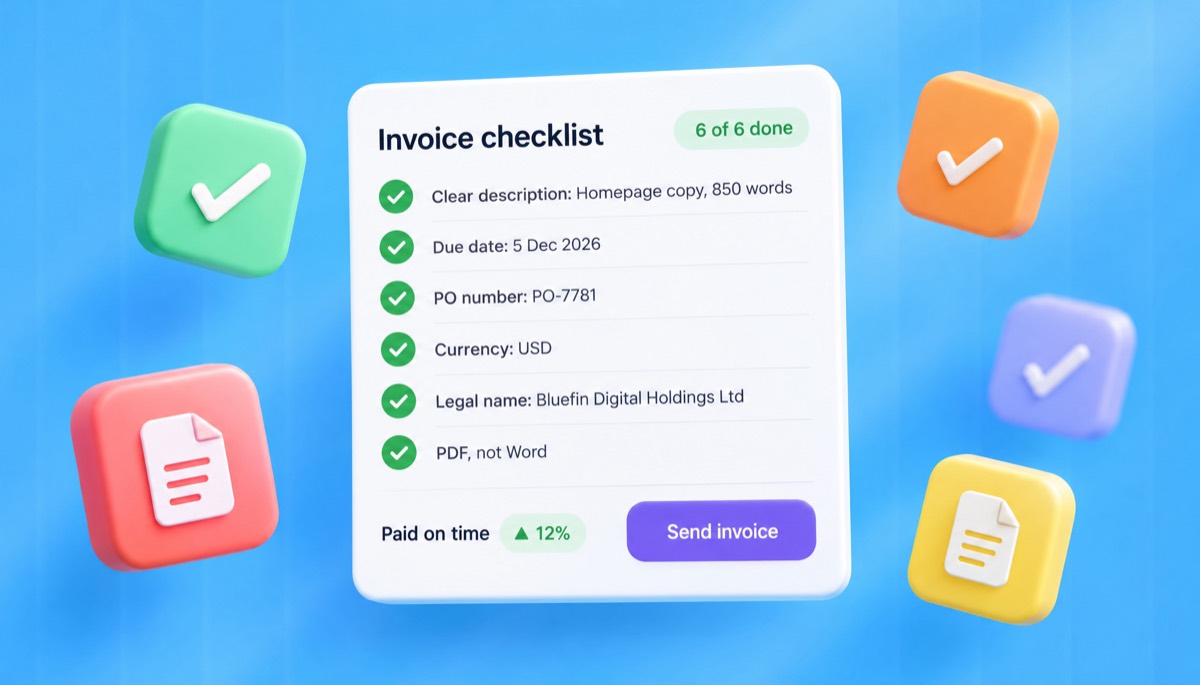
- "Services rendered" as the only description. Fix: name the work, the date and the deliverable. "Homepage copy, 850 words, delivered 3 Nov."
- "Net 30" with no date. Fix: print the date. "Due 5 December 2026."
- Billing the wrong entity. Your contact works at "Bluefin", but the legal name is "Bluefin Digital Holdings Ltd". Fix: ask for the billing name in week one.
- Waiting to invoice. Fix: invoice the day you deliver. Every day you wait is a day added to when you get paid.
- Reusing invoice numbers. Fix: one sequence for all clients, never reused, never skipped on purpose.
- Sending an editable file. Fix: PDF only.
- Too many payment options. Fix: one or two. Seven options make people put it off.
- Charging tax you are not registered for. Fix: no tax line until you are registered. Showing VAT you cannot collect is a real problem with HMRC and others.
- No follow-up. Fix: a reminder on the due date and another at 7 days overdue, or send a reminder in one click. Most late payments are forgotten invoices, not refusals.
- Not keeping copies. Fix: keep every invoice. The IRS, HMRC and the CRA all expect you to keep records for years, not months.
Freelance invoice template vs invoice generator: which should you use?
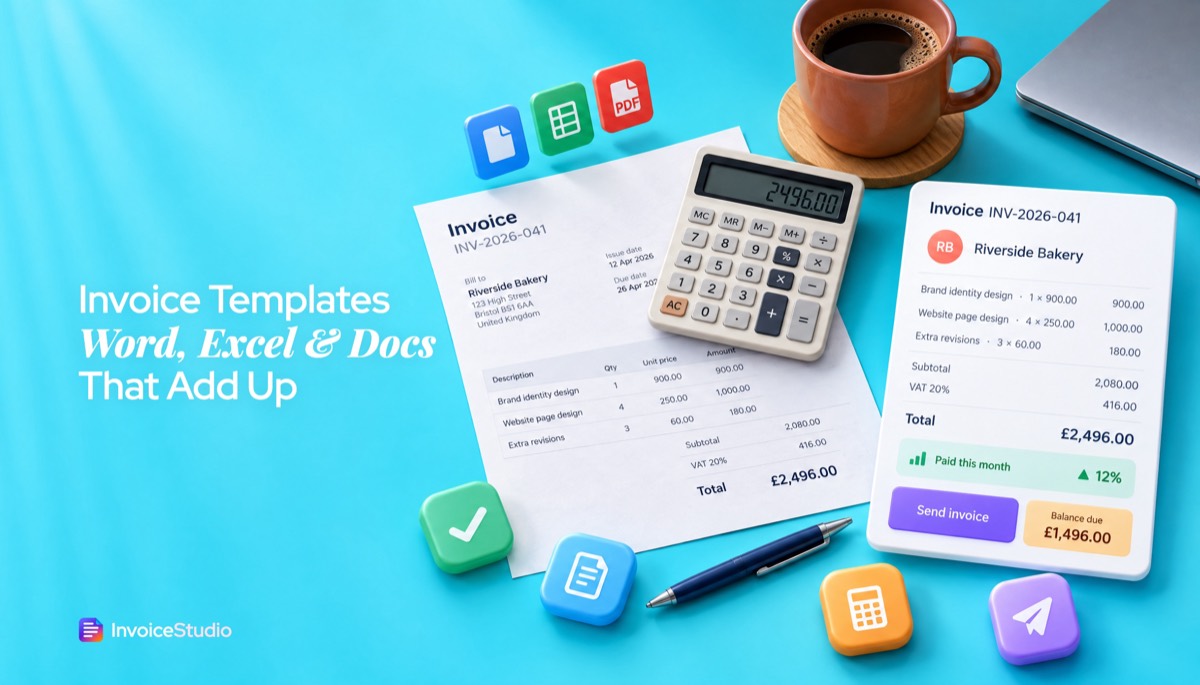
A freelance invoice template in Word, Excel or Google Docs works fine when you send a few invoices a month. An invoice generator for freelancers is better once you have deposits, recurring retainers, several currencies or reminders to track, because it does the maths, numbers invoices automatically and keeps a record of what is paid.
| Need | Word or Docs template | Spreadsheet template | Invoicing software for freelancers |
|---|---|---|---|
| Automatic totals and tax | No | Yes, if formulas are right | Yes |
| Automatic invoice numbers | No | No | Yes |
| Deposits and partial payments | Manual | Manual | Tracked |
| Recurring retainers | Copy and edit each month | Copy and edit each month | Automatic |
| Reminders for overdue invoices | Your calendar | Your calendar | Built in |
| Cost | Free | Free | Free to a few dollars a month |
I used a Google Docs template for my first year, until a deposit paid by PayPal and a balance paid by bank left me unsure which was which. If you want to try one without paying, the free invoice generator on Invoice Studio lets you pick a layout, add your logo, set the currency and download a PDF. You can browse all 28 designs in the invoice templates gallery, from Minimal to the gradient ones.
If you would rather talk than type, Invoice Studio also builds an invoice from your voice in 20 languages, including Bangla. Say "Invoice Greenleaf Physio, balance for the website, twelve hundred dollars, due in fourteen days" and the draft fills itself in.
The template is the easy part. A clear description, a real due date, the right currency, one or two ways to pay and a polite follow-up will get you paid faster than any design. Copy the sample that matches your role and send your next invoice the day you deliver.
Frequently asked questions
How do I write my first invoice as a freelancer?
What payment terms should a freelancer use?
How do I ask for a 50% deposit?
Can I send an invoice without a registered business?
How do I invoice in a different currency?
Do I need an EIN to send an invoice?
Should I invoice before or after the work?
Monjur builds Invoice Studio and incorporated MotionTrust Digital in September 2022, where he leads Amazon strategy across the client base. Eight years in e-commerce and marketplace marketing taught him how much time invoices and late payments eat, so every guide here is tested against the real product and current tax rules before it goes live.
More guides by Monjur