Proforma Invoice: Meaning, Template and vs Commercial Invoice
A plain answer on what a proforma invoice is, when customs needs a commercial invoice instead, and a full export example with HS codes and Incoterms.
- Written by
- Monjur Hossain
- Published
- Last updated
- Reading time
- 20 min read

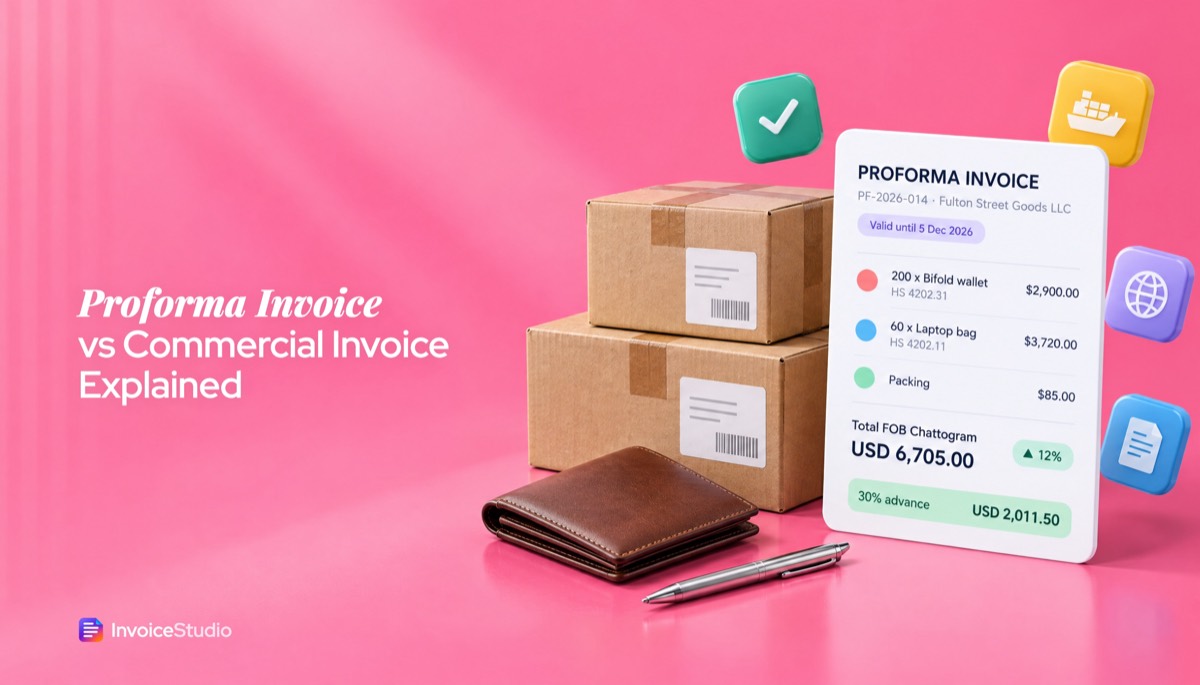
A proforma invoice is a preliminary invoice a seller sends before a sale is final, setting out the goods, price, delivery and payment terms. It is not a payment demand or tax invoice. Buyers use it to approve orders, pay advances or open letters of credit. The commercial invoice replaces it at shipment and is the one customs uses.
On this page 13 sections
- What is a proforma invoice?
- Proforma invoice legal status: is it binding?
- Proforma invoice vs commercial invoice: what's the difference?
- Proforma invoice vs quote vs estimate vs invoice
- What should a proforma invoice format include?
- Proforma invoice template example with real numbers
- What is a commercial invoice used for in customs?
- Who issues the commercial invoice for customs?
- Commercial invoice requirements in the US, UK, EU and India
- How to turn a proforma invoice into a final invoice
- Which proforma and commercial invoice mistakes delay shipments?
- Proforma invoice template: the short version
- FAQs
A proforma invoice is a preliminary invoice that a seller sends before a sale is final. It sets out what the buyer will get, the price, the delivery terms and the payment terms, so the buyer can approve the deal, open a letter of credit, apply for an import licence or send an advance. It is not a demand for payment and it is not a tax invoice. Once the goods ship or the work is delivered, the real invoice replaces it. For goods crossing a border, and for most invoices for cross-border sales, that real invoice is usually called the commercial invoice, and it is the one customs reads.
The trouble starts in the details. Some guides say a proforma is legally binding and others say it is worthless. I have issued proformas to overseas buyers who would not move a dollar without one, and I have watched a shipment of mine sit at a port for nine days because the commercial invoice said "samples" with no HS code. So this guide gives you a plain answer on legal status, a four-document comparison table, a full export example with real numbers, and the fields customs in the US, UK, EU and India actually ask for.
What is a proforma invoice?
A proforma invoice is a good-faith estimate written in invoice format. It tells the buyer exactly what a finished invoice will say if the deal goes ahead as described. The word comes from the Latin pro forma, "as a matter of form", and you will see it spelled proforma, pro forma and pro-forma. All three mean the same document.
The US International Trade Administration describes it well: a pro forma invoice is a quotation prepared in the format of an invoice, and the buyer may need it to apply for an import licence, arrange pre-shipment inspection, open a letter of credit or get approval to transfer hard currency (one reason to invoice in the buyer's currency or in USD). That last use matters in countries with foreign exchange controls, where a bank will often refuse to release dollars for an import without a proforma.
So who actually uses proformas? In my experience, three groups:
- Exporters and importers. This is the main use. The buyer needs a document to show their bank, their customs broker and sometimes their government before the goods exist or before they ship.
- Businesses that take advance payment. If you want 30% or 50% upfront before you start production, a proforma gives the buyer something formal to pay against without you booking a sale you have not made yet.
- Buyers with purchasing departments. Many companies need a document that looks like an invoice to raise an internal approval or a purchase order. A proforma fills that gap.
The proforma invoice meaning in one line, then: a proposal that looks like an invoice but is not one yet.
Proforma invoice legal status: is it binding?
Usually no, not on its own. A proforma invoice is generally treated as an offer or a commitment to sell on stated terms, not as a completed sale, so it does not create a debt the buyer must pay and it does not count as a tax invoice. It becomes part of a binding contract only when the buyer accepts it, for example by signing it, issuing a purchase order against it or paying the advance it asks for.
Guides disagree here because they mix up two separate questions.
Question one: is it a contract? On its face, a proforma is an offer. If the buyer countersigns it or wires the deposit it requests, that can be read as acceptance of the terms written on it. So I treat every proforma as if it could become binding. If the price on it is wrong, you may be stuck with it once the buyer pays.
Question two: is it an invoice for tax purposes? No. In the UK, section 17.3 of HMRC's VAT guide (Notice 700) says a pro-forma cannot be used to reclaim input tax, should be marked "this is not a VAT invoice", and must be followed by a proper VAT invoice once you supply the goods or receive payment. The EU works the same way: VAT invoice rules apply to the final invoice that records a supply, not to a proposal. In India, a proforma is not a tax invoice under GST, so it does not trigger GST liability and the buyer cannot take input tax credit against it.
So the honest answer: a proforma invoice is not binding as a bill, but it can become binding as an offer once accepted. Write it as carefully as you would write a contract.
Copy-paste line for the footer of every proforma: "This is a proforma invoice and not a demand for payment or a VAT/GST invoice. Prices are valid until [date]. A final invoice will be issued on dispatch."
Proforma invoice vs commercial invoice: what's the difference?
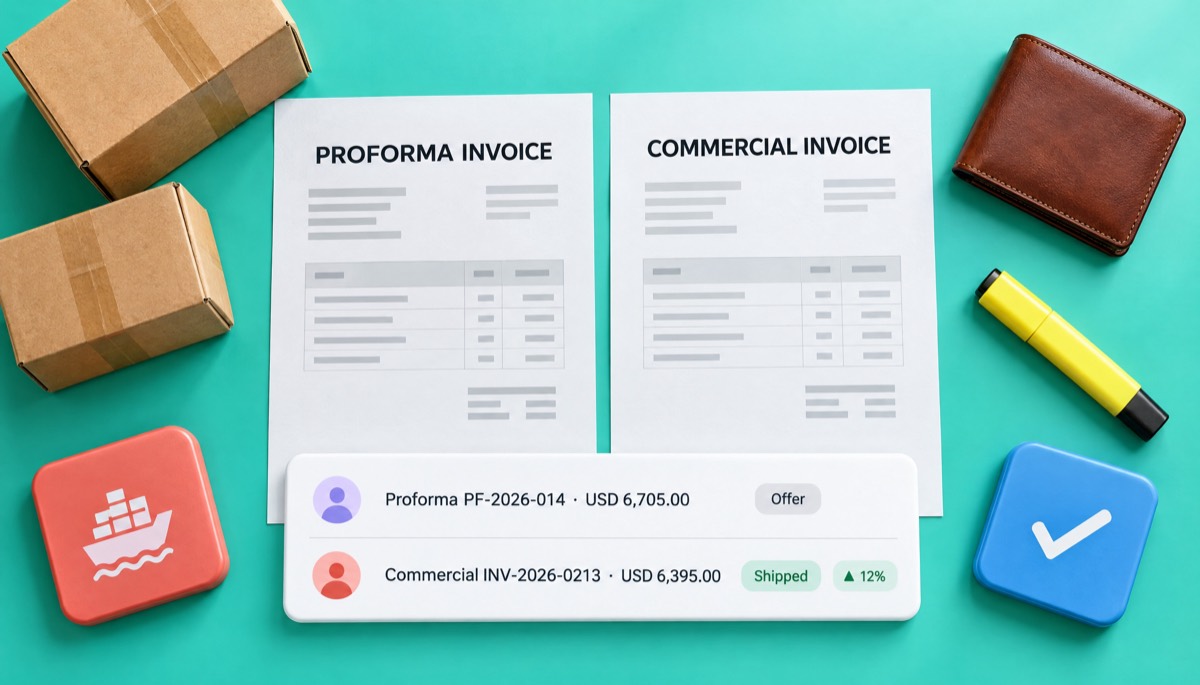
Whether you search it as proforma invoice vs commercial invoice or commercial invoice vs proforma invoice, the difference is timing and legal weight. A proforma invoice is issued before shipment to confirm terms and get approvals or an advance. A commercial invoice is issued at shipment, records the actual sale, is the legal demand for payment, and is the main document customs uses to classify the goods and calculate duty and import tax.
The trade.gov commercial invoice page calls the commercial invoice a required document for export and import clearance, and notes that customs officials in the buyer's country use it to assess duties and taxes. The proforma has no such role unless the commercial invoice is missing, which I will come back to in the US section.
Here is how the two compare field by field:
| Point | Proforma invoice | Commercial invoice |
|---|---|---|
| When it is issued | Before the sale is confirmed or before shipment | When goods are shipped or the sale is completed |
| Purpose | Confirm terms, get approvals, collect an advance, open a letter of credit | Demand payment, record the sale, clear customs |
| Legal status | An offer; not a demand for payment | Evidence of a completed sale; the debt is owed |
| Tax invoice? | No | Usually yes, or it sits alongside the tax invoice |
| Numbering | Own series, such as PF-2026-014 | Your normal sequential invoice series |
| Quantities and prices | Estimated; can change with buyer consent | Actual; must match what is in the boxes |
| Used by customs? | Only as a stand-in when the real invoice is missing | Yes, to classify goods and value them for duty |
| Recorded in your books? | No | Yes, as revenue and accounts receivable |
| Typical label | "Proforma Invoice" | "Commercial Invoice" or "Invoice" |
Proforma invoice vs quote vs estimate vs invoice
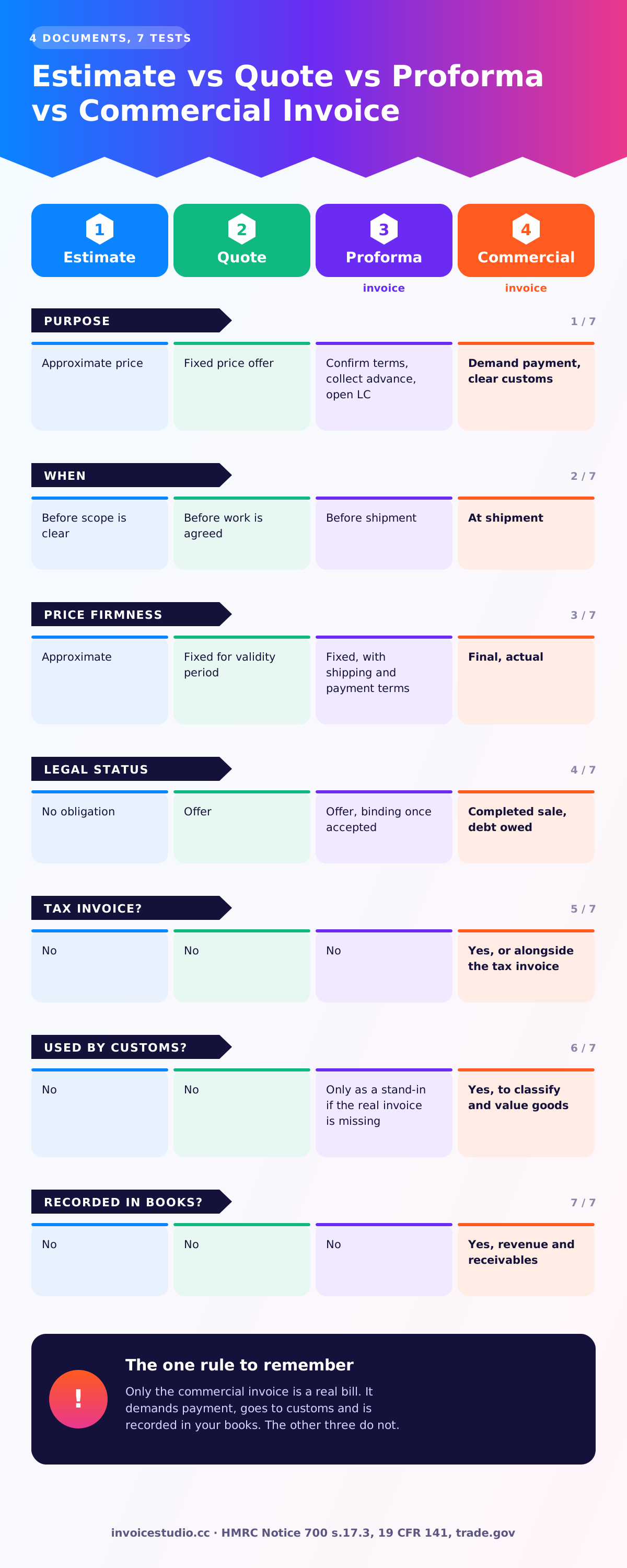
A quote is a fixed price offer, an estimate is an approximate price, a proforma invoice is a quote dressed as an invoice with full delivery and payment terms, and an invoice is the final bill that says money is owed. All four can carry the same line items. What changes is how firm the numbers are and what the buyer can do with the document.
Quote vs invoice confusion is common, and freelancers often ask me whether they need a proforma or whether a quote is enough. For domestic service work, a quote is almost always enough. Some larger sellers send a sales order instead, which is their own confirmation that the order has been accepted, but it plays the same role. A proforma earns its place when a bank, customs office or finance team asks for something "in invoice format".
| Document | What it says | Price firmness | Can buyer pay against it? | Tax invoice? | Best used for |
|---|---|---|---|---|---|
| Estimate | "It will probably cost about this" | Approximate, can move | Rarely | No | Repairs, hourly work, scope not yet clear |
| Quote | "I will do this for this price" | Fixed for a validity period | Sometimes, for a deposit | No | Projects with a defined scope |
| Proforma invoice | "If you confirm, your invoice will look exactly like this" | Fixed, with full shipping and payment terms | Yes, for an advance or letter of credit | No | Exports, advance payments, import licences, bank approvals |
| Invoice / commercial invoice | "This was supplied, pay this amount by this date" | Final | Yes, it is the payment demand | Yes (or with the tax invoice) | Billing after delivery, customs clearance |
The estimate and quote are sales documents, the invoice is an accounting document, and the proforma sits between them. For the invoice side, my guide on what an invoice is and how it differs from a receipt covers the rest.
What should a proforma invoice format include?
A proforma invoice format should include everything the final invoice will contain, plus the terms the buyer needs before committing: the words "Proforma Invoice", a proforma number and date, seller and buyer details, a detailed description of the goods with quantities and unit prices, the Incoterm and delivery point, payment terms, an estimated ship date and a validity date. For exports, add HS codes, country of origin and estimated weights.
Here is the checklist I use, split into fields every proforma needs and extras for cross-border goods.
Fields every proforma invoice needs
- The title "Proforma Invoice". Put it at the top, large. Never let it read only "Invoice".
- Proforma number and issue date. Use a separate series such as PF-2026-014 so it never collides with your real invoice numbers. My guide to invoice number formats explains why gaps and duplicates in the main series cause problems.
- Seller details. Legal name, address, phone, email, and tax or registration numbers (VAT, GST, EIN or EORI where relevant).
- Buyer details. Legal name, address, contact person, and the buyer's reference or enquiry number.
- Line items. Description, quantity, unit, unit price and line total for each item.
- Discounts, packing, freight and insurance. Itemised, not buried in the unit price.
- Currency. Write USD, GBP, EUR, INR or BDT. "$" alone is ambiguous.
- Payment terms. For example "30% advance by bank transfer, 70% against copy of bill of lading".
- Validity date. "Prices valid until 5 December 2026". Without it, the old price stays open forever.
- Estimated dispatch date. Banks need it to set the latest shipment date on a letter of credit.
- Bank details. Account name, number, SWIFT/BIC and IBAN if you want an advance.
- The disclaimer line. "This is not a demand for payment or a VAT/GST invoice."
Extra fields for exports
- Incoterm with a named place. "FOB Chattogram, Incoterms 2020", not just "FOB". The ICC publishes the Incoterms rules, which set who pays freight, insurance and duty, and where risk passes from seller to buyer.
- HS code for each line. The Harmonized System code is the six-digit international classification for goods. Countries add digits on top: the US uses 10-digit codes in its Harmonized Tariff Schedule (trade.gov explains how HS codes work), the EU uses 8-digit CN codes, and India uses 8-digit ITC-HS codes.
- Country of origin. Where the goods were made, not where they ship from.
- Estimated weights, package count, ports and transport mode. Freight forwarders quote from these.
If you sell services rather than goods, drop the export block. A software agency taking a 50% advance from a German client needs only the first list.
Proforma invoice template example with real numbers
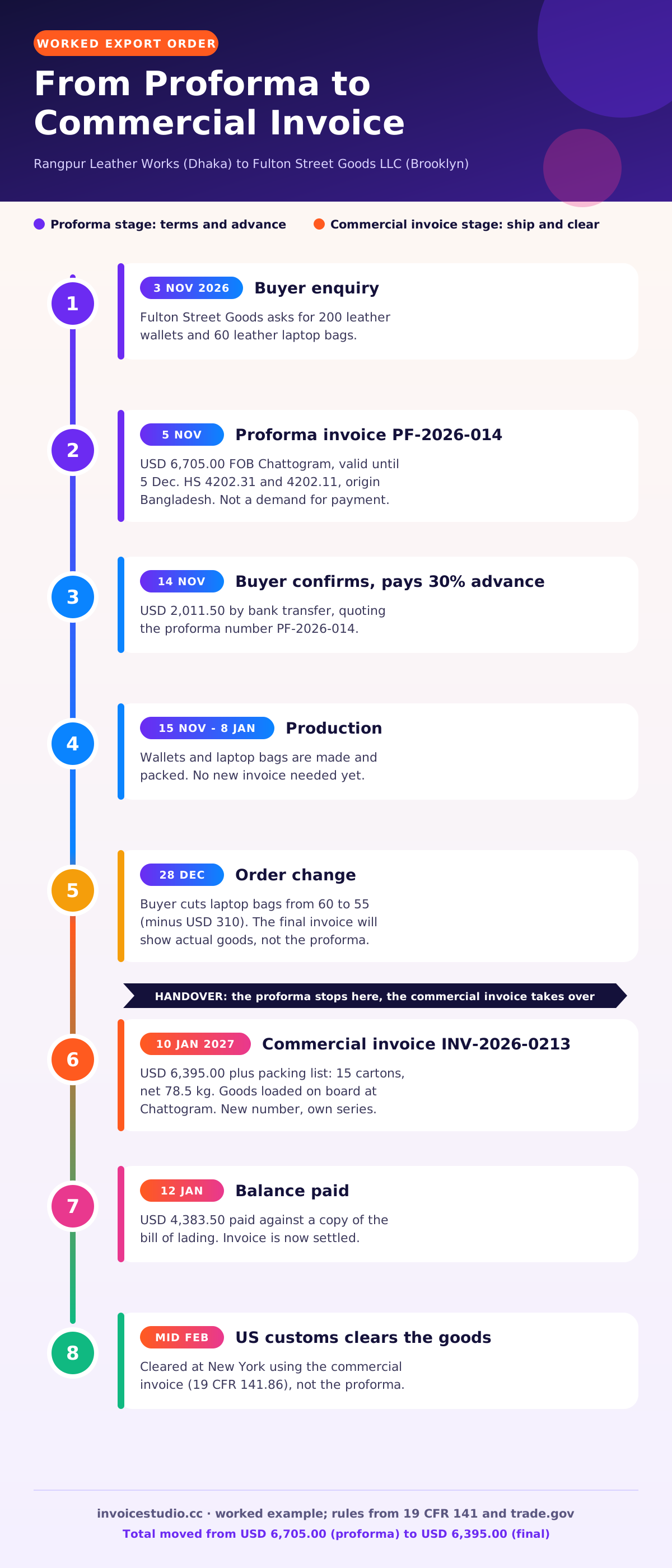
Here is a complete proforma invoice for a real-looking export deal. The seller is a small leather workshop in Dhaka, Bangladesh. The buyer is a gift shop in Brooklyn, New York. The buyer wants 200 leather wallets and 60 leather laptop bags, will pay 30% upfront, and needs the proforma to approve the order internally and book space with their customs broker.
Header and parties
- Title: PROFORMA INVOICE
- Proforma no.: PF-2026-014
- Date: 5 November 2026
- Valid until: 5 December 2026
- Seller: Rangpur Leather Works, House 12, Road 7, Tejgaon I/A, Dhaka 1208, Bangladesh. BIN (VAT) and export registration on file.
- Buyer: Fulton Street Goods LLC, 410 Fulton Street, Brooklyn, NY 11201, USA. Buyer ref: FSG-PO-88 (draft).
- Incoterm: FOB Chattogram, Incoterms 2020
- Port of loading: Chattogram, Bangladesh. Port of discharge: New York, USA
- Estimated dispatch: 10 January 2027, by sea
- Country of origin: Bangladesh
Line items
| # | Description | HS code | Qty | Unit price (USD) | Total (USD) |
|---|---|---|---|---|---|
| 1 | Bifold wallet, full-grain cowhide leather, brown, 11 x 9 cm | 4202.31 | 200 pcs | 14.50 | 2,900.00 |
| 2 | Laptop bag, outer surface cowhide leather, 15-inch, black | 4202.11 | 60 pcs | 62.00 | 3,720.00 |
| Subtotal | 6,620.00 | ||||
| Export cartons and packing | 85.00 | ||||
| Total FOB Chattogram | 6,705.00 |
Terms block
- Payment: 30% advance (USD 2,011.50) by bank transfer within 7 days of confirmation. Balance 70% (USD 4,693.50) against scanned copy of bill of lading.
- Estimated weights: net 84 kg, gross 97 kg, 16 cartons.
- Freight and insurance: for buyer's account from loading on board at Chattogram.
- Note: This is a proforma invoice and not a demand for payment. A commercial invoice will be issued on dispatch.
Check the maths: 200 x $14.50 = $2,900, and 60 x $62 = $3,720. Add $85 packing and you get $6,705. Thirty percent is $2,011.50, leaving $4,693.50. A few cents off and a bank could reject a letter of credit built on it.
On classification: subheading 4202.31 covers leather-surfaced articles carried in a pocket or handbag, which fits a wallet, and 4202.11 covers leather-surfaced suitcases, briefcases and similar cases, where most leather laptop bags land. The US extends these to 10 digits, and the importer's broker enters that number. If you are unsure, ask the broker to confirm before you print it.
On Incoterms: under FOB the seller's risk ends when the goods are on board at Chattogram. The ICC recommends FCA for containerised cargo, since containers are handed over at a depot, but many buyers still ask for FOB out of habit. Either works if the named place is written out.
What is a commercial invoice used for in customs?
A commercial invoice is used by customs to identify the goods, classify them under an HS code, set their customs value and calculate the duty and import VAT or GST owed. It is also the seller's legal bill to the buyer, and banks use it to release payment under a letter of credit.
A customs commercial invoice gets read for four things:
- What is it? The description and HS code decide the duty rate.
- How much is it worth? Most countries value imports on the transaction value, meaning the price actually paid or payable, adjusted for freight and insurance depending on the country. The US values on the price at export (closer to FOB), while the UK and EU value on a CIF basis that includes freight and insurance to the border.
- Where was it made? Country of origin decides whether a trade agreement rate, a normal rate or an extra tariff applies.
- Does it match the paperwork? Quantities, weights and package counts are compared with the packing list, bill of lading and declaration.
The commercial invoice usually travels with a packing list (what is in each carton, with weights), a bill of lading or air waybill (the carrier's receipt and contract), and where needed a certificate of origin. Couriers such as DHL, FedEx and UPS ask for one too, even for a small parcel, and each has its own upload or print rules, so check the carrier's export guide before you book.
If you send a free sample or a warranty replacement, you still need a commercial invoice. Write the fair market value, for example "Value for customs purposes only: USD 40.00, no charge to buyer". Writing "USD 0.00" or "no commercial value" is one of the quickest ways to get a parcel held.
Who issues the commercial invoice for customs?
The seller, or exporter, prepares the commercial invoice. The buyer and their customs broker use it, and the broker may ask the seller to add or correct fields, but the document comes from the party that sold and shipped the goods.
Trade.gov notes that most countries accept the exporter's own invoice if it carries the required information, while a few require a specific form. The first time you ship somewhere new, ask the buyer's broker what they need. One email can save a week.
The seller writes the proforma too. If a buyer sends you a "proforma" they drafted and asks you to sign it, read every line. That is a contract with your name on it.
Who is responsible for the duty is a separate question. That is set by the Incoterm. Under FOB, FCA, CFR and CIF, the buyer pays import duty and tax. Under DDP (Delivered Duty Paid), the seller does, so I would not offer DDP until you have done a few shipments the simple way.
Commercial invoice requirements in the US, UK, EU and India
The core is the same everywhere: parties, detailed description, quantity, unit price, total, currency, Incoterm, origin and HS code. Each country adds its own rules.
United States: 19 CFR 141 Subpart F
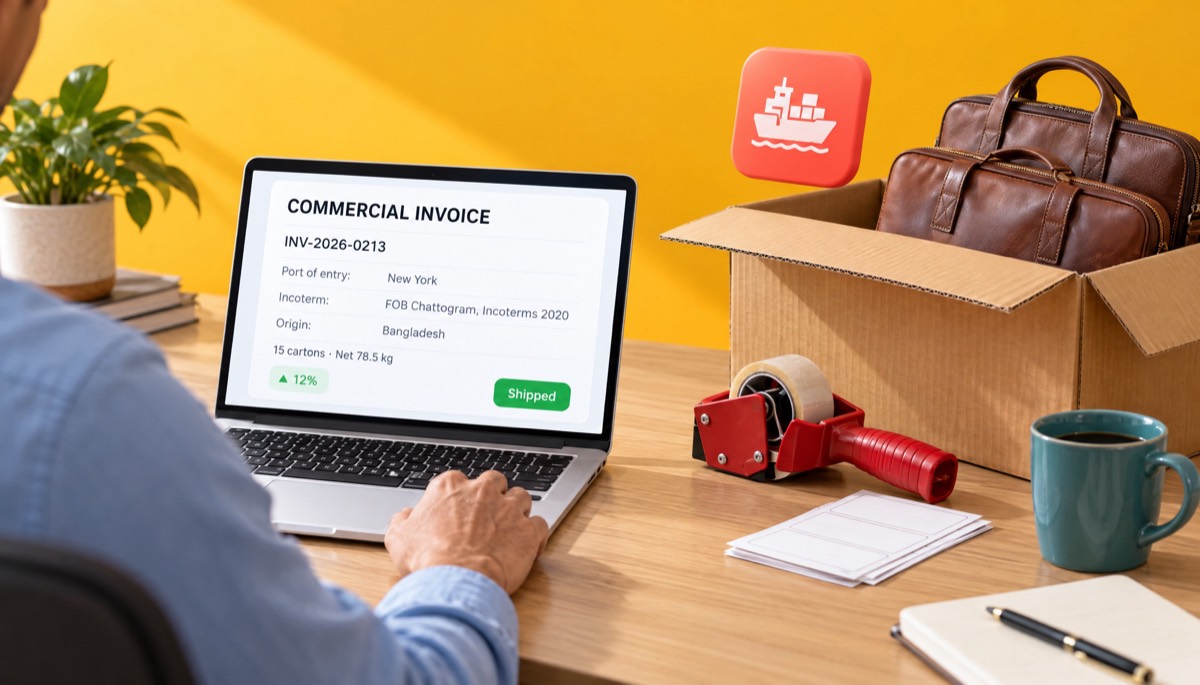
US import invoices are governed by 19 CFR Part 141, Subpart F. Section 141.86 lists what the commercial invoice must show. In plain English:
- The port of entry the goods are going to.
- If sold: the time, place and names of buyer and seller. If consigned: the time and origin of shipment and the names of shipper and receiver.
- A detailed description: item name, grade or quality, and the seller's marks and numbers, plus package marks.
- Quantities in the weights and measures of the country of shipment or the US.
- The purchase price of each item in the currency of the sale.
- If not sold, the value of each item in the currency usually used for such deals.
- The kind of currency.
- All charges, itemised: freight, insurance, commission and packing, unless included in the price.
- Any rebates, drawbacks and bounties allowed on export, itemised separately.
- The country of origin.
- Any goods or services supplied for production that are not in the price, such as dies, molds, tools or engineering work (known as "assists").
Section 141.86 also requires the invoice to be in English or come with an accurate English translation. Then there is the case people search for. Under section 141.91, when the commercial invoice is not available at the time of entry, the importer can file a pro forma invoice instead (section 141.85 sets out its form), with a bond to produce the real invoice later. That is the one situation where a proforma reaches US customs, and it is a fallback, not a plan.
United Kingdom
For UK imports and exports, the commercial invoice supports the customs declaration and the customs value. You will need an EORI number to move goods in or out of Great Britain, and it is wise to print it on the invoice. You can apply for an EORI number on GOV.UK. The UK uses 10-digit commodity codes for imports and 8-digit codes for exports.
If the commercial invoice also serves as your VAT invoice, it must meet HMRC's VAT invoice rules, and a zero-rated export still needs evidence of export. My post on UK VAT invoice requirements lists them.
European Union
Across the EU, the commercial invoice supports the import declaration, and customs value follows the Union Customs Code, which starts from the transaction value. Goods are classified with 8-digit Combined Nomenclature codes, extended to 10 digits in the TARIC database for import measures. You also need an EU EORI number. For VAT, only the final invoice carries the VAT Directive fields, such as a sequential number and "reverse charge" wording where it applies.
India
Indian exporters usually issue a GST tax invoice for the export alongside, or combined with, the commercial invoice. The invoice should show the Importer Exporter Code (IEC), GSTIN, the 8-digit ITC-HS code, and the endorsement "Supply meant for export under bond or letter of undertaking without payment of IGST" or "Supply meant for export on payment of IGST", whichever applies. A proforma invoice has no GST status and is used for the buyer's letter of credit or advance. My GST invoice format guide covers the tax invoice side in detail.
Quick notes for Canada, Australia and Bangladesh
- Canada: A commercial invoice or the Canada Customs Invoice form, with the same core details. GST/HST applies on import.
- Australia: An invoice showing value, origin and tariff classification. GST applies to most imports.
- Bangladesh: Buyers often need a proforma to open an import letter of credit, and exporters file the EXP form with the commercial invoice. Values must match the LC exactly.
Rules change and vary by product. Before you ship a new type of goods to a new country, check the destination customs authority's guidance or ask the buyer's broker.
How to turn a proforma invoice into a final invoice
To turn a proforma into a final invoice, issue a new document with a number from your normal invoice series, copy over the agreed details, update anything that changed (quantities, weights, dates), show any advance already received, and reference the proforma number. Never just rename the proforma, because it has the wrong number and may have the wrong figures.
Let's continue the leather goods example. Six weeks into production, the Brooklyn buyer emails: "Can we drop the laptop bags to 55? Our holiday budget got cut." You agree. Here is what the commercial invoice looks like on dispatch day.
The commercial invoice
- Title: COMMERCIAL INVOICE
- Invoice no.: INV-2026-0213 (your normal series)
- Date: 10 January 2027
- Reference: Proforma PF-2026-014, Buyer PO FSG-PO-88
- Port of entry: New York, USA (required by 19 CFR 141.86)
- Vessel and bill of lading: filled in from the carrier's documents
- Incoterm: FOB Chattogram, Incoterms 2020
- Country of origin: Bangladesh
| # | Description | HS code | Qty | Unit price (USD) | Total (USD) |
|---|---|---|---|---|---|
| 1 | Bifold wallet, full-grain cowhide leather, brown, 11 x 9 cm. Marks: RLW-W01 | 4202.31 | 200 pcs | 14.50 | 2,900.00 |
| 2 | Laptop bag, outer surface cowhide leather, 15-inch, black. Marks: RLW-B15 | 4202.11 | 55 pcs | 62.00 | 3,410.00 |
| Export cartons and packing | 85.00 | ||||
| Total FOB Chattogram | 6,395.00 | ||||
| Less advance received 14 Nov 2026 | -2,011.50 | ||||
| Balance due | 4,383.50 |
Notice what changed. Five fewer bags at $62 takes $310 off, so the total is $6,395. The advance stays at $2,011.50 because that is what was paid, so the balance is $4,383.50, not the $4,693.50 the proforma predicted. Net weight drops from 84 kg to 78.5 kg and cartons from 16 to 15. All of it must match the packing list and bill of lading.
If the buyer opened a letter of credit for $6,705, drawing less is often allowed, drawing more never is. Check the LC wording before you change anything.
Doing this in Invoice Studio
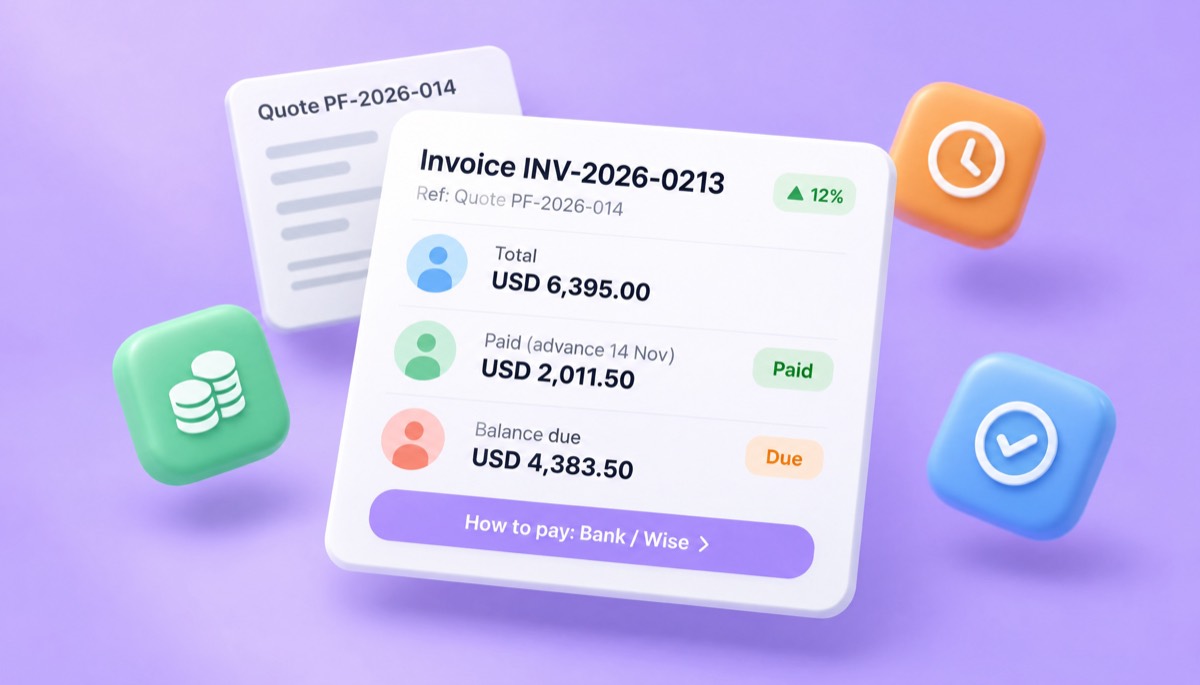
Invoice Studio does not have a separate proforma document type, so here is how I handle it. Create a quote or estimate with the full line items, HS codes in the description, the Incoterm, origin and validity date. In the notes, add "Proforma invoice: not a demand for payment or a VAT/GST invoice. A commercial invoice will follow on dispatch." Put your bank or Wise details under "How to pay" so the buyer can send the advance. Download the PDF and send it.
When the goods ship, create the final invoice in your normal numbering series, update quantities, reference the quote number in the notes, and record the advance as a partial payment so the balance shows correctly. You can use a delivery note as the basis of your packing list, and the buyer's purchase order can be logged too if you want the paperwork in one place. Choose any of the 44 invoice templates and the same brand colour across all documents, so the buyer can see at a glance they belong to the same order. If you need a starting layout, my invoice format samples show the field placement.
Copy-paste email when you send the proforma
Hi Dana,
Attached is proforma invoice PF-2026-014 for 200 wallets and 60 laptop bags, total USD 6,705.00 FOB Chattogram. Prices are valid until 5 December 2026.
To confirm the order, please send the 30% advance of USD 2,011.50 to the bank details on page one and reply with your PO number. We will start production the day the advance arrives and expect to ship around 10 January.
The commercial invoice and packing list will follow on dispatch. If your broker needs anything else, send me their list.
Thanks, Rahim
For sending the balance request as a PDF, see how to send an invoice. If you gave credit terms instead, net 30 payment terms explains the due date.
If a buyer pays an advance and then cancels, refund it, or issue a credit note against any final invoice. My credit memo vs credit note guide walks through that.
Which proforma and commercial invoice mistakes delay shipments?
The mistakes that delay shipments are mostly mismatches and vague descriptions: a commercial invoice that does not match the packing list, a missing HS code or country of origin, a "no commercial value" sample, the wrong Incoterm, or a proforma sent to customs in place of the real invoice. Each one gives a customs officer a reason to stop the goods and ask questions.
The ones I see most, worst first:
- Numbers that do not match. Invoice says 16 cartons, packing list says 15. Customs notices, and banks refuse to pay on discrepant documents. Prepare all of them from the same data on the same day.
- Vague descriptions. "Bags", "parts", "gifts". Write "laptop bag, outer surface cowhide leather".
- No HS code, or a guessed one. A wrong code means wrong duty, a penalty or a hold.
- Missing country of origin. Required in the US under 141.86 and checked everywhere else.
- Undervaluing. Some buyers ask for a lower value "to save on duty". Do not. It is customs fraud, and the risk sits with both of you.
- Sending the proforma at shipment. The entry may then need a bond and a later correction.
- Reusing the proforma number on the final invoice. It breaks your sequential series, which VAT and GST countries expect unbroken.
- No validity date. An open price promise while costs and exchange rates move.
- Incoterm without a named place. "CIF" alone does not say which port. "CIF New York, Incoterms 2020" does.
- Wrong party names. A trading name on the invoice and a legal name on the declaration can trigger a query.
A pre-shipment checklist you can copy
- Commercial invoice number is from the normal series and references the proforma and PO.
- Seller and buyer legal names and addresses match the customs declaration.
- Each line has a specific description, HS code, quantity, unit and unit price.
- Incoterm has a named place and version, such as "FOB Chattogram, Incoterms 2020".
- Country of origin is stated for every line.
- Carton count, net and gross weight match the packing list and transport document.
- Advance received and balance due are shown correctly.
- EORI, IEC, GSTIN or VAT numbers are printed where the destination or origin needs them.
The documents are not hard. They just punish carelessness.
Proforma invoice template: the short version
Here is a quick proforma invoice template skeleton. Change the title to "Commercial Invoice", use your normal number and drop the disclaimer, and it doubles as a commercial invoice template.
PROFORMA INVOICE
No. [PF-YYYY-NNN] · Date [date] · Valid until [date]
Seller: [legal name, address, tax/EORI number]
Buyer: [legal name, address, buyer reference]
[Line items: description · HS code · qty · unit price · total]
Subtotal [ ] · Packing [ ] · Freight [ ] · Insurance [ ] · Total [currency amount]
Incoterm: [term, named place, Incoterms 2020] · Origin: [country] · Est. dispatch: [date] · Est. weight: [net/gross, cartons]
Payment: [e.g. 30% advance by bank transfer, balance against B/L copy] · Bank: [details]
This is a proforma invoice and not a demand for payment or a VAT/GST invoice. A commercial invoice will be issued on dispatch.
Use a quote as the proforma, issue a real commercial invoice when the goods ship, keep the numbers identical across every document, and shipments rarely get held. You can build both in the free invoice generator and download them as PDFs.
Frequently asked questions
What does proforma invoice mean?
Is a proforma invoice legally binding?
What is a commercial invoice used for?
Who prepares the commercial invoice, buyer or seller?
What is the difference between a quote, an estimate and an invoice?
Can I pay against a proforma invoice?
Does a proforma invoice need a tax number?
Monjur builds Invoice Studio and incorporated MotionTrust Digital in September 2022, where he leads Amazon strategy across the client base. Eight years in e-commerce and marketplace marketing taught him how much time invoices and late payments eat, so every guide here is tested against the real product and current tax rules before it goes live.
More guides by Monjur